Author Archives: Art Nicol

Unknown's avatar

About Art Nicol

By exploring a variety of careers and social roles as a child, spouse, parent, grandparent, citizen, community volunteer, attorney, employee, manager, social climber, social outcast, conformist, nonconformist, etc., I've arrived at a place in life where living wisely in the field Rumi describes as "out beyond ideas of wrongdoing and rightdoing" most appeals to me. For me, it is the field of our dreams where we set aside the ego's harsh criticism and implied separation of one another into categories of “winners” and “losers” by a variety of dehumanizing criteria – and its other efforts to find reasons to separate us into isolated beings – and instead embrace unconditional love as the natural environment in which humans thrive. Love is the context of humanity’s sustainability and fosters our capacity to evolve to yet higher levels of consciousness and wisdom. I seek now to join with others to build this field of our dreams for all of us to enjoy as we play ball together and rebuild humanity as a single, harmoniously functioning entity within the natural world of which we are an essential element. I believe that wisdom does teach us to discern the meaning of human differences but not to use those differences to judge others as superior or inferior in some way that means I cannot relate to others or they cannot relate to me. Although I am a follower of Jesus and do my best to implement his principles of love, including all that forgiveness and reconciliation call forth from within me, I also believe that there are many paths of faith by which people grow in awareness of their relationship with a Supreme Being who is devoted to the welfare of all of us. We all are welcome in the divine heart. Enlightenment is not an exotic experience reserved for the few. Our divine destiny is to become increasingly aware of the divine truths that set us all free to enjoy life together and no longer divide ourselves into warring camps simply because we may not always agree. I believe in unity amid diversity and live as best I can as a timeless spirit in the midst of the paradoxes and tensions of human life that may try to pull us apart - both internally from our own integrity and externally from one another. I believe that all forms of violence that humanity inflicts upon ourselves arise from dishonesty about what matters most deeply within our hearts. In learning to deny the full, caring expression of our emotions and trying to live with diminished hearts, we drive ourselves to adopt false identities (called by some "egos") and to develop addictions and other mentally and emotionally unhealthy orientations to life as our means of surviving while coping with the emotions we've buried in our hearts and minds when we were not free to express them earlier in our lives. I believe that we need most to connect again within our hearts as naturally sensitive yet also courageous beings, identify the pains beyond which we need to move by experiencing the process of legitimate grieving and learn again that we are delightfully playful and loving beings here on earth to share life as innocent children of the Creator of Life, free of guilt and blame as well as pride and shame. We need to learn again the difference between peace and emotional numbness, hope and blinding ambition and joy and self-centered pride. The latter alternative within each pairing are ego-based experiences of the mind that is separated from the heart, where genuine peace, hope and joy abide. All unshared emotions, even unshared joy, are painful because we are created to share life heart to heart, not keep ourselves isolated from one another as if we are independent islands without natural connections. I subscribe to a declaration of interdependence beyond independence. I honor our capacity to grow developmentally independent as mature people (even at an early age) and yet also encourage us to move forward into interdependence, beyond artificial and futile efforts at the pretense of self-reliance. In healthy interdependence, we celebrate our naturally unique individuality while also appreciating and encouraging each other to share divine love that welcomes and nurtures each and all of us to become all we are capable of being. I've shared more about my ideas about personal wholeness, authenticity and love at www.freedomwise.com. I welcome your feedback.

Humanity at the Center of God’s Will – Part 3

Wholeheartedness is key.  To once again know ourselves to be the heart of Life as God created Life, we must be wholeheartedly committed to serving God in this role as an act of our free will – and apply for the position as if we were applying for the most rewarding and amazing career we could imagine.  At first it may not feel like an expression of freedom to do so. It may feel like an act of obedience or surrender as if contrary to our freedom to do whatever pleases us. So long as we equate being free to being neglectful, thoughtless, indifferent, undisciplined and wild in self-indulgently pleasing our individual selves no matter the cost to others, we will resist restoration to the heart of God.  Under that false definition of “freedom,” our egos will continue to convince us that pleasing God means sacrificing what’s important to us.  When we value individuality above community in unbalanced ways, we cause suffering – to ourselves and others.  To foster the continuation of such unbalanced living, the ego will continue to value pride as the alternative to shame and argue that cooperating with God’s will is humiliating and can only be done at a great cost to our pride.

The ego is correct that submitting to and cooperating with God’s will and learning to live within the heart of God in line with the Divine Constant is not prideful.  But neither is it shameful.  It is having the humility to reconnect with true power rather than A) remaining disconnected, isolated, lonely and devoid of the joys of healthy intimacy and B) trying to hide from deeply dissatisfying feelings of powerless and loss.  The experience of being restored to alignment with God’s will is vastly rewarding but not on ego’s terms.  So long as we value ego’s terms, we’ll resist God’s terms.  The choice is stark.  We cannot live by both ego’s fear-controlled, loveless terms and God’s courageous, love-enriched terms.  We must eventually choose one or the other.  And we must choose wholeheartedly and remain committed to that choice no matter how the ego tries to tempt us to return to or compromise with ego’s terms.  As we gain progress in implementing our choice to forego the ego entirely, we’ll become increasingly eager to continue making that choice.

For a while, it will seem as if doing what pleases God requires that we do what does not please ourselves.  That sense of loss will continue only as long as we continue to mistakenly identify with ego as our “self.”  That God’s will for Life and our will for Life are one will is not immediately evident to us because our ego-oriented habits will not immediately give way to the new set of habits we will acquire as we master the discipline of living within the Divine Constant as an expression of God’s unconditionally loving heart.  One of the most persuasive arguments the ego will present in favor of remaining loyal to the ego and avoiding learning to live as G.O.A.L. will be to point out that awakening to our emotions and becoming less numb to our hearts requires that we become aware of the negative emotions that the ego convinced us to store away earlier in life.  Under the ego’s influence, it is true that instead of processing our emotions on a current basis we bottled them up and allowed them to accumulate.  The ego will argue, “Look, you’ve stored up a lot of pain trying to avoid feeling it earlier in life. Do you really want to feel that pain now?  Why not keep bottling it up and avoid feeling it as the ego allows you to do?”

Yes, the pain is there, stored up from years of habitually avoiding being honest about your emotions.  With God’s able assistance you will be empowered to look directly at this pain, be honest about it and grieve through it to the brighter life beyond it, where pain will no longer accumulate as a plague upon your heart and mind and motivate you to participate in cycles of violence – as victim or victimizer.  You gain God’s assistance by asking for it and being wholeheartedly committed to receiving it in all the forms it takes.  You can remain enslaved to pain (and to its accumulated version called “chronic suffering”) by continuing to live by your ego’s false identity and obeying the ego’s demand that you condemn and punish yourself and others for “sins,” wrongs and guilt that can be forgiven instead.  Or you can become free of pain and suffering by envisioning life beyond the pain, beyond the suffering and beyond the ego and engaging in the process of grieving to attain relief, a process through which your vision of the Divine Constant draws you like iron filings to a magnetic field.  Which option really pleases you?  Are you really pleased by the prospect of enduring pain and suffering forever as you condemn yourself and others to it by identifying with ego or are you likely to be more pleased by the prospect of ending pain and suffering?  Endure or end pain and suffering?  Is that really a difficult choice?  The main difficulty in the choice presents itself at the beginning – are you willing to take the risk that the Divine Constant exists and will prove to welcome you to life within it?  Are you willing to risk giving up the power to inflict painful revenge in order to discover your natural power to share love and healing instead?  Your sense of risk will gradually fade the more you experience the fruits of your exercising faith in God and allow God to prove Eternity’s favorable faithfulness to you.

Only our egos resist God’s will.  Our true nature as created by God does not resist.  It remains receptive to God’s presence, power and purpose as a beloved child remains receptive to the caring presence, power and purpose of a trusted, nurturing human parent.  (Much of our resistance to trusting God as a nurturing Divine Parent is rooted in our past experiences with human parents and other authority figures whom we expected to care for us on favorable terms but instead treated us according to ego’s terms and – by neglect, abuse or both – failed to express the qualities of God’s care and caused us to feel betrayed.  Now many of us fear being betrayed, rejected and abandoned by God as well as by others.)  As we let down our ego’s guarded stance towards God as Supreme Authority and Caregiver and risk exploring the ego-diminishing experience of God we will be amazed and delighted by what we discover.  The wonderful features and benefits of being human that we’d not known or encountered before – or thought we’d never know or encounter again – come alive and energize life more completely.  We feel the magnetic field of God’s love flowing through and around us and become convinced that we are detecting what scientists have not yet been able to detect.  In this experience, we will know that we are the God-detectors and that our subjective experiences of God are like the responses of iron filings to a magnet’s magnetic field.  Being susceptible to magnetism, the iron filings cannot resist aligning themselves with the magnetic field.  Being susceptible to Love’s Power because we are created by Love, we similarly cannot resist aligning ourselves and all we are with Love’s energizing invitation in our hearts.

Our struggle to let down resistance and trust takes place within our wills and minds.  God has no struggle.  God is wholeheartedly committed to our well-being and always has been and always will be. God knows no other way to Be. The struggle is ours, between our ego’s orientation and our divine, natural orientation.  God trusts that our nature as created offspring of the Origin of Life will ultimately prevail.  There is a struggle within each of us only because we’ve been raised to believe in the ego as our identity.  Our minds have taken up that concept of ego-identity in powerful ways to do our best to adopt it and adapt to it.  We put our faith in those who taught us to be egos and in the rules, roles and rituals by which we learned to belong as an ego in an ego-oriented society.  We may feel betrayed when we discover that “obeying” God’s authority is not humiliating – as it may have been for us to obey human authority figures.  We will discover that “obedience” to God’s will is not a sacrifice at all.  It’s a privilege.  It’s a decision to cooperate, collaborate and co-create with Love’s presence, power and purpose so as to cease to feel little or no personal significance, power or purpose within our own lives.  We will come alive with our own incredible personal presence, power and purpose because we aligned our wills with the Divine Constant and learned to live wholeheartedly committed to all it asks of us to be true to ourselves.

We are not our egos.  The ego is a false identity we adopted to survive in the modern, ego-dominated society where God’s true nature as the Source of Love has been denied – at best relegated to an accessory to modern lifestyles and at worst discredited and discarded altogether.  God is not a handbag, necktie or other accessory to Life.  God is the main point of Life, all that makes Life worth living.  Modern lifestyles that relegate God to a minor role or dismiss Divinity from the team are not actually lifestyles.  They are deathstyles masquerading as lifestyles.  They are deathstyles to the same extent to which they define God, the Creator and Sustainer of Life, to be irrelevant or indifferent – or worse our hostile adversary.  As we learn to restore God to supreme relevance and benevolence at the center of our lives, we will awaken in our hearts to experiences of the Divine Love that have otherwise been missing in action in our lives.  Without God, our lives may be filled with endless action but still be empty of love.  Divine Love will be our reward for “obeying” God and discovering that our free will is truly an honored element of God’s will.  In fact, our will cannot be truly free unless it honors God’s will as its source.  The negative connotations of “obedience” fade away as we realize that all God asks of us is to consent and cooperate in allowing God to deliver us from ego and its fears so that God may gracefully deliver to us all our hearts desire.  The ego asks for our compliance with its subtly manipulative, seductive tyranny.  God invites us to openly, honestly and transparently explore investing our wholehearted consent and cooperation within the Divine Constant and with each other so as to create together the world beyond ego we may have sometimes dared to hope is possible.

Learning to relate to God as a gracefully generous and gentle lover requires renewal of lost trust.  It requires that we trust a Power Greater Than Ourselves to have our best interests in mind and at heart and to show us step by step how love reliably works within the Divine Constant.  The process of trust-building between ourselves and God requires that we risk trusting and appreciating (instead of judging and condemning) each other too.  Through experiences of broken promises and other types of violated trust that we’ve experienced at the hands of other people’s egos, we have learned 1) not to trust God or each other, 2) not to feel our emotions or be sensitive to and aware of our hearts and the hearts of others, and 3) not to talk about things that really matter (as Claudia Black points out in her helpful book*).  To rise beyond ego means to let go of the ego’s dysfunctional rules of distrust, heartlessness and superficiality and move ever deeper into and throughout Life’s enriching, adventurous journey as explorers, pioneers and settlers, not to displace anyone but to find our own place within the infinitely expansive Divine Constant.  In contrast, modern society majors in maintaining distrust, heartlessness and superficiality as our steady diet and as the defining features of the tightly defended, closed comfort zones within which we cower as egos.

The Divine Constant is not our ego’s comfort zone (or status quo, sheltering bubble or closed social system) but it is our Natural Self’s native creativity zone within which we come fully online and enlivened and dare to take the risk of changing for the better and unfolding to be all God created us to be.  It is not the realm where human scientists can detect all phenomena and control all experiments on human terms.  It is a realm of risks.  Some experiments may blow up in our face and splash egg on our egos.  Yet, even experiments that seem to end in ignoble failure contain valuable lessons.  Within God’s grace, no matter how our explorative experimentation may progress as we discover more about who we are and how to express ourselves, we remain secure in our knowledge that we are loved and cared for by a God who is wholeheartedly devoted to us personally – each and everyone one of us singly and all of us collectively.  God’s solidarity with each and all of us is unshakeable, even during our most adolescent phases and fascinations.  And God is wholeheartedly committed to our learning and making progress through all of our experiences as divine “works in progress” who are ever evolving and emerging to be, represent and express the more comprehensive nature of God’s mind, heart and will.

We are God’s will power set free to either live according to the Divine Constant or repudiate it and remain apart from it until we tire of being apart from it and opt to join with it as an expression of our freedom.  Freedom is what it’s all about.  That is why Martin Luther King, Jr. reported after his encounter with God that he was “free at last, free at last, thank God almighty, we are free at last.”  My life purpose is to encourage us to all join MLK Jr. in fulfilling the dream he asked us to envision with him.  He saw what God was seeing and rejoiced to share with us what God had shown him.  So every visionary dreams of doing to the ever-evolving enhancement of the quality of Life on Earth.

A visionary’s inspiration of the Divine Constant: https://www.youtube.com/watch?v=Ld6fAO4idaI.

Fast forward several decades, the Divine Constant remains constantly honored: https://www.youtube.com/watch?v=9Osbub_iTZg.

And articulated in a variety of ways: https://www.youtube.com/watch?v=ziLiIPViM2E.

I propose that we are here on Earth to explore the fullest expanses of Life in the context and under the guidance of Love as shared with God and each other.  We are not here to pursue our lonely, misguided explorations as egos in the context of isolating fears that deprive us of the immense joys of sacred, enthusiastic, heartfelt intimacy.  We are here instead to serve each other as expressions of the Divine Constant, encouraging all of us to participate in that renewing, ancient territory.  Let us agree together to value all that God holds valuable and offers to share generously. Let us let go of all the valueless that ego once convinced us to value.  It feels miraculous to realize that God encourages us to try new experiences beyond pride and shame and guilt and blame and there – in the beyond – engage with Life playfully as innocent children are free to do if given that latitude by those who watch over them as authority figures.  That is the latitude God grants us.  It is also our hearts’ desires come true.

Could life be as simple as deciding to wholeheartedly have faith in a benevolent and merciful God who has no need to argue with anyone nor punish or make anyone feel guilty or ashamed for disagreeing or being different?  What would it feel like to be totally safe while expressing a creative idea or heartfelt feeling to which the mainstream majority may at first react adversely?  What would it feel like to say, “Hey, I have something to say that’s controversial and I’m not sure if it’s correct, but I feel the need to say it anyway because I believe it may be helpful?” and not be ridiculed or in any other manner made to regret speaking up?  What if such uncensored freedom of expression allowed solutions to social issues to arise from the depths of our hearts as we listened to the Spirit of Love within us?   What would it be like if we all did our best to be nonjudgmental as God is instead of defending our egos and projecting our fears on one another?

It is easy to project fears upon the defenseless innocents and make them play the role of scapegoats.  Would it not be more honest and require more courage to recognize our own fears directly and admit how we’re tempted to pretend we are not afraid? Would our relationships work out better is we did not allow our undisclosed fears and their resulting temptation to pretend to dictate how we think, speak and act?  The ego counsels that we hide all our emotions, including our fears, but also our anger, sorrow, peace, hope and joy.  It counsels that we project images of pride (or second best, shame) as substitutes for honest emotions caringly expressed within our relationships.  The ego tends to characterize anger as an expression of power when in fact it’s an expression of deep-seated feelings of powerlessness.   In contrast, the Spirit of Love counsels that we find within our hearts the courage to stand together humbly as honest citizens and live at peace with one another.  The Divine Constant welcomes us to be a constant source of peace, hope, joy and love and a model of emotions of all types expressed caringly.  Constantly.  Can we be it?  Yes, we can, by God’s grace and with God’s empowering assistance.

Would it not be amazing to discover how right both scientists dedicated to the highest principles of science and believers in God dedicated to the highest principles of sacredness have been all along in seeking to be more than superficial observers of Life?  May we all learn to look deep into our hearts and there find persuasive cause to see eye to eye and cease to take an eye for an eye.  May we discover within our shared experience of the Divine Constant that

IIO and

I + I = WE as US (Wise Explorers as United Spirits)

amid a never-ending quest to experience our deepest satisfaction as GOAL.

*Black, It Will Never Happen to Me, 2nd Edition, MAC Publishing, Bainbridge Island WA 2001.

© Art Nicol 2015
Greedy, Needy and Grace

If there is a cultural war that calls forth our best intentions to resolve, it is a war between the prevailing culture of greed that creates homelessness and other forms of neediness and suffering and an ideal greedless culture that would provide adequately for everyone and alleviate suffering. Folk singers Peter, Paul and Mary sang about this cultural war in a song whose lyrics include these lines:

Futility and senseless war, pit the rich against the poor,
While cause is buried long before the fight
For what was wrong, for what was right,
It’s just the strong, who ever says what’s right.

In part because as a young man during the Viet Nam war era I allowed Peter, Paul and Mary’s songs to speak to my heart, I am today an admittedly unrepentant idealist. I became stained with idealism, dyed in the wool as a person in quest of the ideal.  I believe it’s possible for us to resolve this cultural war in favor of the ideal culture.  I also believe that pitting the rich against the poor is a necessary byproduct or effect produced by the “cause” that “is buried long before the fight.”  We need to unbury this “cause” in order to dispel its power to perpetuate the prevailing culture or “status quo” by which neediness and suffering in all their forms are made to seem inevitable. Neediness and suffering are not inevitable.  They are produced by a cause we can dispel.  Once we dispel the cause, the effects or byproducts of the cause will end.

Sound too simple? Surely it does, because we tend to judge it through the filter of the buried “cause” that distorts all things simple to try to keep us from seeing simplicity.  The buried cause insists that life must be more complicated than that and refuses to allow us to accept the simple truth about how readily homelessness and other forms of neediness can be overcome and suffering not only mitigated but gradually ended.  In support of my idealism, I summarize here the means of ending neediness and suffering.  Believe it or not, as you choose.  But, please listen to your heart’s desire as you read.  What does your heart truly desire deep beneath all arguments to contradict the simplicity I present?  Might your mind be arguing against what your heart desires?  Might your heart be wiser than your mind and know what to desire and relentlessly work towards even in the face of arguments to the contrary?  Might grace be at work deep in your heart inviting you to listen and consider what might be true in the face of beliefs you’ve long held dear but which are not necessarily true?

What “cause is buried long before the fight?” I propose that buried beneath our awareness is a cause that promotes futility and senseless war and pits the rich against the poor.  We live in an era when few of us who are exposed to the media can fail to see the senselessness of wars swirling around us and the hostility that many wealthy people feel towards poor people.  The wealthier feel threatened by those who have less wealth.  Many of us in the USA are somewhere on the continuum of relatively “wealthier” and strive to hold our position on that upward ladder of mobility towards success as measured by financial milestones.  The powerful few (among whom we may aspire to someday belong and whose accomplishments we may admire) feel the need to amass even more power to protect themselves from the many who seem powerless and yet somehow make the powerful feel threatened enough to spend their resources setting up defenses to protect their positions amid prevailing economic inequities.  The “haves” fear that the “have-nots” will take from them what they value.  So, they prepare to defend what they have and their “right” to have it.  Why?  What “causes” that to happen?  Why we might ourselves identify with such defensive preparations?  Why might our desire to identify with the wealthy cause us to engage in futility?

Are we ready, willing and able to unbury the “cause” and look directly at it? If we are, we can dispel it as nonsense and move past it into a new era based on a new culture of equitable sharing of resources and opportunities.  The buried “cause” is nonsense, but believing in it assigns power to it.  Our minds have the capacity to give power even to nonsense.  History is filled with examples of such assignments of power to nonsense.  Of course, at the time, humanity did not recognize the nonsense as nonsense and believed it to be truth.  Believing a falsehood or misperception to be true gives it power over our lives.  We live by what we believe, not by objective truth. If our beliefs do not square with truth, then truth does not influence us.  Instead, what we mistakenly believe influences us, even causes us to act consistently with our false beliefs.  Changing our minds to believe differently frees us of the influence of false ideas that previously controlled our actions.  The most empowering decision we can make is to change our minds to let go of a false belief in order to accept a truth in its place. It is wise to seriously consider making such choices.

I write to offer my readers such an opportunity to exercise their will power (or power of choice) in favor of truth in place of false beliefs. The “cause . . . buried long before the fight” that “pits the rich against the poor” and generates “futility and senseless war” is a false belief in who we are.  Fear has persuaded us to believe in a false identity in place of our true identity.  We have buried our fears that cause us to adhere to this false identity so that these buried fears can now cause us to fight with each other and prepare elaborate defenses to protect us from each other instead of trust each other to share this world as a culture of universal peace and good will.  So long as we allow these fears to remain buried they will continuously thwart all efforts to install peace in place of violence as a permanent condition.  We must unbury these fears in order to move beyond the cycles of futility humanity has endured for many generations. Centuries of futility arise from habits of denying the fears that feed the cycles of violence and futility of our efforts to remove violence as a social norm.

Do you want to remove violence as a social norm? Are you sick and tired of violence yet – sick and tired enough to participate in moving into a culture in which violence is not “normal?”  Your heart is likely to desire to move beyond violence if you have loved ones you feel are vulnerable to violence and realize that you cannot protect them from violence on your own.  The “rich” suffer from the illusion that they have sufficient resources to protect their children and other loved ones from violence.  They believe in investing in elegant and elaborate isolation, gated communities and other forms of barriers in an effort to block violence from reaching them.  They believe in raising up military machinery and institutions (and train other people’s children to staff them) that they hope will be sufficient to block access to the territory they/we occupy and prevent needy people from encroaching upon their/our abundance.  They/we are mistaken.  Their/our efforts are futile.  The war will reach them/us beyond every barrier they/we erect.

No matter how much of their/our resources they/we invest in postponing the inevitable, the inevitable will happen.  War is cycling out of control into yet another outbreak of worldwide violence at home and abroad.  Unless we act with determination to establish the true alternative, the two will soon merge and become indistinguishable.  The rich are too few and poor too many to deny the poor access to the wealth and opportunities that the few have for many generations sought to reserve to their/ourselves. With whom will you choose to identify – the rich or the poor?  Is it wise to identify with the rich pitted against the poor?  Or would it be wiser to identify as a participant in reconciling the rich and the poor into one sharing culture in solidarity with all humankind?

Fear is causing us to go to war against ourselves within the human race, to see in the “other” who appears on our doorstep as a stranger the image of an “enemy” to our prosperity, happiness and security. I propose that this is an unnecessary and inaccurate belief as far from truth as the belief that the world is flat once was discovered to be.  While humans believed that the world was flat, they lived as if it were flat.  They feared the “edge” of the earth and shied away from it.  Today most humans know that the world is not flat.  Today we also need to learn to know that the stranger is not a threat to our well-being and that the well-rounded culture of shared resources and opportunities is not an unrealistic ideal but rather the most promising way to bring an end to futility and senseless war and set in motion conditions in which there are no more distinctions between the rich and poor.  The stranger is not the edge of our comfort zones from which to shy away but rather the life-enriching opportunity to embrace life more fully and enjoy all that our self-protective habits have caused us to lose.  Our fears cause us to be violent towards ourselves and lose out on the benefits of a far more expansive and fear-free life than our fears can ever provide.

Buried fears are the buried cause of our futile efforts to resolve conflicts and build long-lasting peace. We will never establish a worldwide culture within which the human race can be at peace with itself/ourself until we bring our fears to light, look at them to see their false foundation and let them go.  They are nonsense.  But they are a nonsense in which we have so long unwittingly believed and for so many generations taught our children to believe that they have taken on the illusion of unquestionable truth.  We have sanctified and made holy false beliefs about who we are and who other people are.  We have failed to learn the lessons of history and remain doomed to repeat them in endless cycles of violence and futility until we unearth the fears that perpetuate such cycles and dispel them as the nonsense they are.

Our egos are the tombs within which we bury our fears generation after generation and perpetuate their causation of futility and senseless violence. We believe ourselves to be our egos.  That’s not true. We are not creatures destined to cower in the dark behind our ego’s defensive walls afraid to welcome strangers or to reach out in good will towards those who arrive on our doorsteps.  We are creatures of light with a far more promising destiny.  We need only dismantle our egos’ defensive structures to realize the truth of our far grander power and capacity to resolve all forms of conflict, share the world and its resources and opportunities and by this process truly protect our loved ones and provide security for all people’s loved ones.  We need not pit the loved ones of some against the loved ones of “others” when we realize that we are all our sisters and brothers.

The ideal I lay out here is an idea by which we need no longer delegate to our children the future prospect of being at war with other people’s children. If we desire in the depths of our hearts not to bury our children and the children of our friends and neighbors and perpetuate our universal grief, we must learn to unbury the fears that cause us to blindly act in futility when we could otherwise act with immense utility.  Blind actions are unwise.  Taking the blinders of buried fears from our minds’ vision will go a long way towards empowering us to work together as collaborators in developing and sustaining the idealistic culture of shared peace, power and purpose about which I dare to boldly write as an advocate.

Am I a visionary and yet also a realistic idealist?  Yes, because the fears that once blinded me no longer blind me.  They need not blind anyone who chooses to unbury them, look directly at them and set them aside as nonsense.  The world is not flat.  Strangers need not be flatly denied access to shared resources and opportunities.  Together, we (“us” and those formerly viewed as “strangers” or “not us”) can build together that which will not be built until we all build it together as members of one community committed relentlessly, resolutely and resiliently to the welfare of all.  It is in such solidarity with all members of the human race that we will find not only the hope of ending war forever but also the seemingly miraculous means for doing so.

© Art Nicol 2015

The Silent Harm of Believing Ourselves Merely to Be Bodies

Since the onset of the scientific era, literate humans have, over the centuries, come to view ourselves as merely bodies occupying space on the Earth as it travels through what we call “outer space.” We’ve amassed a vast body of published ideas shared widely among those who learn to read.  These ideas contain biases and assumptions we rarely question but instead allow to point us ever outward in a relentless exploration of expansively more outer space.  Which ideas are published and made available to the public is, for the most part, determined by a publication industry that has adopted the same biases and assumptions, resulting in the continuing promotion of biased reporting of ideas, not the diet of vigorously robust, broad-ranging ideas upon which the human mind may feed to thrive and grow stronger.  As a result, our minds are starving for more nourishment than typical publications provide.

Our mental diet is anemic, lacking in vital nutrients necessary to sustain humanity’s existence. Why?  Because we are not merely bodies but have unquestioningly adopted the assumption that we are.  This silent assumption neglects the features of humanity that are not physical and promotes violence towards our physical health as well.  We are neglecting our wholeness because of our assumptions in favor of the false primacy of our physicality.  We still have time to free ourselves of this deadly trend and reverse the harm it has caused.  In challenging the assumption that we are merely bodies we will discover the healing and restoration of wholeness that we need and so desperately desire.  We can remain literate without remaining ignorant of the more holistic truths that will set us free from violence and its harm.

As a consequence of the assumptions upon which our current focus of literacy is based, we’ve become convinced that the ultimate truths most essential for understanding life await to be discovered “out there” by someone bold enough to go “there” personally or by some form of technology. In the process we’ve become enamored with technology and our ever increasing capacity to see and explore beyond the Earth as well as into features of Earth both at macro- and micro-physical dimensions.  We spend billions of dollars based on the biases and assumptions unquestioned within our materialistic, scientific viewpoint on life.  Sciences tend to examine the outer, physical world in greater and greater scope and detail without questioning whether we may be overlooking other areas of inquiry vital to our understanding of life.

In relatively recent times, scientific investigations have turned to seeking greater understanding of our minds. Our minds are not assumed to be “out there” beyond us but instead to be somehow “in here,” within of us.  Some investigate the mind as an individual phenomenon inherent in each person.  Some investigate the individual mind as having a capacity to connect with other individual minds so as, perhaps, to form a collective, single mind of all humanity. Where might individual minds and a collective mind exist, if they exist? “Out there” or “in here?” The investigation of the mind’s nature includes studies of the physical organ, the brain, that we associate with our mind.  But many investigators do not assume that the mind is limited to the brain.  How the brain relates to the phenomenon we call “mind” remains a mystery we continue to explore.  But at least the study of the mind has caused scientific investigative methods to no longer be applied only to exploring “out there.”  Now, we use scientific methods to explore the possibility of a realm of experience “in here.”

The expansion of science into exploring the possibilities of “in here” has brought science and mysticism into closer communication and proximity. It might challenge scientists to call science “scienticism” in parallel with mysticism to demote it from the sacred pedestal upon which we’ve set science for centuries. Might it be possible that scientific methods are no more and no less reliable a means for discovering truth than mystic methods?  Might the assumption that mystic methods are inherently unreliable be a product of the biases and assumptions that arose during the dawn of science in medieval times and now be in need of re-examination? Do we really want biases inherent in science since its birth to rule our world today? Might scienticism be the way of the left brain (analysis) while mysticism be the way of the right brain (intuition)?  Might we more completely understand life if we were to honor both as avenues of discovery and blend their inputs into an integrated whole?

The birth of science coincided with the onset of published ideas during a period of human history when we assumed many things that we’ve since proven to be incorrect. For example, we no longer believe the Earth to be flat nor the center of the Universe.  We have recognized the role of previously undetected “invisible” micro-organisms in the transmission of diseases, the digestion of nutrients and the recycling of debris.  Simultaneously our means of publication have evolved as have the scope of ideas included within the “sciences.”  Yet have we failed to examine the possibility that becoming capable of reading published science-biased ideas and incorporating them into our daily thinking may blind us to other avenues of exploration and to truths not discoverable through science?  Might it reflect an unhelpful bias to characterize all “nonscientific” methods and ideas as “superstitions?’  What if the past centuries of examining all things physical and material in greater detail and scope has drawn us unwittingly away from other means of investigating truths that are not limited to the physical world “out there” and more likely to discover important features of the nonphysical world “in here?”

My proposition is that we’ve become blind to the value of what might be called “nonscientific” methods of inquiry that are of great value to humanity’s understanding of life and promise to reveal truths essential to the long-term welfare of humanity. Do we really need to wait for scientists to conduct research based on research methods biased by centuries of unexamined assumptions about the material nature of life?  Suppose we stopped assuming that we are merely bodies and bundles of atoms structured together to create the physical systems of which our bodies are composed. Suppose we attribute to life other qualities than physical and material, qualities that must be sensed by means not currently developed by any form of science?  Might we not make more rapid advances in understanding essential truths about life that would save humanity from extinction and save Earth as a habitat fit for life in all forms? Suppose humanity is a habitat for divinity that we’ve allowed ourselves to appreciate too little because of the assumption that we are merely bodies.

I offer these alternative propositions because I believe that we need to consider them for the sake of our children’s future. I ask questions and offer alternative ideas on behalf of the minority of humans who currently do experience ourselves as more than mere bodies. There is a minority who truly experience themselves as forms of energy not adequately explained alone on physical terms now or likely to ever be adequately explained according to the biases and assumptions now limiting scientific inquiries.  Will the majority continue to disregard the input of this minority at the expense of humanity’s welfare?  Might those who have become enamored with science because they know how to read and consider themselves to be well-educated be willing to set aside the biases and assumptions of their social orientation and listen with more open minds to input from what is typically characterized as “unscientific” methods of inquiry?

Among those who experience themselves as more than merely bodies are intelligent men and women of integrity who earnestly desire to share what they sense about life for the benefit of the collective entity we call “humanity.”  We are individuals who care about the welfare of the whole of the human race and every individual in it.  That’s a mystic’s orientation.  It is not a sexual or gender orientation. It is not an orientation defined on the assumption that sex-linked or gender-linked features of our bodies or social orientations are the defining features of life.

Mystics do not define ourselves by our bodies. We define ourselves by our inner experiences and yet concern ourselves with the whole race who are largely focused on their outer experiences.  Mystics don’t generally need to be funded for our research or inquiries into the inner experiences “in here.”  We simply set aside time and opportunities to go inward to seek answers to questions that concern us, often questions of universal concern to all human beings.  Ours is a method of inquiry all members of the human race can master without needing to first acquire extensive formal education or even needing to learn to read published ideas.  It’s entirely feasible to learn to sense ideas “published” within our hearts and minds as if they are broadcast from a Divine Source for the universal benefit of all humankind.

Mystics have learned to tune into transmissions broadcast as energy in the inner realm of human experience by tuning out the alternative messages so abundantly transmitted by technological means “out there.”  Do we listen inwardly or outwardly? It would be wise to master the discipline of listening in both directions without blinders imposed unwittingly by unexamined biases and assumptions carried over from medieval times when mystics were purged, driven into exile and burned at stakes because their orientation offended the politically powerful who were then fighting for dominion in an increasingly materialistic world.  The fight to build political empires across the face of the physical Earth and beyond need not doom us to extinction.  We can stop competing against each other for dominion and learn to share the Earth as divine beings experiencing ourselves as bodies as for the purpose of building our character and exploring how to share life on Earth as life is shared in Heaven.

© Art Nicol 2015


The Privilege of Connecting with Another Who Sees

“Earth’s crammed with heaven, and every common bush afire with God; but only he who sees takes off his shoes.” From Aurora Leigh by Elizabeth Barrett Browning

I want to step aside from attempts to be objective and didactic and share a more personal, subjective response to another person’s blog. Since I do not have permission to reveal this blogger’s name, I’ll not reveal it. Perhaps it’s helpful not to identify the writer so that any reader can identify with my response to any other writer. I am writing because I felt a connection with this other writer. I’m an avid reader and have felt connections with writers since I first began to read. I believe that in this recent connection with this blogger I’ve come to understand more about why I feel the connections I feel. I think it’s because I have an imagination through or within which I “see” things that are beyond my immediate range of physical sight and feel connected with artists who share their own sense of this kind of sight through whatever medium they work within. As Elizabeth Barrett Browning stated, it feels like I’m standing on holy ground and see the world afire with the Spirit of Truth when this feeling of connection happens.

As those who have read my material know, I often write about the ego and its effect in isolating us from one another. The ego is the walls or barriers that keep us from connecting with each other more completely. It is the isolated mental outcome of believing that we are bodies and nothing more than bodies, and will die without any continuity of life beyond the body once our body ceases to function. It is a choice to adopt this mindset or perspective, but it is a choice we make gradually in so many small steps that we don’t realize we’ve made it until it’s entirely made and we no longer “see” an alternative. Those who dare to see with the power of their imagination have awakened my own imagination and re-introduced me to the possibility that there is more to me than meets the physical senses. Writers of both nonfiction and fiction have invited me to imagine a life that exceeds the life my physical senses detect and invited me to step beyond the physical to explore what’s more than physical. As I accepted that invitation, I discovered the “more” my heart desired to believe just might be possible and regained my optimism about life’s being an adventure worth living as Love in search of Love.

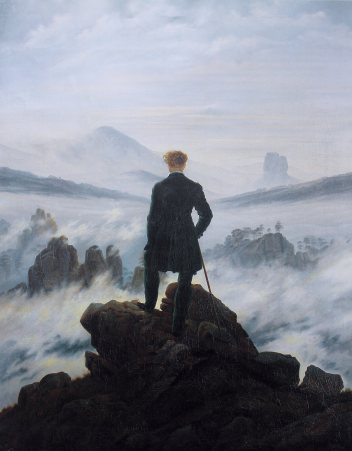
The writer about whom I write says that the painting entitled Wanderer above the Sea of Fog by Caspar David Friedrich is his favorite painting. I share it with you here:

Wanderer above the sea of fog Caspar David Friedrich

The blogger who declares his favor for this painting says he’s not sure why he likes it so much. In sharing his thoughts and feelings about this painting, this writer drew me into a conversation with the painter and the blogger who appreciates the painter’s work. This diablog is my participation in that conversation. I believe that the conversation is among all of us who sense within us the imagination of an artist and the heart of a lover awakening. I invite all with whom this diablog resonates to feel this awakening presence and savor it as our renewed awareness of the interconnecting synergy of wholeness that is within each of us. It is not necessary that we all feel the same emotions on account of viewing and interacting with this painting. That it invokes emotions is what we have in common. The heart that feels! That is the holy ground to which Browning referred as the place where taking off our shoes seems an apt response, just as it did to Moses in the presence of his burning bush. Our hearts leap up aflame with emotions at the presence of fresh, creative possibilities radiating from the Mystery when life calls us to turn aside to see what’s going on that is out of the ordinary and unconventional – above and beyond the sea of fog.

Our minds are curious to see and learn more when the Mystery draws us in by our hearts’ desires and passions. Our hearts require us to turn aside. We may have been wandering a long time or a short time, but as wanderers we are seeking, consciously or unconsciously for answers to Life’s Mysteries. When the Creator speaks, our hearts respond. For any of us, another artist may be the Creator’s voice in whatever medium the artist works. Wanderer above the Sea of Fog may serve as one of our burning bushes if it speaks to us. We may turn aside to contemplate it, seeking to comprehend why it speaks to us and what it is saying that so intrigues us. In that moment, we may identify with being the wanderer who sees a vista within our imagination populated with pinnacles of clarity above and beyond the more common fogginess among which we spend most of our days. We stand transfixed by the vision we have stumbled upon. We have been climbing uphill in our wanderings, aware that we were struggling upward and yet not knowing what we might expect to find. Suddenly we are no longer a mere wanderer. We have become a wonderer in the Presence of the Divine Mystery that awaits all who seek to see above the sea of fog that otherwise hampers our vision.

Suddenly we see both the fog that had hampered our vision and the vision we’d not known to expect but which drew us relentlessly onward and upward nevertheless. Blind wandering in response to our heart’s desires becomes an amazing sight before which we stand in awe, transfixed as we take it all in as best we can. We recall dimly the way we came to reach this pinnacle experience and are uncertain how we’ll descend again. We cannot go back the way we came. We must somehow move forward, most likely back down the other side once more into the sea of fog – for leaping from pinnacle of clarity to pinnacle of clarity seems impossible. Yet, we cannot forget the vista we’ve encountered or dismiss the power of our imagination to capture and be captured by it. We are one with the vista and its novel clarity. It is ours, we are its. We are the vista and it is us. We’ll never be the same again. Having awakened we must remain awakened no matter how the sea of fog once again surrounds us and clouds our vision. We remember clarity of sight. We now know that it is possible. We stumble onward hoping that future opportunities to climb will present themselves that we may again see with clarity, the clarity that only heights confer.

Can we be sure of achieving a height again? Do we want to achieve it the same way twice or is there a natural high we seek beyond the ones we may have stumbled upon before? What enhances clarity and what does not? We are learning as we wander. We are becoming the Eternal Wonderer. In time and space we wander while in Eternity we wonder. Having once connected with the Master Artist whose Master Artwork we each are and remembered, we cannot forget again. We carry the memories of past encounters with the Divine as it has spoken to us and feel the power of its inspiration ever drawing us forward as we wander along life’s convoluted pathways in search of the being who we are and the Being from whence we came and to which we return. We seek to return to oneness with ourselves and all Creation and with the Creator of all that is alive and well. We are Love’s emerging Presence in an unfolding realm of Love that has no beginning and no end. No sea of fog can obscure that Truth forever.

© Art Nicol 2015


Wholeness as the Pivot Point of Change

Let me keep this simple. Unless a person who seeks to be the change in the world he or she wants to see (pursuant to Gandhi’s admonition) slips out of and beyond his or her ego, he or she will fail to participate in a true change. The ego is a master of disguises. To change from one ego-disguise to another is no change. For the world to outgrow violence as a norm and instead enter into a phase devoted to healing the wounds of past violence as a new norm, individually and collectively we all must become humble, ego-free healers.

Beyond the phase of healing awaits the phase in which no harm is ever done that requires healing. To reach that harmless phase, we must undo the harm that our harming stage has done.  To pivot away from ego requires what we pivot out of the ego’s closed system of thinking to enter into the only true alternative — open-mindedness to all creative possibilities.  Wholeness offers us the pivot point around which to turn all of the ego’s ways of thinking on their heads and emerge beyond ego as if we’ve entered into and passed beyond the worm hole into a whole new universe of grand options that set us free to be more than ego wants or believes we can be.  Freedom frightens the ego.  Freedom wisely lived requires no ego and thus no longer lets fear of change hold us back. Only then can we become the change in the world our hearts desire but our egos fear.

Phase 2 is upon us. We either elect to participate in Phase 2 as one of the healers of the harm done in Phase 1 or we remain a participant in Phase 1. Any attempt to remain loyal to the ego while claiming to do no harm is the cover-up of codependency and enabling that the ego employs to perpetuate its reign of terror. “Oh,” you may say, “but I’m a helpful person who never harms anyone.” Perhaps you truly are. Perhaps you truly intend to be but do not yet realize how your best intentions remain unfulfilled.  It is more likely than not that you are allowing your ego to fool yourself into believing you are doing no harm while it’s not true. Do I sound too harsh and unkind to you? Please forgive me if I seem that way.  In actuality, all I’m inviting you to do is move beyond the mistakes I made as a co-dependent enabler who failed to realize that my ego was still in charge of my heart and mind and running me in circles like a fool.

Despite the fact that I once desperately wanted to never be a fool, I was one. It was much more obvious to others than it was to myself, but that’s how the ego operates. It makes you look like a fool to others so that they in their own ego-oriented foolishness can comment upon, judge and find fault with your foolishness rather than see and address their own. It serves the ego’s purpose to make each of us look like a fool to others of us.  It serve the ego’s goal of perpetuating itself to generate controversy among us and set us to judging one another instead of seeing the ego at work behind the scenes. The ego achieves this ego-perpetuating status quo by convincing each of us to adopt one of its contrasting sets of values as “ours” and set ourselves apart from “others” by virtue of our chosen set of values. Sets of values that contrast with one another establish the basis for on-going, continuous conflicts, discussions to resolve conflicts and all out battles when discussions fail to resolve them. The ego does not want our conflicts resolved. So, my ego will do everything it can to justify my claiming the superiority of my set of values over contrasting sets of value and my unwillingness to see things through the eyes of others whose sets of values differ from mine.

Sets of values may in fact differ for a variety of reasons. But if the reason is not focused with clarity upon the role of ego in perpetuating conflicts and correspondingly upon the means by which we may rise beyond ego, then the sets of values conflict only in relatively superficial ways. Superficial differences among sets of values have historically been sufficient to justify all levels of conflict, including wars. That one group may raise three fingers while pronouncing a blessing while another group raises two fingers is nonsensically superficial. Other superficial differences that have seemingly justified violence by one group upon another may not be as obviously superficial and foolish, but they are. People who allow their egos to be in charge of their decisions resort to a wide variety of excuses for identifying other people as enemies upon whom the infliction of violence is seen as fully justified, even reasonable.

Wholeness is the alternative to the ego. That is why wholeness is the necessary, pivotal component of any path by which a person who seeks to be the change in the world he or she wants to see achieves that goal rather than remains trapped within the ego’s conflict-perpetuating worldwide status quo. A person must be willing to become aware of his or her wholeness and devoted to its nurture and perpetuation in order to stop participating in the perpetuation of ego-generated harm. Wholeness is health. Devotion to the nurture and perpetuation of wholeness in ourselves and others is healing. Without wholeness neither health (Phase 3) as a goal nor healing (Phase 2) as an interim path to that goal is possible. Why? Because the ego will successfully resist healing and health and preserve the status quo of ill-health and harmfulness in order to preserve itself as essential to the person’s sense of personal safety and personal identity.

We who have been raised in an ego-oriented society to believe ego to be our identity are like fish who have been swimming in water without being aware of the water. The only reason I become aware of the water is there came to be a time in my life when I felt like a fish out of water. Amid the discomfort of flopping around and suffocating on the shore, I awoke to the realization that my ego was not my true identity. On that shore, my ego died and yet I, the true me, was still alive. In that phase of my life, I suffered an acute identity crisis. If my ego is not I, then who am I? I spent several years on a quest for the answer to this amazing question I’d previously failed to ask. Who am I?

Early in my quest for answers to this pressing question, I was introduced to a work called A Course In Miracles. I devoted myself to studying this course with more diligence than I’d ever studied before. I had been a fairly good student of other areas of study in my past. This area of study motivated me like none had previously motivated me. In the past I studied other subjects to please others, not expose myself to the shame of public failure and achieve academic expectations and benchmarks set by others. In studying A Course In Miracles, I studied and applied what I learned for reasons far more personal to me, from motivations that arose from within me, as if Life itself called me to succeed. Through this process I awakened to and gradually accepted my true identity and discovered many answers as well as many continuingly unanswered questions. I learned to live by faith in the presence of the Mystery of the Divine, including of my own identity within the Divine.

Above and beyond all else that has motivated me have been the experiences of peace, hope, joy and love that my ego never allowed me to encounter and enjoy. On account of those experiences alone, and not for any argumentative reasons, do I now encourage you to enter upon your own quest for your identity beyond the ego and the path that will take you through Phase 2 into Phase 3 as you emerge to yourself and others as a whole person rather than remain disguised behind the masks and entrapped behind the walls of your false identity of ego. If you feel so called, come forth to join me and others in the realm beyond ego of which Rumi wrote when he penned,

“Out beyond ideas of wrongdoing and rightdoing there is a field. I’ll meet you there. When the soul lies down in that grass, the world is too full to talk about.”

Let me here share a snapshot of my own version of that truth in the form of an illustration I invite you to contemplate for its value to you as your inner voice of Spirit counsels you to do.  More about this topic is available by clicking on the Heartbook tab on the menu.

Wholeness Archtype with text 2015

For more encouragement from Rumi as a source of inspiration and wisdom, visit http://launchyourgenius.com/2014/08/04/rumi/.

For more encouragement to understand how to use your own path of faith to grow beyond the ego’s confining definition of your past, present and future, make it a point to enter into your own personal quest for answers to the pressing question “Who am I?”  Our human race will not develop beyond its current adolescent stage until each of us asks this riddle of the Universe and learns to listen to the answer we receive within our hearts and minds.  I would be honored to encourage you to find deepest satisfaction in your quest.

© Art Nicol 2015


Free Will – What Is It, How Does It Work?

Free will has challenged human beings since the beginning of time. In fact, mystics say that we used free will to create the illusion of time in the first place. What is free will? How does it work? These are two questions vital to the welfare of humankind in an age when power expressed as force is running amok around the globe destroying much of life. Is such violent disregard for life an exercise of our individual and collective free will?

To keep it simple, let’s consider “free will” to be one of the features of humans that distinguishes us from other life forms. A sign of this distinction is that we function with a consciousness of time. No other life form has perfected the art of “telling time” as we have. Agates, asteroids, asters, apples, anthrax, amoebas, anemones, anacondas, aardvarks, antelopes and apes do not schedule their lives by the clock even though some do order their activities based on the effect of the sun as the earth rotates. They live in relationship to such conditions naturally without concern for predicting them or controlling them. They’ve found no need or ability to invent sun dials and other handier timepieces until they arrive at a precision pegged on the periodic motion of atoms. We have chosen to do so as no mineral, plant or animal has. Our power to make such choices and carry them out can be called “free will.”

Free will is a power. We sometimes call it “willpower.” We can choose intentionally to fix our wills upon a goal with such determination and discipline that it appears we’ve lost our freedom to choose otherwise. Yet, the truth is that we remain free to choose to focus our determination and capacity for discipline differently if we conclude that the first exercise of our focus and capacity is not achieving the goal we seek and decide to take another approach. “Deciding” is an aspect of our free will. All we need to do to “free” it again is to realize what we’ve focused it on one goal and can nevertheless, despite every argument to the contrary, change our focus if we want to.

Yes, if we “want” to. The exercise of our free will is heavily influenced if not totally dictated by what we “want” to happen or “want” to be true. That’s why it’s important to be aware of what we truly are “wanting” in order to be truly free to exercise our will. Most of us do not remain fully or even partially aware of what we “want” and allow our buried desires to take control of our wills and establish our life’s direction and destiny – even our demise. Beneath the destructive forces now at work around the globe is a desire to do or die. We are choosing death over life, more freely than we realize. We may have become unaware of the origin of our choice to “do or die” but we’ve made it. It remains there for us to choose differently if we want to choose differently. Do you “want” to choose to violate the norms of our violence-prone society and create for yourself and others who choose with you a society based on peace and love instead? You can if you truly want to.

Our “wanting” is the same as our “heart’s desires.” What are your heart’s desires? If what’s happening in your life is not in line with your deepest heart’s desires, why not? What other desires or “wants” have taken over your will to make it seem less than free? Why might you have unwittingly joined in the collective decision to “do or die” instead of to “do and live?” Why might you be willing to throw out the baby of life with the bathwater in order to achieve a death that vindicates your belief, opinion or perspective about anything? About what topic would you prefer to die instead of admit you might be mistaken and could, if you wanted to, change your mind?

I’ve asked key questions. Now, I want (yes, want and as an exercise of my free will) to share with you a perspective that has helped me decide to participate in the peace-and-love-prone alternative to a violence-and-hate-prone society. What I learned that helped me to change my mind arises from our understanding of the process of grieving. I learned that many of our decisions are influenced by our emotions and that we think we “want” what we’re in the mood for. I learned by experience that it’s not always wise and healthy to opt for what I’m in the mood for. Moods offer poor guidance for free will.

Grief is a process. The process of grief takes us stage by stage from the pain of being hurt in some manner to the release of that pain and a life beyond that pain. How these stages may progress in your life may differ from the pattern in my life. But, let’s consider how universal it is that grief begins with anger and resolves itself in peace if we allow all of our stages of grieving to function fully. The grieving process starts with the emotion of anger and winds up at the emotion of peace if we let it arrive there and don’t insist on remaining angry or sad (depressed) along the way. Our heart’s desires are influenced by the emotional state we are in. I suggest that being in an early stage of grief allows anger to dominate our “wants” and our wills and sets the stage for revenge-stoked violence to be our choice. That’s why I have learned the wisdom of not making important choices when I am in a HALT mode: Hungry, Angry, Lonely or Tired. When in these mood-modes, it’s wise to wait and allow the mood to pass before exercising my will. Otherwise my will is not as “free” as I would want it to be. (Yes, I do “want” to learn to exercise “free” will, not some form of imprisoned or compromised will.)

I invite you to observe reports of violence for a while and to notice how many acts of violence occur under the influence of anger and/or fear. How many occur while the person who acts violently is still heavily influenced by the motive of revenge? Anger is an emotion that barely hints at the level of pain that a person is carrying around inside from encounters with pain from the past. Unhealed emotional pain is the same as unresolved grief. The “desire” to have revenge or “settle the score” is a symptom of unhealed, internalized pain, even when it may be called “justice.” As the saying goes, “an eye for an eye makes us all blind.” We are in grave danger of being blinded by the violence awash in the world and unable to see our way clear of it. But there is an alternative to blind rage and anger-clouded vision. We can see our way clear if we’ll take the time to grieve, resolve the painful issues of our past and present lives and then move forward together in peace. We can build lasting peace, not merely intermittent truces, through such patient processing of our collective and individual griefs.

Are you willing to step back from the frenetic pace of your life and grieve sufficiently so that your heart’s burdens of pain are resolved and you rise up with fresh energy to help build peace on earth among all peoples of good will? Good will is free will. All human beings are good people at heart. In the depth of our hearts we can find the common ground upon which to build lasting peace. We can find by faith that this common ground is there because the Creator of us all put it there. But to see and stand together upon such holy common ground we must be willing to be determined to acquire, honor and relentlessly use the habits of grieving needed to keep our visions clear and our minds focused on peace instead of focused on justifying anger.

We can “do” peace and live together in it. We need not allow hidden griefs and motives of revenge to dominate and imprison our hearts and minds – or our wills – as if we have no other choice. We do have another choice, a healthier and more promising one. I hope what I’ve written here helps us to see it and to make it. We can choose unifying humility in preference to divisive pride and shame. We need not proudly fight to our deaths over things that matter little in comparison to love’s simpler, more highly valued features and benefits over which no one needs to fight because they are universally available for free. We need not shame, blame or guilt-trip ourselves or others for our decisions or theirs. We can seek to understand by compassion’s perspective “There but by the grace of God go I.”

Many people who advocate on behalf of violence as a solution to human conflicts and confrontations (including to protect innocent defenseless people or in self-defense) have endured trauma in their past, sometimes trauma too severe to imagine if one has not been exposed to it personally. What I write here in no way denies or minimizes the pain that traumatized people have endured or continue to carry as ongoing suffering. I know that I’ve been fortunate to experience only moderate levels of emotional pain. I do not know by personal experience the fuller intensity of pain and suffering. Yet, I continue to advocate on behalf of grieving as the way to heal even the most severe pain and to relieve suffering that otherwise occurs when ungrieved emotional pain is allowed to take root unaddressed, often unnoticed as an underlying theme so prevalent as to be taken for granted as one of life’s unavoidable and permanent conditions.

Ungrieved pain is generating havoc around the world, nearby in our own homes and neighborhoods and far away in the homes and neighborhoods of other members of the human race. My heart’s desire is to help stop this havoc and chaotic, misplaced reliance on inflicting more pain as a response to pain. It’s time to see through the clouds of pain and dust storms of suffering that anyone who acts out violently, even with the full sanction of his or her social institutions, is acting out of unresolved pain. Our social institutions that rely upon punishment to control other people’s actions or impose guilt and shame as a “consequence” of violating those institutions’ rules, roles and rituals are contributing to the overarching pattern of violence that threatens to end the human race. While it is true that we must not deny or minimize pain, we must also not justify inflicting it is as if it is an essential part of the solution. It is a symptom of the problem of emotional unhealthiness we must all address more effectively together. Inflicting more pain and suffering in response to existing pain and suffering is totally counterproductive.

It is my intention to encourage us all to address this unhealthy condition in societies around the world by promoting the mastery of the grief-relief process in place of the grief-infliction process. Too many of our rules, roles and rituals perpetuate grief and pass it along generation to generation, person to person, group to group and humanity to our ecosystem (animals, plants and minerals). Let’s us experiment together instead with the process of relief and see the miracles that peace beyond anger and depression will bring.

Longer explanations of free will have been written by many superb thinkers. If you want to read examples of such works, check out Rollo May’s books entitled Love and Will and Freedom and Destiny. You’ll find great value in focusing your mind on these books and others like them. To do so would be an exercise of your own free will in a nonviolent way. My shorter discussion of free will is not alone sufficient to bring it all home to your heart. If it gets the ball rolling, please keep this ball of healing energy flowing freely within your life as you cultivate your own motivation for learning more about the process of relief called “grieving.” There is no more promising way to exercise your free will than to learn that it’s simply not true that “Big boys don’t cry” or that tears are a sign of weakness. Emotionally unhealthy boys, girls, men and women don’t cry. Ones with tender hearts, reasoning minds and good wills do. Please don’t be ashamed to be one of us.

© Art Nicol 2015


Which Arms Race Do You Choose to Enter?

Once again it is evident that those who profit from manufacturing and marketing military weapons continue to engage in propaganda urging US taxpayers to foot the bill for their luxury lifestyles. (Those who pay directly or indirectly for governments around the world are also roped in by this global propaganda machine underwritten by multinational corporations who are more loyal to fattening their own bank accounts and indulging in conspicuous consumption as global playboys and playgirls than they are to any nation or peoples beyond their immediate families.) The main theme of such propaganda is the “arms race.” According this propaganda, we are always at the mercy of hostile nations and unruly hostile non-nations acting on their own. Threats from all sides seem to justify arming ourselves to the teeth. Add to that the seeming threats from within our own borders attributed to criminals, terrorists and general crazies and we have the makings an endless arms race from which no one escapes but a few definitely profit. It’s a bonus to the profit-makers that many US citizens have decided that the only adequate response to this growing perception of apparent hostility from others outside and inside our borders is to arm themselves with weapons supplied by the same arms industry. Ah, the profitability of fear!

Are you and I powerless in the face of this arms race that sucks resources from our pockets as relentlessly as lampreys suck life from lake trout and leeches suck blood from any animal to which they can attach themselves? Are we at the mercy of these profit-making vampires who own and operate major media sources so as to keep their propaganda ever before us? Do we have no choice but to be taken in by the propaganda and participate as unsuspecting or suspicious but compliant dupes and funders of the excesses of those who profit from this arms race?

Not necessarily. First we can decide to disregard the propaganda that tells us that the world is entirely hostile towards the US and that we have no choice but to arm ourselves with a succession of soon-to-be-obsolete weapons in an endless race towards the wars we cannot avoid. The inevitability of war is assumed by the propaganda and the only issue presented is how well prepared will we be to win that war. Few of us want to go down in defeat. So, if one assumes that war is inevitable, most of us will join the cry for increased preparedness at any cost. Yet, we don’t have to believe that assumption or buy into the propaganda. We can choose to participate in an alternative arms race instead.

What might that alternative arms race look like? It would look like neighbors opening their arms to each other and reaching around the globe to welcome strangers as neighbors in our global village. We can ignore the doomsayers and act as if we have a better future based on peace and good will shared by good-natured, reasoning people who populate the globe with values and priorities akin to our own. We can assume not hostility but instead common ground in our shared hearts’ desires to raise children in healthy conditions and share life with loved ones in stability and harmony without fear of losses inflicted by hostile forces prepared only to spread violence like an epidemic throughout the human race.

We could engage in a race into each other’s arms if only we trusted each other more than feared each other. Are we willing to take that risk? Might we set aside our xenophobia and reach out to each other as if we might find friends instead of enemies? What do we have to lose? The military version of the arms race dooms all of us. All we have to lose by taking the risk of embracing each other as neighbors instead of as hostile strangers is doom. Might it make sense to you and I to forsake doom in exchange for embracing peace and the freedom to share the globe with good will?

How will we ever find the courage to take such a risk in the face of pressures to believe the propaganda and stand apart in fear? I suggest our courage will come from our faith that there’s a power greater than the arms merchants and their minions, a Power that will aid our alternative arms race. If we race into the arms of the Creator who loves us, we will discover divinely inspired courage within our hearts and God’s corresponding wisdom to make our dreams of peace on earth among people of good will a reality even in the face of contrary arguments proposed by distributors of death. All we need to do is to decide to be customers of the Distributor of Life who charges us nothing for receiving all we can open ourselves to receive of life. It costs us nothing but our egos to open our hearts and minds to the Source of Life and receive in abundance all that the Source generously offers to share with us. Is humility too great a price for peace on earth?

I hope that anyone who prefers life over death and love over fear will consider joining me in the alternative arms race into the loving arms of God and the people who say “Amen” to God in whatever language they choose to say it. God is great in any language spoken around the world by people of all faiths in a God who wills that the human race enjoy being surrounded and filled with love and allowed to live into the fullness of time as Eternity’s children.

© Art Nicol 2015


Open Letter to Those Reaching Out to Outcast LGBTQ Youth and Young Adults

If you are reaching out to LGBTQ youth and young adults who feel unwelcome in their families, communities of faith, schools and other traditional social institutions, first let me say “Thank you” for your earnest effort to awaken dignity and self-respect in those harmed by the lies by which mainstream society surrounds them and inevitably fills them as these lies seep in to poison their hearts and minds. The harm is oftentimes mental and emotional before its toxicity builds up to the point of causing physical harm.   Self-destructive actions come along after self-destructive ideas about how life works take root and toxic emotions that naturally result from believing lies about being unworthy of dignity, respect and love color self-perceptions. Since self-rejection, self-hatred and self-punishment follows on the heels of social rejection, it is helpful to have society cease to reject and begin instead to wholeheartedly accept LGBTQ youth and young adults as welcome members of society. If given enough opportunity, self-acceptance, self-love and self-actualization will also follow from the healing power of social acceptance. But it is not enough to convert the shame of social rejection into the pride of social acceptance. Why? Because shame and pride are flipsides of the same coin by which an ego-based society enslaves us all. We need to do more than help LGBTQ youth and young adults to adopt the ego’s ways of being enslaved to social approval by pride and taken for the ego’s ride to a destiny unworthy of all human beings.  The ego’s way is not the solution. There is another resolution to the dilemma of being nonconforming or “different.”

Because a spiritually rooted and enriched life is the only true alternative to the ego’s seductive illusions, I especially want to thank those who are doing all they can to alert men and women who claim to speak for God to the harm caused by religious teachings that utterly denigrate the personhood and dignity of people with nonmainstream sexual and gender orientations.  As a follower of Jesus, I encourage you to challenge those who claim to honor Jesus to do much, much more than to stop spreading the lies that purport to condemn people of all ages who live with nonmainstream sexual and gender orientations to lives of guilt and shame and doom them forever to hell as unqualified to ever enter heaven.  To end systemic and individual bigotry is a worthy goal because once it’s achieved, we’ll stop harming our youth and young adults who dare to feel “different” and as part of their feeling different struggle secretly or openly with “different” sexual and gender orientations than the mainstream may admit to sharing.  But ceasing to do harm is not enough.  We must invest ourselves without reservation in undoing harm already done and in healing broken hearts much in the need of mending.  Only then will we face within ourselves the adverse effects of ego on and within all of us and evolve beyond ego’s limitations to embrace lives flowing freely with love’s most desired and treasured experiences.

Until their hearts are healed, those who have been wounded by lies and social rejection carry emotional pain and will continue to act out their pain in ways that socially conformist folks will condemn as “proof” of the wounded’s inherent unholiness.  Inner pain is often acted out in socially nonconformist (even rebellious) ways in the face of the conformity that has caused the pain.  (Such acting out is a way of saying, “No, you cannot do that to me anymore.”)  We must educate conformists (adherents to traditions) to be aware of how their unreasonable, fear-based demands for conformity are themselves a root cause of psychic pain and of the resulting harm that flows from believing oneself to be utterly unworthy of and unavailable to God’s love.  Lies confuse our minds.  Confusion = a form of psychic pain that couples with feelings of guilt, shame, inadequacy, powerlessness and resentment to imprison a person’s mind in a dilemma from which there appears to be no escape but death.  Death looks like the only relief after forms of temporary relief like drugs, alcohol, sex and other thrills and pleasure-triggering pursuits prove futile.

We must learn to say to inflexible traditionalists “If, in order to please God and experience Divine Love in abundance, I have to be 100% like you and not deviate in any way from the model of human life that you have adopted, then you are saying that God did not create diversity within the human race even though God created diversity among all other realms of Nature.”  Minerals, animals and vegetables embrace diversity without judging any aspect of diversity unworthy of belonging.  We must be willing to ask “What other expression of Nature polices its members to demand conformity and penalizes by rejection the minority who may not conform? Are not other species wise enough to accept nonconformity as a source of new-and-improved versions of the species that may prove to be more adaptive to changing conditions and capable of causing the species to survive those changes? Might demanding conformity and rejecting nonconformity doom the human race to extinction? Might a holy race include nonconformist expressions of holiness in all innocence as a way of ensuring that the race thrives beyond its currently limited vision for itself? Might God’s vision for the future of the human race encompass more than past traditions have embraced? Might future traditions embrace more of life, love, liberty and laughter because ancestral traditions learned to be more open to God’s creativity as a (re)new(ed) tradition?”

I’m not qualified to address how people of other religious flavors may view the socially marginalized (social “outcasts” or “rejects”), but I am qualified to speak to my brothers and sisters who claim Jesus as their Lord and Savior, as their primary Teacher and Friend.  We who follow Jesus are called to go far beyond stopping the transmission of harmful lies.  Yes, we do need to stop spreading messages of condemnation in the name of the one who said to the adulteress “And neither do I condemn you.”  Her sanctimonious, self-righteous neighbors accused her of “sin” and then dropped their stones when Jesus reminded them to look into their own hearts at their hidden, unconfessed and unrepented shortcomings.  All “sin” means at its origin is “separation.”  Jesus came not to separate from but to reconcile us to the Creator of Us All who loves and favors each of us as the individual and collective apple of His/Her eye.

The shortcomings of followers of Jesus include not only 1) accusing others of different sexual and gender orientations of being lifelong, irredeemable sinners (forever “separatists” from God doomed to suffer throughout all Eternity) but also 2) failing to heal and comfort those who are condemned.  It is not enough to stop condemning.  Jesus is a healer.  His followers must take up healing as their primary avocation until the harm done by the Church (and others) is undone.  We must heed the call to be allied not against but alongside those whom less understanding members of society have rejected as unacceptable family members, friends, classmates, fellow worshippers , co-workers, etc.

As an example of the misguided conclusions researchers are coming to about how to respond to the harm such condemnation causes, I cite this article: http://www.huffingtonpost.com/2015/02/26/lgbt-homeless-youth-survival-sex_n_6754248.html?utm_hp_ref=gay-voices.

As this article evidences, researchers tend to intellectualize their way through data to spot the harm (as if it needs to be proven, which it does only to those who otherwise restrict their lives to associating with other members of the privileged class and remain blind to the plight of the less privileged). But they know nothing of the response followers of Jesus are called to provide in response to such harm.  We are not called to study “the problem” in order to gain “insight into a little-understood world and demonstrate the need for more government-funded shelter beds and other resources focused on LGBTQ youth.”  Government is not the answer here anymore than government-run orphanages and foster care meet the needs of unwanted children and youth to be welcomed in homes where they are wanted.  Plenty of followers of Jesus have homes that have room to welcome unwanted youth to be included there as members of the family, as spiritually adopted children and siblings simply because they are already divine children of the Divinely Loving God Jesus called Abba.  We need not out-source the care of the unwanted youth and young adults to governments or any other resource beyond the Christian community itself.  We who claim to occupy the privileged status of having Jesus’ care and guidance must take into our hearts and homes those Jesus says he identifies with, whom the Bible says he called “the least of these.”

I urge you who advocate on behalf of LGBTQ youth and young adults not to settle for speaking to believers in Jesus as if the government is the resource Jesus calls upon to serve God in his name and nature.  Jesus calls upon his followers to serve according to his way, truth and life.  He says we will do what he did and greater things will we do.  He does not teach that his followers should badger politicians into spending taxpayers’ money to provide for the socially marginalized.  He calls for his followers to serve directly in accordance with the blessings that they have received, to dig into their own pockets as the Good Samaritan did to provide for the stranger found beaten and abandoned along the road.  Emotionally beaten and abandoned LGBTQ street kids (as well as LGBTQ youth elsewhere in society) need more followers of Jesus to heed their Lord’s commandment to love God and one another and to leave no one out of their circle of love.

Others may be free to insulate themselves from direct involvement in the lives of those whom the distorters of Jesus’ teachings have harmed.  We who live by the truth of Jesus’ teachings must step forward to demonstrate by the congruency of our words and deeds that the age of  hypocrisy is over and a new age of integrity has begun.

To those who advocate on behalf of LGBTQ youth and young adults and seek to serve their best interests, I say, “What you are doing is a much needed beginning to the age of integrity.  I encourage you to take it all the way and call upon followers of Jesus to confess their own shortcomings as followers, turn from their adherence to habits of falling short, take up their responsibilities and follow the One who sends the Holy Spirit to leads us into all truth.” And I repeat, the gratitude of all whom you serve and of the God of Love who watches over them goes with you always. May you be open to reaping as you sow from the One who sows generously within the hearts and lives of all who serve in the nature of truth and love!

© Art Nicol 2015

A is for the Artificiality that Makes Men Mean

In the ABCs of Love, A stands for Authenticity. In the ABCs of Hate and Fear, A stands for Artificiality. Each alternative emotional ecosystem – love or hate/fear – offers its basic ABCs. When boys are raised to be authentic and true to themselves with the freedom to be gentle, creative and caring, they become nurturing, appreciative and affectionate men because their loving qualities are rooted in their nature as children of Divine Love and spring up naturally to be explored, expressed and experienced without inhibitions.

But, when a boy grows up in an artificially superficial, image-conscious, media-hyped modern society – a world in which being authentic, trusting and honest is too emotionally risky to endure – the boy becomes a man who has learned to defend against being hurt and to protect his heart from being shared “too” openly. Open, tender-heartedness is not allowed in modern society without great penalties of guilt, shame and pain, especially among male members of society. Tender-heartedness is ridiculed as unmanly, an offense to a masculinity that is supposed to conform to social norms to earn social approval. To introduce the A of Artificiality into men, is to turn “men” into “mean.”

One way to look at this transformation of gentle, tenderhearted boys into mean men is to realize that the modern world forces them to choose to be either outright bullies to some degree or another or scared men who won’t stand up for what they believe in because they are intimidated by bullies. It takes courage to be a genuinely caring and nurturing man who is both not a bully and not scared into silence and inaction by bullies. Men who live like bullies or who allow bullies to run society are mean towards themselves and others. In their divine core, all men have what it takes to join together to create a society far different from what modern society has become. We can set aside our personally customized version of meanness and rise up together as mean-free men of honorable valor and highest value.

Me + n (for “nurturing”) stands for men who live true to their divine nature as children of an infinitely loving Divine Parent. It’s true that at some point in our development, we become aware that we are an individual “me.” “Oh, look at me, can you see me?” Experts in human development identify the emergence of our individuality in games like “peek-a-boo” or watching and reacting to ourselves and others in a mirror. In both games and other life lessons (such as being weaned from breast and/or bottle to feed ourselves), we learn to tell the difference between ourselves and others. We no longer see ourselves as being entirely incorporated within an undivided whole. We begin to learn that we are separate from the others around us and are then expected to learn how to live in awareness of this separation. For most of us in modern society, we learn to some degree to be scared by separateness because it seems as if we no longer can trust the “others” from whom we feel separate to treat us gently, affirm our value and meet our needs. Separation anxieties seep into our hearts and take up permanent residence as agents of the fear of being alone combined with the fear of not being left alone instead of bullied.

Have you ever struggled with the fear of being alone while also realizing that you don’t want to be hurt anymore by someone you allow to be close to you? Can we trust anyone to be close to us to prevent our being alone without having to allow that person to somehow be mean to us and make us pay a price for not being alone? That’s a key issue in modern society and has been a key issue in human society for a long, long time. How long? For as long as men have been taught to be aggressive with their greater physical strength in order to protect more vulnerable members of society (typically women and children) from harm inflicted by other aggressors – both human and non-human. So long as we expect stronger men to take up the role of protectors from aggressors, we distort their perspective on life and teach them that we expect them to learn to be mean, not merely nurturing.

The A that stands for “aggression” is an artificial quality for humans of any gender. When we expect males to adopt aggression as a lifelong quality we expect them to internalize that “a” and add it into the formula to become “me + a + n = mean.” The quality of aggression interferes in the development of nurturing qualities when boys and young men instead engage in male roles by adopting stereotypical aggressive solutions to social problems. (Expressions of aggression can be mental instead of physical in boys and young men who have exceptionally quick minds and discover that they can outthink others to have their way even when they don’t have stronger bodies. Sometimes such boys and young men turn their aggression inward upon themselves and act out in self-harming ways rather than harm others. In that case, they are punishing themselves for not living according to society’s masculine norms. Believing oneself to be an utter failure in the eyes of those who matter most can lead to self-abuse – including abusive use of drugs, alcohol, sex, food and other pain-numbing distractions – and ultimately suicide.)

We are unreasonable to complain when men we’ve expected to develop aggressive qualities to protect us from other aggressive people continue to be aggressive when they leave the social roles we trained them to fulfill as aggressive men and try to move into other social roles. For example, we train some of our young men to be aggressive members of our military at the time of young adulthood when it would be natural for them to learn instead to be nurturing partners within intimate relationships. We cannot next expect these young men to become gentle, nurturing spouses and parents without supporting their letting go of the habits of aggressive problem-solving required in military action and their learning replacement habits of nurturing problem-solving required of competent caregivers. When we welcome these young military-oriented men to become police officers and structure and equip our law enforcement system like a branch of the military we are hardly fair to these men.

In fact, we are entirely unreasoning and unreasonable. We surround them with all of the signs, symbols and symptoms of still being in the military and expected to be at war with an enemy and then burden them with a contrasting set of expectations brewed largely of force-based responses to threats while laced with inadequate training in alternative responses. This is especially unreasonable when we expect our our militarily trained young adults (both men and women) to use violence to defeat enemies who hide among civilian populations and then ask them to return to our civilian population and not continue to sort automatically between friend and foe on whatever terms they learned in the military. We are now the civilian population among which hide those (also here out of uniform) from whom we hope the police will protect us.

(A similar line of reasoning applies to young men whom we encourage to be trained in aggressive sports for our entertainment, as if they are modern gladiators fighting to the “win/death” in our technologically enhanced and broadcast coliseums. Pay-for-violence media abound as avenues for boys and young men to achieve fame and fortune, the ultimate in social approval! Yet, somehow magically we expect them to be model intimate partners off their fields of battle. We pay them handsomely for their on-target violence and then fault them for targeting others with it.)

Men who faithfully learn to be mean in order to survive in life-threatening (and pride-gaining) circumstances will not suddenly stop being oriented to meanness when they are no longer immersed in those circumstances. A change in outer circumstances is not alone adequate to cause a change in inner orientation. Habits of aggressive emotional, mental and social reactions take time and practice to learn. They also take time and practice to unlearn. It matters little whether those habits were learned in a highly competitive family, school, sports, street life, military or other intensely performance-oriented setting in which a male’s identity is equated with success as an aggressor. Once such habits are taken to heart, men who are trained in this manner need generous and gracious help and abundant opportunities to release their mean habits and acquire new ones that are nurturing.

The A in mean men is not a permanent quality. Beneath it are the natural, lifelong and life-sustaining qualities of affection, appreciation, affirmation, acceptance and assertiveness. In short, other A-list qualities are far more natural to male members of society than aggression ever is. Aggression is artificial, not at all natural to men. Let’s no longer ask men to be unnaturally aggressive and instead encourage and allow them to be comfortable with being assertive and other A-list qualities. Let’s affirm men as expresses of God’s affection and appreciation and stop insisting that they be expressions of God’s anger.

Anger is not even an A-list quality of God. If we are willing to listen to Jesus who said, “He who has seen me has seen the Father,” we’ll realize that God is not angry with us and we need not be angry with or aggressive towards ourselves or each other. We are not sinners in the hands of an angry God or in the hands of anyone else who feels angry. We are innocent children of God whom an artificially oriented modern society born of centuries of mistaken ideas has wronged by insisting that we feel guilty and ashamed of ourselves for our best qualities. In God’s eyes, we have nothing to be guilty or ashamed of. We have made the mistake of believing those who do not speak for God’s heart and do not know God’s true mind towards us.

Jesus spoke and speaks for God. Other kind, gentle, nurturing and courageous males and females who are wholeheartedly committed to the welfare of all humanity have pointed us towards the authentic nature of God too. Those who have known God intimately have gently tried to redirect our attention to the qualities of God too often overlooked when we feel afraid and want God to protect us from harm. We expect God to use force and be aggressive on our behalf as we expect larger-bodied humans to do. In that manner, we have tried to reduce God to the limitations of physically expressed humans. God is bigger and more powerful than that even while remaining totally nurturing, accepting, affirming and actively in favor of each of us.

© Art Nicol 2015

Has Christianity Functioned as an Invasive Species?

The habitat of the lionfish used to be limited to warm parts of the Pacific Ocean but now lionfish have begun to occupy reef marine communities in warm Atlantic waters too. It is likely that humans introduced the lionfish to these waters by releasing them as no longer-wanted pets. In the absence of natural predators for lionfish in Atlantic waters, the lionfish population in Caribbean waters has grown unchecked. Since lionfish prey upon the young fish of other species, populations of native species in these reef communities have inevitably declined as lionfish consume their young and wipe out future breeders. In this manner, lionfish have functioned as a typical invasive species to reduce populations of native species by their predatory actions. Lionfish have no interest in preserving native populations when those populations feed their appetites.

Christians used to live in certain parts of the European continent where they identified themselves with the empire-building practices of the Roman Empire and used their religious beliefs to justify conquest of other people and their lands when the resources and peoples of conquered populations fed Europeans’ appetites for pleasure and for power. Many Europeans who traveled to the continent of North America to occupy what they claimed to be vacant lands brought their version of Christianity’s attitudes, beliefs and conquest-justify orientation with them to justify taking the lands occupied by indigenous members of the human race away from these native populations.

In the process of insuring that native populations (called tribes) would not resist the empire-building of European Christians, the European Christians removed the young of native tribes to teach them in schools away from their families and native traditions. They taught them a Western language, Westernized modern values and Westernized thinking to replace and wipe out the native language and rich heritage these young would otherwise have acquired from their tribal elders. As a result, the population of native tribes declined as their young became consumed by Western values and identified with Western lifestyles. The reefs that previously covered the continent where native tribes once thrived shrank into tiny remnants of the lowest quality lands least desired by the European conquerors. Today those shrunken reefs are more commonly known as “reservations.” They function as a patchwork of impoverished sanctuaries for the endangered indigenous members of the human race who occupied the North American continent before the arrival of Europeans.

There are parallels at work here. Do these parallels demonstrate the invasive and parasitic nature of the form of Christianity that Europeans exported to the North American continent? In the process of this exploitative exporting of toxic distortions of Jesus’ teachings, what happened to his teachings about how those with greater power should treat those with less power? With their superior weaponry and access to continent-spanning communications and transportation systems, were not the Europeans the more powerful? But which espoused true wisdom – the version of Christianity exported to the North American continent or the spirituality of the native populations? Centuries have passed. The evidence is now in. European values and methods have exploited the lands and waters and air as no native population has had the means, heart or will to exploit. We have become a nation rich on material terms and impoverished on wisdom’s terms.

Perhaps it is time for those who have subscribed to the justifications of modern Christianity to repent and turn away from their traditions as their ancestors once demanded that Native Americans turn away from their native traditions. Perhaps it is time for all who have subscribed voluntarily or involuntarily to the language and mindset of domination, conquest and exploitation to repent and learn the language and the practices of Jesus, the language and practices of divine love shared among the peoples of the Earth about which Jesus spoke and according to which he lived while in an earthly form. Beyond his earthly form, Jesus continues to call us to turn aside from the ways of the world, take off our shoes when we are on holy ground and listen to the voice that spoke to Moses from the burning bush. It is the same voice Jesus heard while in the wilderness and invites us today to hear by the power of the Holy Spirit blazing in our hearts.

Could it be that Jesus is so invested in the welfare of the whole human race (and every member of us) that he calls for each and all of us to stop doing unto others what has been done unto us and turn away to do unto others what we prefer from the depths of our hearts be done to us instead? Might we reverse the tides of toxic relationships that are washing across our lands if we were each to become totally committed to allowing the Holy Spirit to detoxify our own hearts and minds and to supporting each other in doing likewise? Could that be Jesus’ plan for ending the suffering we otherwise inflict upon ourselves and others in self-condemnation on account of our buried guilt and shame? Let us hear and honor by word and deed the message “Neither do I condemn you” as we turn away from our stony hearts and instead listen to the stories our hearts yearn to share about the love we want to dare and the miraculous ways we want to care.

© Art Nicol 2015