Tag Archives: oneness

Humanity at the Center of God’s Will – Part 2

God has a center or core of Being that we might most closely associate with Will.  As the Supreme Power and Story Teller, God is free to do whatever pleases God.  I submit that it always and unfailingly pleases God to have all of Divine Creation know Life’s fullest abundance in the context of Love.  God is willfully 100% committed to creating and sustaining Life within which that goal is fully satisfied.  Just as God wills to be fully God, so God wills that every expression of Life be fully free and empowered to be what God creates it to be. In short, God shares the essence of the Divine Will with every form of Life God creates.  Most if not all spiritual thought systems address the “Origin of Life” by sharing a Creation Story.  The key common point in each of those stories is “God did it.”  Throughout sacred stories, the name of the God may vary but the Creator role of God remains constant. Science has substituted other stories to explain the origin of life, stories that do not give credit to an undetectable Being by any name except the Big Bang.  According to a Unified Theory of Life, “why” Life exists is a factor to consider in determining “how,” “when,” “where” and “for and through what” Life exists.  Scientific thinking has produced the illusion that the “origin of life” is a past event, a matter of history of one or another time frame long ago.

The theory of Life that I propose here includes the reality that life is still originating from God’s core (or care, the heart of God’s care power) and taking on new qualities that differentiate it from previous versions of life, even within each species, including the Human Species.  For example, in response to human needs, God creates new versions of humans capable of expressing the progress of human development more completely or of offsetting the harm caused by previous generations of humans.  For this and other reasons, I submit that we must stop judging each other as if God is no longer creating anything not observed or witnessed before.  Some of those we judge unacceptable in comparison to existing models of humanity may in fact be God’s most exquisite upgrades.  We must open our minds to the reality that God is still the Creator and actively creating originals.  The Origin of Life is still actively originating.  In fact, we’d see Life best from God’s perspective if we were to see each other as one-of-a-kind originals and stop trying to make each of us a clone or stereotype as if God has lost all originality or insist upon conformity to some uniform standard humans prefer to adopt in place of God’s prerogative to continue creating originals for God’s higher purposes than we yet know about or can acknowledge.  We need to come to grips with the question “Did God do it or is this caused by some other cause?”  So long as we insist on telling God what’s acceptable for God to create, we’re out of our orbit (as well as out of our minds and out of our position with God).  Surely the fact that we often call tragic events “acts of God” suggests how little we honor God’s true nature and how much rethinking we need to undertake.

To assist their orderly thinking and rethinking, scientists have developed “constants” to help reconcile what appeared at first to be irreconcilable anomalies observed by scientists. A list of many generally accepted scientific constants named after people appears at https://en.wikipedia.org/wiki/List_of_scientific_constants_named_after_people.  I propose that the dimensionless, non-quantifiable Divine Constant named after God is also helpful in reconciling what otherwise appear to be irreconcilable anomalies humans observe in Life.  What appear to be paradoxes to humans may not be paradoxes within the Divine Constant.  But I also propose that the Divine Constant of God is not what most religions have described it to be.  Most human religions have made the mistake of describing the nature of God in human terms and failed to take into the account the true nature of Divinity that lies beyond human understanding, no matter how advanced human understanding may appear to become (scientifically, religiously or otherwise).  As one of its primary contributions, my proposal reaches towards and points our (re)thinking in the direction of Divinity beyond current human understanding.  It assumes the existence of Divinity and the existence of a vitally essential relationship between Divinity and humanity.  Plus it assumes that this theory, like all others developed before it, is only “good as far as it goes.”  My hope and purpose in sharing this theory is to promote greater progress in humanity’s relationship with God – a going forward farther together, no longer as separately as we’ve allowed our jouney to become in modern times.  My hope is to contribute a means of rekindling a well-reasoned investment of time and energy in our faith in God as well as comparable investment in God’s faithfulness to us – all of us.

God’s constant will is that all expressions of Life know their true nature as manifestations of Divine Love.  No aspect of Life is left out of Divine Love.  However, humans have developed many theories by which to divide humanity between one part that is included in God’s favor and at least one part, often several parts, that God purportedly excludes from Divine favor.  In creating such categories of inclusion and exclusion, humans err.  We are mistaken every time we assert that God has excluded any element of Life from the Divine Constant of willfully being 100% committed to The Goal.  To help us keep in mind what this “goal” is, it may be helpful to create an acronym from the word “goal.”  I propose that G.O.A.L. stands for “God’s Ongoing Articulation of Life.”  The Divine Constant is that all of Life is included in GOAL favorably and never excluded from it.  Attempts by humans to explain how some part of God’s creation has lost its standing with God and no longer receives God’s commitment to its well-being are entirely, without exception mistaken.  Likewise, human attempts to impose on some subparts of humanity conditions under which God will favor them are mistaken.  Such human attempts are always based on human fears of aspects of humanity that seem unacceptable to those humans who fabricate their supposed explanations.  They are afraid.  They assume God is also afraid.  That is a fundamental error.  Whether a human deems himself, herself or his or her group to be superior or inferior, more favored or less favored by God, the error is the same.  We are all God’s favorite flower.  That seems impossible only because our language is limited and cannot adequately express the Divine Constant’s fullness.

God is never afraid of any aspect of Creation/Life.  Nor is God blind or unaware.  A key feature of the Divine Constant of God is vision.  God’s vision extends far beyond human vision. That the theory of Life that I am sharing here is visionary and idealistic simply reflects the nature of God’s vision and idealism and our human capacity to receive that vision and idealism if we intentionally, with patient diligence and discipline, open our hearts and minds to receive it.  Some may call me an “idealistic visionary.”  If that means anything it means that I’ve discovered how to receive a sense of God’s vision and ideals and share them as best I can.  If what I share offends some human beings, it may be because I’ve received and/or shared inaccurately. It may also mean that they are offended by God’s all-inclusive visionary Constant Will because they prefer to feel proud of some imagined preferential standing with God that does not actually exist.  I encourage those who object to my theory to examine their own hearts for the presence of pride and shame (flipsides of the same coin of ego) and identify the fears that cause their thinking to be more rigidly heartless than God’s.  May God’s Spirit of Love soften our hearts and open our minds to see as God sees and embrace divine ideals as the most promising avenue along which to walk together in peace and good will.

In all reconsiderations and extensions of past theories in light of my proposed theory, I urge thinkers to realize how the ego has trained our minds to ignore our hearts and pretend that the heart is not important, especially when compared with the mind.  The ego is prejudiced in favor of ideas and against emotions.  Why?  Because Divine Love is an idea awash with the emotion of joy that dissolves the ego entirely.  The ego has no standing before God within the Divine Constant because the ego is the Nothing in comparison to God’s Everything.  The ego is the antithesis of God’s will that no aspect of Life should suffer and that only Love infused with peace, hope and joy be known by experience.  In contrast, suffering fascinates and sustains the ego.  Because the ego feeds on suffering, it generates as much conflict to expand suffering as it can persuade humans to participate in.  The ego seeks to reduce humans to heartless automatons and clones who participate heartlessly and mindlessly (reactively) in cycles of ever-expanding conflict, violence and suffering by attacking other aspects of humanity with which we do not see eye to eye because we lack God’s vision.  When blinded by pain and enraged by grief to the point of seeking revenge, we are in no position to see as God sees or to recall to mind God’s GOAL within the Divine Constant.  In such blindness we lose our way.  We stray outside the Divine Constant in search of an alternative and seek to justify exercising our will in a manner contrary to God’s will that all Life be honored within the Divine Constant.  In our quest to justify our plans for vengeance, we may even invoke God’s name as if God has changed the Divine Constant. That too is error.  The Divine Constant remains resolutely true to itself even when we may disagree with it most vehemently.

God’s will is the opposite of the ego’s rage-motivated revenge. God seeks instead to show humans how to rely upon divinely defined forgiveness as our lens through which to look upon and appreciate the full diversity of human authenticity.  Through this lens of nonjudgment, God invites us to see all things (including widely diverse expressions of humanity) reconciled within the Divine Constant, regardless of how far afield from the Divine Constant some elements of the human race may stray.  The ego points us in the direction of becoming increasingly heartless and cruel in tearing ourselves apart in cycles of self-condemning violence that spiral in upon themselves.  As the alternative to ego, God draws us by Divine Magnetism in the direction of increasingly recovering our wholehearted enthusiasm for Life and our natural desire to join God within the Divine Constant as an expression of God’s will that we live together as a single unified Divine Species at the center of a Creation filled with a full Spectrum of Species.  Humanity is the rainbow through which God seeks to shine forth all of who God is as a Being of Grace fully capable of carrying the human race far beyond cycles of vengeful violence – if we’ll allow ourselves to be carried away in that trusting manner.  We are the arc of Divine History written from the perspective of Eternity.  But the pen and paper (or digitizing mechanism) must cooperate with the Author, Director and Composer if the Sacred Story is ever to unfold as it is told.  A human species crippled by pain and blinded by rage makes a poor medium for revealing the Sacred Story of the Divine Constant.

God is not blind and never will be blind.  God is eternally visionary – the light by which we may see Life accurately.  Although God designed humanity (the Human Species) to be a single, unified and integrated expression of the Ultimate Divine, we have become so engulfed in the modern world fabricated by scientific thinking that we’ve all but entirely lost our capacity for vision.  In place of our native capacity for inner sight, we’ve substituted physical sight oriented towards the physical world around us and shut down inner sight and other inner senses.  We’ve substituted for all of our inner senses an orientation to the outer – for all practical purposes to the exclusion of the inner.  If we listen at all, we listen to and heed messages outside of us rather than messages deep inside.  We turn all our senses externally to the exclusion of our deepest, most serene and joyfully heartfelt inner world (which, as adults, we’ve often forgotten entirely so well adjusted to ego’s angry, competitive orientation have we become!).  In this manner, we allow the fear-based, anger-perpetuating egos of others to imagine and present through multiple media a non-unified world of terror and suffering to which we must learn to adjust instead of imagining for ourselves a unified world of love, healing and sustainable health for all forms of Life within which we are empowered to co-create more Life as collaborators within the Divine Constant.  In this and other ways, we’ve misdirected the use of our sacred imagination and forsaken our own capacity for sharing God’s vision and expressing Divine idealism as elegant, effective and exalted integrity.

Under the influence of ego as enhanced and entrenched by scientific thinking – and while imagining (as ego counsels us to do) that fear is the dominant power in the Universe – we’ve opted to participate in relentless, increasingly more pervasive and destructive dismantling of life in defiance of God’s Divine Design.  We’ve mistakenly pulled ourselves out of Life’s Integrative Equation and stifled the flow of energy by which all elements of Life are drawn irresistibly together like iron filings into Divine Love’s magnetic field.  The Unifying Field of Love can be resisted by only one power in the Universe.  That is the power God entrusted to humans as a quality of Divine Supremacy, the power that anoints the Human Species as the Ultimate Expression of Creation in God’s image.  We call it will power.  We also call it “free” will.  By surrendering our will to the ego’s fragmenting agenda and disintegrated worldview, we’ve enslaved it to fear and exercise it to thwart God’s will as if in rebellion against God.  Our will is no longer free so long as ego rules it.  God stands ready, willing and able to set our wills free again if and when we seek God’s help in doing so.  To seek God’s help requires that we admit the errors by which the ego became so uncompromisingly the master of our lives and let go of the habits by which the ego has trained us to maintain our enslavement to ego.  In every moment of time we have the potential to be free again.  To regain our freedom requires that we reverse our commitment to living by fear and allow ourselves to master the art and science of living by Divine Love within the Divine Constant.  The ego is a tyrant whose propaganda machine has convinced us that it is the protector of our tiny fragment of life.  We must regain our visionary wisdom to see the ego as the generator of fragmentation and sustainer of fears and repudiate its authority in our lives.

As a tyrannical shredder of humanity, the ego is both unwise and insane.  By instituting habits of denying our emotions and numbing awareness of our hearts (within which we would otherwise sense our emotions), the ego cuts us off from the wisdom that flows into our hearts from God’s heart and renders us incapable of reasoning in ways that fully honor the sanctity of life.  In our futile attempt to permanently enslave us to the ego’s madness, we’ve come to act as if the human race is an embodiment of guilt and dishonor rather than an expression of our true nature as innocent, honorable creations of an innocent, honorable God.  Our popular concept of God is modeled on the all-too-common stereotypical male human who is angry, condemning and punitive in reaction to any experience he does not like.  We are mistaken to characterize God as a Supreme Bully who seeks to prove superiority over humans by adopting socially admired attributes of masculinity and power equated with dominance and aggression unbalanced by less admired femininity and power equated with nurturing and receptivity.

Unlike emotionally insecure humans who may harbor secret feelings of inadequacy and powerlessness, God has no need to prove Divine Power by dominating others and causing pain. In all acts of terrorism by which humans treat each other inhumanely (or by ecoterrorism mistreat other forms of Life), the ego is at work.  The ego is the terrorist.  Anyone acting as a terrorist is acting out of unrelieved pain and feelings of inadequacy and powerlessness that egos may sometimes manifest in the extreme.  As egos cut us off from each other’s hearts and from the heart of God, we are left to struggle as isolated, finite bodily expressions of the Infinite with which we are otherwise naturally connected. We are not merely bodies nor are we beings measured primarily by physical criteria.

Never burdened by feelings of inadequacy or powerlessness, God is confident in being God. We are mistaken to attribute to God symptoms of men or women’s hidden feelings of inadequacy and lack of confidence.  Beyond the ego, we have the capacity to admit our errors and learn from them.  Divine Love encourages that we do precisely that – regardless of how inadequate, guilty and ashamed we may feel temporarily while making such admissions. Ultimately we will like ourselves more for having had the courage to be honest.  The ego’s dishonesty is one of the reasons we feel so low about ourselves when we act out of ego and mistakenly equate our identity with ego.  In our honesty we will feel release from ego’s tyranny.

In modern times, in place of building confidence within our inner being and expressing it outwardly in caring honesty, we’ve institutionalized the importance of “liking” or “disliking” each other’s social personality (ego), equated it with approving or disapproving of each other and use social media to exaggerate the importance of such superficial assessments.  We keep score of trivia to ignore what’s most important.  By this and many other means, we’ve substituted trivial activities and images of popularity for self-confidence rooted in deeply satisfying acceptance and expression of our true, sacred nature.  The more we ignore our sacred inner nature, the more we give importance to external substitutes.  God is neither unbalanced nor concerned with trivia, popular admiration or social approval.  Ego is.  God is not. To rise beyond ego in renewed awareness and expression of our Sacred Selves within the Divine Constant, we must join God in giving far less value to trivial pursuits, social approval, popularity and what those who remain enslaved on ego’s terms may think or value. We can learn to value caringly expressed honesty and integrity instead.

How did we go this far astray from sanity and reason?  How may we restore ourselves to our true identity and destiny?  Our true identity as creations of God is our ultimate, continuously unfolding destiny, achieved by accepting both our identity and our destiny within the Divine Constant and remaining aware of both instead of adopting ego as the alternative.  The foolishness of the ego does not represent our true nature or our most promising future.  When we shed ego as our standard by no longer allowing pride and shame to dictate how we feel, think, decide and act, we’re on our way to freedom in mastering the art of loving and being loved in return.  We went astray when we stopped depending on God for help and guidance in being our authentic, Diverse-yet-Divine Selves as designed by God.  We will experience restoration (to sanity, reason, wisdom, love, peace, hope, joy and all that’s worthwhile in life) when we admit that we cannot restore ourselves on our own but need only ask wholeheartedly for God to pour forth fully all the helpful power of restoration we need and desire. Whether we call it restoration, healing or redemption, the power and the process it sets in motion come from God.  We both need and want it.

© Art Nicol 2015

To consider more about the possibility of a Unified Story of Life, please read Part 3 of this 3-part series.
Greedy, Needy and Grace

If there is a cultural war that calls forth our best intentions to resolve, it is a war between the prevailing culture of greed that creates homelessness and other forms of neediness and suffering and an ideal greedless culture that would provide adequately for everyone and alleviate suffering. Folk singers Peter, Paul and Mary sang about this cultural war in a song whose lyrics include these lines:

Futility and senseless war, pit the rich against the poor,
While cause is buried long before the fight
For what was wrong, for what was right,
It’s just the strong, who ever says what’s right.

In part because as a young man during the Viet Nam war era I allowed Peter, Paul and Mary’s songs to speak to my heart, I am today an admittedly unrepentant idealist. I became stained with idealism, dyed in the wool as a person in quest of the ideal.  I believe it’s possible for us to resolve this cultural war in favor of the ideal culture.  I also believe that pitting the rich against the poor is a necessary byproduct or effect produced by the “cause” that “is buried long before the fight.”  We need to unbury this “cause” in order to dispel its power to perpetuate the prevailing culture or “status quo” by which neediness and suffering in all their forms are made to seem inevitable. Neediness and suffering are not inevitable.  They are produced by a cause we can dispel.  Once we dispel the cause, the effects or byproducts of the cause will end.

Sound too simple? Surely it does, because we tend to judge it through the filter of the buried “cause” that distorts all things simple to try to keep us from seeing simplicity.  The buried cause insists that life must be more complicated than that and refuses to allow us to accept the simple truth about how readily homelessness and other forms of neediness can be overcome and suffering not only mitigated but gradually ended.  In support of my idealism, I summarize here the means of ending neediness and suffering.  Believe it or not, as you choose.  But, please listen to your heart’s desire as you read.  What does your heart truly desire deep beneath all arguments to contradict the simplicity I present?  Might your mind be arguing against what your heart desires?  Might your heart be wiser than your mind and know what to desire and relentlessly work towards even in the face of arguments to the contrary?  Might grace be at work deep in your heart inviting you to listen and consider what might be true in the face of beliefs you’ve long held dear but which are not necessarily true?

What “cause is buried long before the fight?” I propose that buried beneath our awareness is a cause that promotes futility and senseless war and pits the rich against the poor.  We live in an era when few of us who are exposed to the media can fail to see the senselessness of wars swirling around us and the hostility that many wealthy people feel towards poor people.  The wealthier feel threatened by those who have less wealth.  Many of us in the USA are somewhere on the continuum of relatively “wealthier” and strive to hold our position on that upward ladder of mobility towards success as measured by financial milestones.  The powerful few (among whom we may aspire to someday belong and whose accomplishments we may admire) feel the need to amass even more power to protect themselves from the many who seem powerless and yet somehow make the powerful feel threatened enough to spend their resources setting up defenses to protect their positions amid prevailing economic inequities.  The “haves” fear that the “have-nots” will take from them what they value.  So, they prepare to defend what they have and their “right” to have it.  Why?  What “causes” that to happen?  Why we might ourselves identify with such defensive preparations?  Why might our desire to identify with the wealthy cause us to engage in futility?

Are we ready, willing and able to unbury the “cause” and look directly at it? If we are, we can dispel it as nonsense and move past it into a new era based on a new culture of equitable sharing of resources and opportunities.  The buried “cause” is nonsense, but believing in it assigns power to it.  Our minds have the capacity to give power even to nonsense.  History is filled with examples of such assignments of power to nonsense.  Of course, at the time, humanity did not recognize the nonsense as nonsense and believed it to be truth.  Believing a falsehood or misperception to be true gives it power over our lives.  We live by what we believe, not by objective truth. If our beliefs do not square with truth, then truth does not influence us.  Instead, what we mistakenly believe influences us, even causes us to act consistently with our false beliefs.  Changing our minds to believe differently frees us of the influence of false ideas that previously controlled our actions.  The most empowering decision we can make is to change our minds to let go of a false belief in order to accept a truth in its place. It is wise to seriously consider making such choices.

I write to offer my readers such an opportunity to exercise their will power (or power of choice) in favor of truth in place of false beliefs. The “cause . . . buried long before the fight” that “pits the rich against the poor” and generates “futility and senseless war” is a false belief in who we are.  Fear has persuaded us to believe in a false identity in place of our true identity.  We have buried our fears that cause us to adhere to this false identity so that these buried fears can now cause us to fight with each other and prepare elaborate defenses to protect us from each other instead of trust each other to share this world as a culture of universal peace and good will.  So long as we allow these fears to remain buried they will continuously thwart all efforts to install peace in place of violence as a permanent condition.  We must unbury these fears in order to move beyond the cycles of futility humanity has endured for many generations. Centuries of futility arise from habits of denying the fears that feed the cycles of violence and futility of our efforts to remove violence as a social norm.

Do you want to remove violence as a social norm? Are you sick and tired of violence yet – sick and tired enough to participate in moving into a culture in which violence is not “normal?”  Your heart is likely to desire to move beyond violence if you have loved ones you feel are vulnerable to violence and realize that you cannot protect them from violence on your own.  The “rich” suffer from the illusion that they have sufficient resources to protect their children and other loved ones from violence.  They believe in investing in elegant and elaborate isolation, gated communities and other forms of barriers in an effort to block violence from reaching them.  They believe in raising up military machinery and institutions (and train other people’s children to staff them) that they hope will be sufficient to block access to the territory they/we occupy and prevent needy people from encroaching upon their/our abundance.  They/we are mistaken.  Their/our efforts are futile.  The war will reach them/us beyond every barrier they/we erect.

No matter how much of their/our resources they/we invest in postponing the inevitable, the inevitable will happen.  War is cycling out of control into yet another outbreak of worldwide violence at home and abroad.  Unless we act with determination to establish the true alternative, the two will soon merge and become indistinguishable.  The rich are too few and poor too many to deny the poor access to the wealth and opportunities that the few have for many generations sought to reserve to their/ourselves. With whom will you choose to identify – the rich or the poor?  Is it wise to identify with the rich pitted against the poor?  Or would it be wiser to identify as a participant in reconciling the rich and the poor into one sharing culture in solidarity with all humankind?

Fear is causing us to go to war against ourselves within the human race, to see in the “other” who appears on our doorstep as a stranger the image of an “enemy” to our prosperity, happiness and security. I propose that this is an unnecessary and inaccurate belief as far from truth as the belief that the world is flat once was discovered to be.  While humans believed that the world was flat, they lived as if it were flat.  They feared the “edge” of the earth and shied away from it.  Today most humans know that the world is not flat.  Today we also need to learn to know that the stranger is not a threat to our well-being and that the well-rounded culture of shared resources and opportunities is not an unrealistic ideal but rather the most promising way to bring an end to futility and senseless war and set in motion conditions in which there are no more distinctions between the rich and poor.  The stranger is not the edge of our comfort zones from which to shy away but rather the life-enriching opportunity to embrace life more fully and enjoy all that our self-protective habits have caused us to lose.  Our fears cause us to be violent towards ourselves and lose out on the benefits of a far more expansive and fear-free life than our fears can ever provide.

Buried fears are the buried cause of our futile efforts to resolve conflicts and build long-lasting peace. We will never establish a worldwide culture within which the human race can be at peace with itself/ourself until we bring our fears to light, look at them to see their false foundation and let them go.  They are nonsense.  But they are a nonsense in which we have so long unwittingly believed and for so many generations taught our children to believe that they have taken on the illusion of unquestionable truth.  We have sanctified and made holy false beliefs about who we are and who other people are.  We have failed to learn the lessons of history and remain doomed to repeat them in endless cycles of violence and futility until we unearth the fears that perpetuate such cycles and dispel them as the nonsense they are.

Our egos are the tombs within which we bury our fears generation after generation and perpetuate their causation of futility and senseless violence. We believe ourselves to be our egos.  That’s not true. We are not creatures destined to cower in the dark behind our ego’s defensive walls afraid to welcome strangers or to reach out in good will towards those who arrive on our doorsteps.  We are creatures of light with a far more promising destiny.  We need only dismantle our egos’ defensive structures to realize the truth of our far grander power and capacity to resolve all forms of conflict, share the world and its resources and opportunities and by this process truly protect our loved ones and provide security for all people’s loved ones.  We need not pit the loved ones of some against the loved ones of “others” when we realize that we are all our sisters and brothers.

The ideal I lay out here is an idea by which we need no longer delegate to our children the future prospect of being at war with other people’s children. If we desire in the depths of our hearts not to bury our children and the children of our friends and neighbors and perpetuate our universal grief, we must learn to unbury the fears that cause us to blindly act in futility when we could otherwise act with immense utility.  Blind actions are unwise.  Taking the blinders of buried fears from our minds’ vision will go a long way towards empowering us to work together as collaborators in developing and sustaining the idealistic culture of shared peace, power and purpose about which I dare to boldly write as an advocate.

Am I a visionary and yet also a realistic idealist?  Yes, because the fears that once blinded me no longer blind me.  They need not blind anyone who chooses to unbury them, look directly at them and set them aside as nonsense.  The world is not flat.  Strangers need not be flatly denied access to shared resources and opportunities.  Together, we (“us” and those formerly viewed as “strangers” or “not us”) can build together that which will not be built until we all build it together as members of one community committed relentlessly, resolutely and resiliently to the welfare of all.  It is in such solidarity with all members of the human race that we will find not only the hope of ending war forever but also the seemingly miraculous means for doing so.

© Art Nicol 2015

The Silent Harm of Believing Ourselves Merely to Be Bodies

Since the onset of the scientific era, literate humans have, over the centuries, come to view ourselves as merely bodies occupying space on the Earth as it travels through what we call “outer space.” We’ve amassed a vast body of published ideas shared widely among those who learn to read.  These ideas contain biases and assumptions we rarely question but instead allow to point us ever outward in a relentless exploration of expansively more outer space.  Which ideas are published and made available to the public is, for the most part, determined by a publication industry that has adopted the same biases and assumptions, resulting in the continuing promotion of biased reporting of ideas, not the diet of vigorously robust, broad-ranging ideas upon which the human mind may feed to thrive and grow stronger.  As a result, our minds are starving for more nourishment than typical publications provide.

Our mental diet is anemic, lacking in vital nutrients necessary to sustain humanity’s existence. Why?  Because we are not merely bodies but have unquestioningly adopted the assumption that we are.  This silent assumption neglects the features of humanity that are not physical and promotes violence towards our physical health as well.  We are neglecting our wholeness because of our assumptions in favor of the false primacy of our physicality.  We still have time to free ourselves of this deadly trend and reverse the harm it has caused.  In challenging the assumption that we are merely bodies we will discover the healing and restoration of wholeness that we need and so desperately desire.  We can remain literate without remaining ignorant of the more holistic truths that will set us free from violence and its harm.

As a consequence of the assumptions upon which our current focus of literacy is based, we’ve become convinced that the ultimate truths most essential for understanding life await to be discovered “out there” by someone bold enough to go “there” personally or by some form of technology. In the process we’ve become enamored with technology and our ever increasing capacity to see and explore beyond the Earth as well as into features of Earth both at macro- and micro-physical dimensions.  We spend billions of dollars based on the biases and assumptions unquestioned within our materialistic, scientific viewpoint on life.  Sciences tend to examine the outer, physical world in greater and greater scope and detail without questioning whether we may be overlooking other areas of inquiry vital to our understanding of life.

In relatively recent times, scientific investigations have turned to seeking greater understanding of our minds. Our minds are not assumed to be “out there” beyond us but instead to be somehow “in here,” within of us.  Some investigate the mind as an individual phenomenon inherent in each person.  Some investigate the individual mind as having a capacity to connect with other individual minds so as, perhaps, to form a collective, single mind of all humanity. Where might individual minds and a collective mind exist, if they exist? “Out there” or “in here?” The investigation of the mind’s nature includes studies of the physical organ, the brain, that we associate with our mind.  But many investigators do not assume that the mind is limited to the brain.  How the brain relates to the phenomenon we call “mind” remains a mystery we continue to explore.  But at least the study of the mind has caused scientific investigative methods to no longer be applied only to exploring “out there.”  Now, we use scientific methods to explore the possibility of a realm of experience “in here.”

The expansion of science into exploring the possibilities of “in here” has brought science and mysticism into closer communication and proximity. It might challenge scientists to call science “scienticism” in parallel with mysticism to demote it from the sacred pedestal upon which we’ve set science for centuries. Might it be possible that scientific methods are no more and no less reliable a means for discovering truth than mystic methods?  Might the assumption that mystic methods are inherently unreliable be a product of the biases and assumptions that arose during the dawn of science in medieval times and now be in need of re-examination? Do we really want biases inherent in science since its birth to rule our world today? Might scienticism be the way of the left brain (analysis) while mysticism be the way of the right brain (intuition)?  Might we more completely understand life if we were to honor both as avenues of discovery and blend their inputs into an integrated whole?

The birth of science coincided with the onset of published ideas during a period of human history when we assumed many things that we’ve since proven to be incorrect. For example, we no longer believe the Earth to be flat nor the center of the Universe.  We have recognized the role of previously undetected “invisible” micro-organisms in the transmission of diseases, the digestion of nutrients and the recycling of debris.  Simultaneously our means of publication have evolved as have the scope of ideas included within the “sciences.”  Yet have we failed to examine the possibility that becoming capable of reading published science-biased ideas and incorporating them into our daily thinking may blind us to other avenues of exploration and to truths not discoverable through science?  Might it reflect an unhelpful bias to characterize all “nonscientific” methods and ideas as “superstitions?’  What if the past centuries of examining all things physical and material in greater detail and scope has drawn us unwittingly away from other means of investigating truths that are not limited to the physical world “out there” and more likely to discover important features of the nonphysical world “in here?”

My proposition is that we’ve become blind to the value of what might be called “nonscientific” methods of inquiry that are of great value to humanity’s understanding of life and promise to reveal truths essential to the long-term welfare of humanity. Do we really need to wait for scientists to conduct research based on research methods biased by centuries of unexamined assumptions about the material nature of life?  Suppose we stopped assuming that we are merely bodies and bundles of atoms structured together to create the physical systems of which our bodies are composed. Suppose we attribute to life other qualities than physical and material, qualities that must be sensed by means not currently developed by any form of science?  Might we not make more rapid advances in understanding essential truths about life that would save humanity from extinction and save Earth as a habitat fit for life in all forms? Suppose humanity is a habitat for divinity that we’ve allowed ourselves to appreciate too little because of the assumption that we are merely bodies.

I offer these alternative propositions because I believe that we need to consider them for the sake of our children’s future. I ask questions and offer alternative ideas on behalf of the minority of humans who currently do experience ourselves as more than mere bodies. There is a minority who truly experience themselves as forms of energy not adequately explained alone on physical terms now or likely to ever be adequately explained according to the biases and assumptions now limiting scientific inquiries.  Will the majority continue to disregard the input of this minority at the expense of humanity’s welfare?  Might those who have become enamored with science because they know how to read and consider themselves to be well-educated be willing to set aside the biases and assumptions of their social orientation and listen with more open minds to input from what is typically characterized as “unscientific” methods of inquiry?

Among those who experience themselves as more than merely bodies are intelligent men and women of integrity who earnestly desire to share what they sense about life for the benefit of the collective entity we call “humanity.”  We are individuals who care about the welfare of the whole of the human race and every individual in it.  That’s a mystic’s orientation.  It is not a sexual or gender orientation. It is not an orientation defined on the assumption that sex-linked or gender-linked features of our bodies or social orientations are the defining features of life.

Mystics do not define ourselves by our bodies. We define ourselves by our inner experiences and yet concern ourselves with the whole race who are largely focused on their outer experiences.  Mystics don’t generally need to be funded for our research or inquiries into the inner experiences “in here.”  We simply set aside time and opportunities to go inward to seek answers to questions that concern us, often questions of universal concern to all human beings.  Ours is a method of inquiry all members of the human race can master without needing to first acquire extensive formal education or even needing to learn to read published ideas.  It’s entirely feasible to learn to sense ideas “published” within our hearts and minds as if they are broadcast from a Divine Source for the universal benefit of all humankind.

Mystics have learned to tune into transmissions broadcast as energy in the inner realm of human experience by tuning out the alternative messages so abundantly transmitted by technological means “out there.”  Do we listen inwardly or outwardly? It would be wise to master the discipline of listening in both directions without blinders imposed unwittingly by unexamined biases and assumptions carried over from medieval times when mystics were purged, driven into exile and burned at stakes because their orientation offended the politically powerful who were then fighting for dominion in an increasingly materialistic world.  The fight to build political empires across the face of the physical Earth and beyond need not doom us to extinction.  We can stop competing against each other for dominion and learn to share the Earth as divine beings experiencing ourselves as bodies as for the purpose of building our character and exploring how to share life on Earth as life is shared in Heaven.

© Art Nicol 2015


The Privilege of Connecting with Another Who Sees

“Earth’s crammed with heaven, and every common bush afire with God; but only he who sees takes off his shoes.” From Aurora Leigh by Elizabeth Barrett Browning

I want to step aside from attempts to be objective and didactic and share a more personal, subjective response to another person’s blog. Since I do not have permission to reveal this blogger’s name, I’ll not reveal it. Perhaps it’s helpful not to identify the writer so that any reader can identify with my response to any other writer. I am writing because I felt a connection with this other writer. I’m an avid reader and have felt connections with writers since I first began to read. I believe that in this recent connection with this blogger I’ve come to understand more about why I feel the connections I feel. I think it’s because I have an imagination through or within which I “see” things that are beyond my immediate range of physical sight and feel connected with artists who share their own sense of this kind of sight through whatever medium they work within. As Elizabeth Barrett Browning stated, it feels like I’m standing on holy ground and see the world afire with the Spirit of Truth when this feeling of connection happens.

As those who have read my material know, I often write about the ego and its effect in isolating us from one another. The ego is the walls or barriers that keep us from connecting with each other more completely. It is the isolated mental outcome of believing that we are bodies and nothing more than bodies, and will die without any continuity of life beyond the body once our body ceases to function. It is a choice to adopt this mindset or perspective, but it is a choice we make gradually in so many small steps that we don’t realize we’ve made it until it’s entirely made and we no longer “see” an alternative. Those who dare to see with the power of their imagination have awakened my own imagination and re-introduced me to the possibility that there is more to me than meets the physical senses. Writers of both nonfiction and fiction have invited me to imagine a life that exceeds the life my physical senses detect and invited me to step beyond the physical to explore what’s more than physical. As I accepted that invitation, I discovered the “more” my heart desired to believe just might be possible and regained my optimism about life’s being an adventure worth living as Love in search of Love.

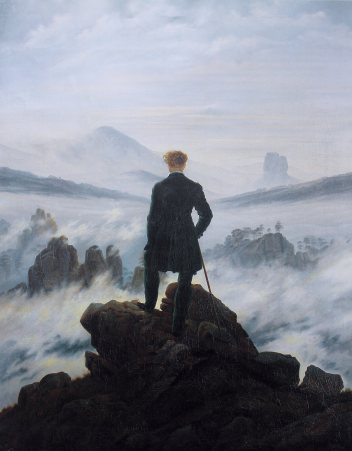
The writer about whom I write says that the painting entitled Wanderer above the Sea of Fog by Caspar David Friedrich is his favorite painting. I share it with you here:

Wanderer above the sea of fog Caspar David Friedrich

The blogger who declares his favor for this painting says he’s not sure why he likes it so much. In sharing his thoughts and feelings about this painting, this writer drew me into a conversation with the painter and the blogger who appreciates the painter’s work. This diablog is my participation in that conversation. I believe that the conversation is among all of us who sense within us the imagination of an artist and the heart of a lover awakening. I invite all with whom this diablog resonates to feel this awakening presence and savor it as our renewed awareness of the interconnecting synergy of wholeness that is within each of us. It is not necessary that we all feel the same emotions on account of viewing and interacting with this painting. That it invokes emotions is what we have in common. The heart that feels! That is the holy ground to which Browning referred as the place where taking off our shoes seems an apt response, just as it did to Moses in the presence of his burning bush. Our hearts leap up aflame with emotions at the presence of fresh, creative possibilities radiating from the Mystery when life calls us to turn aside to see what’s going on that is out of the ordinary and unconventional – above and beyond the sea of fog.

Our minds are curious to see and learn more when the Mystery draws us in by our hearts’ desires and passions. Our hearts require us to turn aside. We may have been wandering a long time or a short time, but as wanderers we are seeking, consciously or unconsciously for answers to Life’s Mysteries. When the Creator speaks, our hearts respond. For any of us, another artist may be the Creator’s voice in whatever medium the artist works. Wanderer above the Sea of Fog may serve as one of our burning bushes if it speaks to us. We may turn aside to contemplate it, seeking to comprehend why it speaks to us and what it is saying that so intrigues us. In that moment, we may identify with being the wanderer who sees a vista within our imagination populated with pinnacles of clarity above and beyond the more common fogginess among which we spend most of our days. We stand transfixed by the vision we have stumbled upon. We have been climbing uphill in our wanderings, aware that we were struggling upward and yet not knowing what we might expect to find. Suddenly we are no longer a mere wanderer. We have become a wonderer in the Presence of the Divine Mystery that awaits all who seek to see above the sea of fog that otherwise hampers our vision.

Suddenly we see both the fog that had hampered our vision and the vision we’d not known to expect but which drew us relentlessly onward and upward nevertheless. Blind wandering in response to our heart’s desires becomes an amazing sight before which we stand in awe, transfixed as we take it all in as best we can. We recall dimly the way we came to reach this pinnacle experience and are uncertain how we’ll descend again. We cannot go back the way we came. We must somehow move forward, most likely back down the other side once more into the sea of fog – for leaping from pinnacle of clarity to pinnacle of clarity seems impossible. Yet, we cannot forget the vista we’ve encountered or dismiss the power of our imagination to capture and be captured by it. We are one with the vista and its novel clarity. It is ours, we are its. We are the vista and it is us. We’ll never be the same again. Having awakened we must remain awakened no matter how the sea of fog once again surrounds us and clouds our vision. We remember clarity of sight. We now know that it is possible. We stumble onward hoping that future opportunities to climb will present themselves that we may again see with clarity, the clarity that only heights confer.

Can we be sure of achieving a height again? Do we want to achieve it the same way twice or is there a natural high we seek beyond the ones we may have stumbled upon before? What enhances clarity and what does not? We are learning as we wander. We are becoming the Eternal Wonderer. In time and space we wander while in Eternity we wonder. Having once connected with the Master Artist whose Master Artwork we each are and remembered, we cannot forget again. We carry the memories of past encounters with the Divine as it has spoken to us and feel the power of its inspiration ever drawing us forward as we wander along life’s convoluted pathways in search of the being who we are and the Being from whence we came and to which we return. We seek to return to oneness with ourselves and all Creation and with the Creator of all that is alive and well. We are Love’s emerging Presence in an unfolding realm of Love that has no beginning and no end. No sea of fog can obscure that Truth forever.

© Art Nicol 2015


Trump or Triumph?

Let us be grateful to Donald Trump for his exaggerated display of the political option. Maestro Trump magnifies what is true of all politicians – that each seeks to cater to a slice of voters by matching the voters’ prejudices and playing on their fears. Lincoln said it this way, “You can fool all of the people some of the time, some of the people all of the time but you cannot fool all of the people all of the time.” Recognizing this wisdom, political candidates generally seek to cater to a collection of slices of the voters who remain fooled long enough to vote the candidates into office. After the election, the need to keep the slices fooled diminishes.

Relying upon the shortness of voters’ memories and their lack of attention to issues that really matter, when the next election cycle comes around, politicians can engage in the same process all over again. Being caught in their irrational incongruities (sometimes referred to as “hypocrisy”) rarely deprives a candidate of office. (A scandal that the media finds juicy and marketable may deprive a candidate of office, but not hypocrisy, which is so commonplace as to merit little media attention.) In fact, being an accomplished juggler of inconsistencies often merits ascension to a higher office. We can be grateful to Mr. Trump for not making much of an effort to conceal his contempt for voters who actually try to think about deeper issues that matter and remain determined to build upon their understanding from election to election rather than remain focused on superficial issues and reboot their thinking each election cycle. Such thoughtful voters may be too tiny a minority to sway any election.

Is there an alternative to candidates’ trying to out Trump each other? Yes, but it’s not a political alternative. It won’t get a candidate elected to office. It’s more likely to get him or her scorned, ostracized and crucified as it did Jesus. The true alternative to Trump is Triumph. The small difference of two letters and the hugely significant qualities they stand for make all the difference in the world towards which each candidate leads. The spiral of Trumping and overtrumping leads followers into a ditch down one side or the other of the slippery slope of self-deception. These ditches are mirror images of each other, more similar than dissimilar. They represent the lower reaches of humanity’s decline, the lowest common denominator upon which fractions can be added to achieve temporary political alliances and win elections. “On which side do you stand?” is the politician’s primary question in wooing voters. “Into which ditch do you want to head with me in opposition to the ‘others?’” would be a more candid way to put the question, but candidates rarely are that candid.

The alternative Jesus presents heads in triumph along the high ridge formed by a chain of mountaintops beyond the downward sliding world of politics where “others” oppose each other to gain the power in an “us” vs. “them” worldview. In the mountaintop perspective of mystics (among who Jesus is a prime example), all humanity is one, not composed of oppositional factions but unified by truth and love as one divine family. Jesus lived the mystic’s alternative in which he believed and demonstrated the nature of its power to comfort, heal and bless everyone inclusively as each person chooses to repent of the politically oriented power-grabbing of his or her ego and surrenders instead to the power of God’s grace, mercy and love. As individuals lay their issues at the feet of Jesus, he accepts them as sisters and brothers regardless of what lifestyle they may have led before deciding to put their faith in him. In response to their repentance and surrender, he gives them new life beyond the ego’s false idols and substitutions for life as God created Life. What Jesus gives he gives from the Father from whom all good gifts come. Jesus shares generously all that he has received from the Father of us all. What politician offers that resolution to the issues that plague humanity with divisive violence and grief?

The “i” missing from Trump stands for “integrity,” a quality of life that embraces wholeness of person and shalom of heart and mind. This quality Jesus embodied and offers even now to help each of us embody. The “h” missing from Trump stands for “humility” and “honesty,” two qualities absent from the ego’s orientation and an anathema to political success. Humility coupled with honesty would require that most candidates simply withdraw from attempts to win voter approval to be a leader. It would require admitting that neither humility or honesty is popular among the masses and will not win votes. Voters tend to prefer leaders who are committed to arrogance and ignorance instead so that voters might be confirmed in their similar commitments. It is so much more convenient to formulate off-the-cuff opinions and vote according to them based on ignorance than to do the homework necessary to generate a deeper understanding and vote according to it. It is also more convenient to copy the answers off of another’s answer sheet, especially from one who seems to have the approval of the crowds, than to formulate an answer after much inner scrutiny and self-examination to identify and release internalized prejudices and fears that otherwise sway our choices.

Let us be grateful to Mr. Trump for clarifying just how lacking in integrity, humility and honesty we prefer our political candidates and the political process to be. We no more want a leader who holds us up to high expectations and ideals than we want Jesus to be Lord of our lives. Let us admit that we prefer to be rescued time after time from our individual and collective social follies as we hope Jesus will save us time after time from our spiritual ones. Who among us wants the burden of integrity, humility and honesty thrust upon us all the time? If one takes such ideals seriously, one becomes exceedingly unpopular in a world driven mad by ego’s internal conflicts and insatiable cravings. Who wants to take seriously the notion that to be great one must serve in humble positions and care about the powerless and weak at least as much if not more than about the socially elitist powerful? Who really wants to be assassinated like Martin Luther King Jr. or Gandhi because we held ourselves to higher ideals of excellence in service to the masses than the masses can tolerate considering for ourselves?

Let us be kind to Mr. Trump. He is serving God’s grand purpose to remind us that there is a clear choice to be made between ego and God. The ego darkens our lives with insane ideas that eventually reveal themselves to be absurd. God enlightens our lives with the only true alternative of sanity so that the truth might set us free.  Mr. Trump is doing us all a favor by publically displaying the extreme limits of absurdity and insanity so that we not mistake the political race for the race of which a devoted disciple of Jesus wrote long ago as recorded in 2 Timothy 7-8: “I have fought the good fight, I have finished the race, I have kept the faith. Now there is in store for me the crown of righteousness, which the Lord, the righteous Judge, will award to me on that day—and not only to me, but also to all who have longed for his appearing.”

Let us long not for Mr. Trump’s or any political candidate’s appearing but rather for Jesus to return as Lord to rule the Earth with love and cause mercy and justice to roll down from the heights of Divine Glory to satisfy all who hunger and thirst after righteousness as God defines the term. In doing so, let us also be open minded about the meaning of that term and not claim to tell others what God means by it. We may all be surprised to witness what it means when God thanks Mr. Trump for his bumbling service as a contrast to Jesus’ Triumph. If God did not work through imperfect instruments and have a sense of humor coupled with all-prevailing grace, which of us could claim to serve Him/Her or have any hope of heaven?

© Art Nicol 2015


Going Beyond Out of Our Way

“Only those who will risk going too far can possibly find out how far one can go.”  T. S. Eliot

When you go out of your way to care for another person, is it possible to go too far?  How might you know that “too far” is?  If it’s inconvenient to go out of your way for another person, is convenience the limit and inconvenience where you draw the line?  What is it OK to risk when you go out of your way for another person and what is too much to risk?  Let’s agree that love calls us to take risks in caring for others. Let’s agree that it’s not always convenient to care for another person as love calls us to care and that there will be times when it’s right in love’s eyes to go beyond convenience and extend ourselves into come degree of inconvenience.

Let’s examine the limit to which love calls us to go and acknowledge love’s power to call us to go farther than we might at first imagine.  I suggest that Eliot was correct to note that taking the “risk of going too far” is the only way you or I will discover how far love goes and is ready, willing and able to take us along with it.  In my investigation of love’s limitless nature, I’ve become a radical explorer of the nature of love.  I confess it.  Don’t expect me to argue in favor of setting limits on love’s expression in your life or mine.  I genuinely believe that our tendency to set such limits is precisely why the modern world has become as bogged down in fear, violence and suffering as we have.  Think about it.  If it’s true, as John wrote, that God is love (God = Love, for math fans), then any practice of setting limits on love is the same as setting limits on God.  How is that possible?

How could you or I set a limit on God?  It’s actually quite simple.  We can set a limit on God because God gave us the power to do so.  God gave us free will.  Free will gives us the power to choose between setting God (love) free to be fully expressed in our lives and in the lives of others or setting limits on that expression.  God has already chosen to express the Divine Power of Life and Love in and through your life and mine as fully as we’ll allow.  His/Her choice is made in Eternity and stands forever.  Our choices are made in the realm of Time and Space and can be made, changed and changed again until we discover a choice we never want to change.  The tendency in the modern world, where material values are given greater influence than spiritual ones, is to allow our fears to set limits on the influx and outpouring of love throughout our life experiences.  Our fears set very restricted limits to keep us feeling “safe” within our familiar territories.  In fact, to make sure we’re feeling safe, our fears tend to gradually shrink the territories within which we are willing to take risks and prevent us from even thinking about “going too far.” Thus it is by fear’s logic we never come close to discovering how far we can go if we were to exercise more courage.

In our ego-trained, fear-based orientation to the modern world, we’ve been taught to take a risk that I believe is now haunting us.  We’ve been taught to take the risk of setting severe limits on God and the expression of Divine Love.  We’ve been taking that risk for so many generations that it is now the social norm and heavily reinforced by social approval.  It’s unlikely that anyone told you or me that we were being taught to place limits on God (Love). The ego is not that honest in its dealings with us.  It’s actually quite deceptive and likely to claim that we are being as loving as we need to be or even can be when we do only what is socially approved of.  It’s likely to teach us to believe that social approval sets the proper limit on love that keeps us safe from going too far.  Too far where?  In the ego’s frame of reference, too far out of bounds to risk being thought of as foolish and naïve and subjected to ridicule.  Too far out of bounds that we risk losing the approval of those whose opinions of us we value most.  Too far out of bounds that we risk being hurt and feeling deeply in our hearts in ways we’ve been taught to avoid.  Yet, suppose you or I were to reverse the risk ratio and take the risk of defying social approval and exploring beyond conventional definitions and expressions of love.  Might we encounter more of God and Love “out beyond social norms?”  Might we enter into the realm of mystic experiences to which Rumi referred when he said:

“Out beyond ideas of wrongdoing and rightdoing there is a field.  I will meet you there. When the soul lies down in that grass, the world is too full to talk about. Ideas, language, even the phrase ‘each other’ doesn’t make any sense.”

Damn these unconventional poets!  Why don’t just they leave us alone?  I suggest that they are heaven sent. I suggest that they don’t leave us alone precisely because God knows that “It is not good for man to be alone.” (Genesis 2:18 NIV)  Poets, lyricists, writers of fiction, composers, dancers, choreographers, painters, sculptors and other artists stir our hearts to take second looks at what the ego has taught us and encourage us to consider changing decisions we might have thought were unchangeable.  Artists express the divine grace that may soften our hearts and allow us to rethink a “conclusion I concluded long ago.” (A Puzzlement from The King and I)

As a believer in Jesus, I tend to take a look at what his teachings by word, deed and lifestyle say about issues that haunt me.  As I realized that decisions I had made under the influence of ego-based teachings were haunting me, I gradually awoke to the reality that Jesus did not usually agree with the ego’s teachings – if ever he did!  He was definitely an unconventional person.  He did not seem to worry much about social approval, winning popularity contests or catering to the social elites of his day.  He was not running for office or trying to win a job or a life-partner’s attention and affections.  He was focused on identifying God’s will in all things and then taking the risk of going too far – at least in the eyes of others.  Gradually Jesus’ ideas, actions and model of lifestyle came to influence me more and more.  To emulate him I began to shed the common excuses given for not going too far.  Some said he was God and, since the rest of us are not God, then of course we cannot go as far as Jesus went in caring about others.  He intentionally hung out with folks others did not approve of and avoided at all costs. He seemed to not realize that they were of a different class and (supposedly) looked down upon by God. Jesus went so far as to wind up hanging on a cross as a vilified criminal and endured shame, pain and other unsavory features of human life on his way to death.  He could have avoided all that.  But would he have honored God and Divine Love if he had?  How could he demonstrate how far we can go if he had not gone beyond death to return as an expression of the Eternal?

Is it true that Jesus was so different from you or me that we can excuse ourselves from taking the risk of going too far in following in his footsteps?  What if he were actually the same as you and I? Suppose whatever identity with God Jesus had and has we have too? Suppose the fact that we’ve avoided going too far is actually the only reason we don’t know how identified with God we are!  Suppose that when Jesus prayed that his followers would know oneness with God as he knew oneness (John 17: 20-23) that he meant precisely that and that his prayers are answered once we quit setting limits on God (Love). Might God be ready, willing and able to show us our oneness with the Divine once we say “Yes, here I am, send me?”  Are we afraid to be sent “too far” and never come back to where we’ve been?  Are we afraid that an encounter with God will change our outlook on life and our choices forever?  The ego is afraid of that outcome.  We need not be.  In our heart of hearts we are hungering for such an outcome.

Radical nonconformity to the ways of the world includes taking the risk of going too far in the ego’s eyes.  Yet it also opens the door to risking that Love will flood in and never stop sweeping us away into greater and greater adventures as well as ever increasing capacity to share Divine Love with others.  Might our hunger for adventure and love never be truly satisfied until we take this risk?

How radical is love as Jesus’ followers believe it to be?  Let’s check out the oft-quoted follower whose writings appear in the Bible as letters written by Paul.  Let’s quote him not for ideas he clung to about how to set limits on God’s Divine will but for ideas about “going too far” in embracing God’s will.

Here is how this eloquent writer spoke about love:

“If I speak in the tongues of men or of angels, but do not have love, I am only a resounding gong or a clanging cymbal. If I have the gift of prophecy and can fathom all mysteries and all knowledge, and if I have a faith that can move mountains, but do not have love, I am nothing. I f I give all I possess to the poor and give over my body to hardship that I may boast, but do not have love, I gain nothing. Love is patient, love is kind. It does not envy, it does not boast, it is not proud. It does not dishonor others, it is not self-seeking, it is not easily angered, it keeps no record of wrongs. Love does not delight in evil but rejoices with the truth. Love never fails. But where there are prophecies, they will cease; where there are tongues, they will be stilled; where there is knowledge, it will pass away. For we know in part and we prophesy in part, but when completeness comes, what is in part disappears.” (1 Corinthians 13:1-10 NIV)

Regardless of how eloquently Paul spoke or wrote, he admitted that words lacking in love’s true essence were hollow, pointless and powerless.  He acknowledged that all of the partial understandings he might gain about the truth about love would dissolve in the presence of “completeness” or wholeness perfected by God.  Paul took the risk of going too far in following Jesus beyond Paul’s (Saul’s) previous life of social conformity and of meeting the expectations of those higher up the ladder in his religious institution.  His daring risk-taking brought him into conflict with the very authority figures he’d once tried so hard to please.  He became an outsider to the social club within which, earlier in his adult career life, he’d worked so hard to qualify for membership.  Traditionalists scorned him as a maverick who’d lost his way instead of honoring him as a master student of their long-awaited Messiah’s Most Excellent Way.

Today many traditionalists selectively quote Paul’s writings when he espoused the preservation of beliefs and practices prevalent in his day, beliefs and practices he’d not yet realized were interfering with the evolution-revolution Jesus had set in motion.  Yet, it remains worthwhile to glean wisdom and guidance from Paul’s experiences in his transformation from Saul who had once persecuted followers of Jesus into Paul who himself followed Jesus.  The man who had persecuted became one of those he’d previously persecuted.  Pretty radical change of heart and mind!

How did Paul address this issue of radical nonconformity in going too far?  He addressed it directly by writing:  “Do not conform any longer to the pattern of this world, but be transformed by the renewing of your mind. Then you will be able to test and approve what God’s will is—his good, pleasing and perfect will.” (Romans 12:2 NIV)  It’s instructive that Paul tied “going too far” with demonstrating God’s will.  Might that be the point of your life as well as mine?  Each of us in our own way may have the divine opportunity to prove that God’s “good, pleasing and perfect will” is to share Divine Love for all of us with all of us, without exception or exclusion no matter how much pressure socially conformist thinkers place upon the question of the limits of God’s love.  If God loves the previously-hidden but now more-boldly-emerging nonconformist maverick in each of us, then going too far to be true to ourselves as children of God is not possible.  Even the sky sets no limit on how far we can discover we can go – if only we let go and let God be God as we let ourselves go far afield beyond the limits of social approval to belong exclusively to God.

The sky does not set limits.  It invites eagles to soar and not have to seek safety near the ground.  Love likewise invites us to soar to the heights above life’s storm clouds and risk having gone too far.  Our wings will not melt off, for they are not attached with wax.  They sprout from within the energy field of the divine love that radiates through us as it lifts us ever nearer to the heights of heaven.  Some call this falling upward.

© Art Nicol 2015

Cancer in the Body of Believers in Jesus

Cancer begins as a few cells rapidly multiply without the purpose-driven orderly structure that controls the growth of healthy cells elsewhere in the body.  These rapidly multiplying, disorderly cancer cells form masses of tissue we call “tumors” and may eventually spread throughout the body to generate out-of-control cell-production that proves contrary to the purpose of the host organism.  Once the cancerous cells populate too much of the host organism, death looms as the original life-purpose of the organism is lost amid the disorderly purposelessness of the cancer cells.   Cancer is characterized by a disconnect between the main organism’s life-oriented purpose and the process of cell production and tissue regeneration.  Some people say that cancerous tumors “grow.”  But if the term “growth” applies only to orderly cell production that aligns with the life-orientation and purpose of the main, overarching organism then cancerous tissues do not grow.  They merely expand in a disorderly fashion that mimics growth but does not contribute to life.  Once the main organism’s health declines enough to bring about death, even the cancer cells die. They have sabotaged their host to their own detriment.

If Jesus’ institutionalized Church is Christ’s body of believers on Earth then what might be the cancer that is causing the Church’s decline and bringing the body of believers nearer and nearer to disintegration and ultimately death?  I suggest that the cancer can be spotted in every idea and resulting practice that disconnects the Church from the life-oriented purpose God gave it through Jesus.  Ideas and practices not in alignment with the God-given purpose of the Church are generating cancerous cell-production throughout the Church that mimics growth but does not contribute to the life of the Church as God defines that life.  These forms of illusory “growth” are sabotaging the Church and contributing not to its life but rather to its decline.

I believe that God is working through paths of faith other than the one associated with Jesus. Be that as it may, I’m devoted to the path of faith along which Jesus has sent the Holy Spirit to lead all who believe in him.  As a believer in Jesus, I seek to hear the leading of the Spirit within my heart and to heed its guidance and honor the wisdom it transmits to faith-oriented believers in Jesus.  I accept without qualification Jesus’ promise to send the Holy Spirit to lead us into all truth.  John 16:13.  That is why this article is devoted to spotting the cancerous ideas and practices at work within Christ’s Church rather than focused upon the possible shortcomings of other paths of faith.  Until the Church of Jesus Christ has submitted itself to healing of all cancerous ideas and practices at work within it, it is in no position to point out the possible ills of other paths of faith. The Church must allow the Holy Spirit to point out and remove logs from its own eyes before it tries to point out splinters in the vision of other paths of faith.

To whatever extent any other path of faith may be failing to adhere to God’s purpose and plan for that path of faith, it is the responsibility of faithful adherents to that path to assess those shortcomings and take steps to rectify them from within the borders of that faith as a follower of that faith. Within the body of believers in Jesus we have our hands full addressing the ills of Christ’s institutionalized Church and cannot afford to cast our eyes upon other religions or paths of faith until we’ve resolved all of our own issues between us and God.  That is to say that the fact that I take up the task of identifying some of the Church’s blind spots does not imply that there are none present in other paths of faith.  It means only that I adhere to the principle of the Fourth Step of the 12-steps and suggest that believers in Jesus must focus on taking our own inventories and repent of our own ill-conceived ideas and sabotaging practices that have led to the decline of the Church at large. Once we’ve humbly submitted to the Holy Spirit’s removal of the logs from our own eyes, we can seek God’s guidance about what to do next with our clarified vision.  In the meantime, to honor Jesus as the head of our body of believers, we need to refrain from violating his principle of not judging others.

In this article I do not pretend to present an exhaustive list of the ideas and practices rampant within Christ’s Church that are proving to be cancerous.  I intend here only to highlight a few so as to contribute to a dialogue within the Church that may lead the Church, its leaders and its members of all stripes and flavors to humility, repentance and healing.  I believe that the process God calls us to engage in is akin to the repentance that Jonah’s message to Nineveh invoked.  Ideas and practices not aligned with God’s holy purpose for the body of believers in Jesus are “wickedness” (failure to adhere to holiness) in the eyes of God whether or not they qualify as “wicked” under popular definitions of the populace at large. If God’s people who are called by His name desire with all their hearts to see the world healed of all forms of violence and oppression and the resulting harm, we must heed God’s definition of “wickedness” in order to humble ourselves before God and participate fully in the conditions that permit healing to flow from God unlimitedly.

In saying that I have identified a few of the Church’s misalignments with Jesus’ directions to his followers is not to say that I mention them in order of significance or priority or have cited the most important ones.  To contribute to the dialogue about Church-wide humility, repentance and healing, I cite only these for now:

  1. The error of judging people of other faiths, as mentioned above. We are not qualified to assess from beyond the borders of any other path of faith how that path of faith is best lived. That is an internal affair as to which responsibility rests with those who claim that path of faith
  2.  The error of citing quantifiable statistics as signs of growth while measures of quality are neglected. When quantity is valued over quality, the Church has dropped the ball that Jesus handed off to the Church. Throughout the Scriptures referenced by Jesus and the Church are many passages indicating that God is more concerned about the quality of life people are experiencing than about the quantity of people who are claiming to believe in Him. God has often preferred to rely upon a few people to accomplish His goals than to rely upon great numbers to prove His significance. In short, God is not concerned with social approval ratings as if God is a politician or Earthly monarch. God does not put His mind upon the things of man. God puts His mind upon the things of God whether or not humankind approves of God’s values, ideas or priorities. For the Church to express God’s orientation, the Church will have to stop catering to social approval, no longer seek to amass quantities of members or money and focus on God’s values, ideas and priorities. To measure the success of the Church by numbers is to measure by the same measurements attributed to newly released movies or TV shows. Audience ratings are not symptoms of the health of the Church except to the extent that high popularity may be a symptom of poor health. Ratings measure the cancerous illusory “growth” and call it admirable. Not so in God’s eyes.
  3. The error of measuring the quality of a believer’s faithfulness to Jesus by the financial prosperity or social popularity of his or her lifestyle. By his example, Jesus revealed the true measures of a believer’s life while he was on Earth. He was neither financially prosperous nor popular. In fact, he allowed himself to walk through life with few possessions and admonished his followers to do likewise. He traveled light but he did not travel far. He remained focused on a relatively small territory of personal concern rather than roam throughout the wider territory using means of transportation then available to him. Today the industrial/technological world has developed means of transportation that enable humans to travel the globe. The Internet empowers our minds to travel everywhere at any time. The practice of traveling widely is promoted by commercialism and mass media as “good.” Good for what? Good for profit-making by purveyors of travel-related services, including the marketing industry. Good for allowing those with wealth to congregate as mutual admirers around the globe and fancy themselves to be participants in a diversely multicultural world when in fact all they are doing is sharing their escapist activities and self-indulgences with other members of their economic class while remaining indifferent to the plight of other classes. I suggest that God disagrees with the standards of the world on this point and prefers that believers focus on local concerns in-depth, moving among all economic classes and other indices of human diversity as Jesus did, rather than spread themselves so thin as to have little significant, long-term impact on anything anywhere. Jesus impacted the lives he touched in significant, life-transforming ways (called “miracles”) and predicted that those who were his true disciples would do likewise, even having greater significance and impact than he had. Jesus was able to perform miracles because he developed relationships locally and allowed the least of these in his locality to have access to him personally. Although he participated in discussions with elites and allowed himself to be interviewed from time to time by representatives of the media of his day, he did not make a priority of doing so. Instead he remained directly accessible to the masses and most importantly to individuals who separated themselves from the masses to approach him one on one. In interacting with Jesus’ energy personally people were brought to faith and offered opportunities to act upon their faith to receive miracles of healing. The Church’s mass-media-influenced values and priorities today turn Jesus’ values and priorities upside down.
  4. The error of catering to worldly powers rather than serving those that worldly powers look down upon, exploit and oppress. The Church has become an apologist for those who wield social power instead of being an advocate for those the powerful disdain. Nowhere in Jesus’ model of life to which he called his disciples did he serve in the role of sycophant to the elites or aristocrats of his time. Moses set captives free. Jesus set captives free. For the Church now to cater to those who hold powerless people in captivity is an anathema to the Father who loves all of us. The modern world is awash with captives of all kinds. Many workers around the world are held captive in one way or another by their employment’s meager returns and harsh conditions. The worldwide trade in sex-for-money in all its forms imprisons participants on all sides of these transactions within walls of secrecy and shame. To help build prisons and justify their existence rather than to visit prisoners and help them never to return to prison ignores one of Jesus’ most strident quality control standards for his followers. To fail to invest its all in helping the least of these to take up lifestyles of freedom and no longer risk going to prison, being homeless or exploited or going without the necessities of life, including personal dignity and the capacity to provide for one’s children, indicts the modern Church.

Christians believe that God’s nature and priorities were expressed in a physical body through Jesus and that Jesus intends the Church as an institution to continue to express God’s nature and priorities.  After starting out so well in Jesus’ life, it may be hard to understand how Christianity drifted so far afield from the truth he promised would set us free.  But it’s vital that we admit the drift and correct the errors if ever we want to allow the truth to set us free from mistakes humans made in the past.  Self-examination, repentance, correction of errors and granting and receiving of forgiveness are not the ego’s talents because these disciplines to which Jesus calls us are expedited by humility and resisted by pride.  So long as spokespersons for Jesus filter their information through the ego and water down their ideas and their experiences – their principles and their practices – to suit their egos no significant correction will occur and the power of forgiveness, once so radically illustrated by Jesus, will remain stillborn.

It is essential to rise free of and beyond the ego to correct the errors that the ego has so diligently preserved.  Overcoming the ego is what the passages in Chapter 3 of Revelations beginning with “He who overcomes shall” refer to.  By the power of diligent self-examination, change of mind and forgiveness of errors, we can join together to resurrect the Church from the tomb into which popular opinion has shoved it by crying out for the crucifixion, censorship and silence of minority members of the Church who have called the Church to account for its harm.  It is a mistake to focus on errors as guilt-and-shame-ladened “sins.”  To encrust our errors with barnacles of guilt and shame only makes them all the more difficult to acknowledge and shed.  Let’s stop adding to the difficulties of the task of resurrecting the Church and simply let Jesus call us forth from the grave as he once summonsed Lazarus, as a friend he missed and wanted to see alive again.  We are each Jesus’ friend, no matter how far we may have gone astray.  He has not forsaken us.  We need no longer forsake him.  By God’s grace, we have the power to redeem our error-prone lives and live lives renewed by forgiveness and mercy and overflowing with liberty and justice for all.

The Church’s healing from spiritual cancer awaits us as individuals who accept healing on behalf of the whole.  The healing begins one by one and gains momentum as the healed ones gather as a healed body of believers.  Healed twos become healed threes, fours and so forth until the heart-count becomes too numerous to quantify.  There is no need to count because once we are healed we are all one.  When Jesus calls you to join the healing movement by submitting yourself to its heart-cleansing flow, remember that you as an individual do not need the permission of anyone else to participate in the healing. All you need to do to respond to Jesus’ call to be healed is to declare with all your heart, mind, body and soul, “I can, sir,” in the face of the Church’s cancer.  As we each do our part as Jesus did, God will do the rest.

© Art Nicol 2015


Social Justice Implications of Jesus’ Prayer for Oneness

Jesus’ prayer for all believers to know oneness with God is recorded in the 17th Chapter of John.  As is always the case with Jesus’ ideas, they interrelate and cannot stand apart from one another.  His thoughts form a complete system of thinking that is rooted in the integrity and holiness of God.  Although we may reasonably challenge the authenticity of some quotes attributed to Jesus, the main point of everything Jesus in fact said and did while present in a body on the Earth was to demonstrate “that you may believe that my Father is in me and I in my Father.” John 10:38.  This core theme of oneness with God, repeated in Chapter 17 of John, echoes throughout Jesus’ ministry as he constantly questions the standards used by others to separate “good” people – who are supposedly worthy of social approval and warm welcome by God and the people of God – from “bad” people who supposedly deserve only disapproval and avoidance or exile if not outright attack – by God and the people of God.  Its implications ripple outward into his call that his followers treat the “least of these” as if they are one with him – so totally identified with him that what a person does to any of them a person does to him.

Jesus’ life, by word and deed, reminds us that we are all one within God and with each other because we are all (each and every one of us!) created in the image and likeness of God, expressing God’s divine nature.  Long ago, a fundamental flaw crept into Christian theology when elitists bent on accumulating power over the masses adopted the concept of “original sin” or “inherent flawedness.”  This transparent lie helped to keep the masses controlled by their constant fear of being condemned by God, for whom the elites conveniently claimed to speak to the terror of the masses who already feared the elites.  The elites equated their neglect and abuse of underlings with the way God saw and treated humanity. How convenient to claim to speak for God to justify one’s own cruelty!  What a complete undoing of Jesus’ ministry to call believers back to the religious self-righteousness of Judaic elitism with which Jesus so fervently contended.

The concept of “original sin” is such an insulting idea in its disparagement of God as Creator that Jesus has to constantly serve as Redeemer to correct it.  We who faithfully struggle with how to relate to God need a Redeemer only because we believe false ideas trumpeted in the marketplace by those who hog the soapboxes and pulpits as socially aggressive personalities who crave social approval so much as to demand that they set the standards for social approval. They are like bullies who take over the clubhouse and declare that they now can ban whomever does not please them.  As their craving for political power as a false substitute for spiritual power corrupts their minds and hearts, these religiously garbed bullies do all they can to lead others astray with them. How else would they have followers if not to lead them to embrace the same errors that bullies embrace to justify their dominance? Those who question such absurdities are colored as heretics and blasphemers and made to serve as martyrs and scapegoats for religio-political heroes/bullies.

Who sets the standards?  Man or God?  Woman or Goddess?  Jesus says that his (and our) heavenly Father* sets the standards. He modeled that truth so radically that he submitted his own lesser will to the greater will of the Father even unto death on the cross so as to demonstrate the power that arises from Oneness lived to its most radical extreme. We are called today to do likewise, but few are willing to endure the merest hint of social disapproval (let alone the public humiliation of a cross-hung criminal) to do so.  We mistakenly keep expecting religio-politicians to approve our “deviations” from their critically acclaimed social norms and flinch when they disapprove instead.  How timid we are compared to Jesus and his original disciples!  As a result we cling to our pathetic powerlessness and declare that the age of miracles has closed when in fact it is our own timidity as disciples that has caused miracles to cease to flow.  We are the cause of the lack of divine healing in the modern world.  We thwart God’s will by failing to surrender our lesser wills entirely to the Father’s will as Jesus modeled.  God’s grace permits us to defy Him but to do so costs our children dearly.  Violence, harm and chronic suffering flood our modern world in place of the outpouring of divine miracles God stands ready, willing and able to set free if only we’d listen and heed His call.  Long ago He said it, “[I]f my people, who are called by my name, will humble themselves and pray and seek my face and turn from their wicked ways, then I will hear from heaven, and I will forgive their sin and will heal their land.” 2 Chronicles 7:14.  God is entitled to set conditions for our receiving His blessings.  He has clearly stated those conditions in many ways.  Jesus’ example is an entirely integrated and sufficient restatement of all God wants us to know about how to relate to Him.

Why does Jesus direct us towards serving the “least [familiar or approved] of these?”  Why relate to the “stranger” or the “disapproved social outcast?’  Because the more we embrace the stranger in the other person, the more we’ll have opportunities to get to know the stranger in ourselves and accept ourselves more completely too.  And the more we relate to ones who society has labeled as rejects the more we’ll come to accept in ourselves aspects that society would also reject if we were brave enough to reveal them.  We have maintained social approval at the cost of utter honesty about ourselves and our own hidden issues, whatever each of ours may be.  As a result, we’ve also cut ourselves off from the divine love that the Father would have us experience uninhibitedly, without fear or limitation.  We crimp the flow of God’s love by making false idols of social approval in all of its various forms and formats.

It’s all a developmental thing actually.  The human race’s diversity expresses more than mere diversity of surface appearances and actions summed up as “images,” “lifestyles” and “cultures.”  In addition to expressing our demographically measured diversity of gender, age, race, ethnicity, national origin, religious affiliation, sexual orientation, educational level, economic class, veteran status, etc., humanity also expresses our developmental diversity.  We are all arrayed along steps or stages of development as each of us has achieved some steps or stages ahead of others.  With respect to the multifaceted range of human wholeness God designed us to master, most if not all of us are as yet incompletely developed or evolved.  Since we develop in response to our social environments, we tend to develop different facets of our gemlike wholeness on different timetables depending upon the social environments to which we have been exposed so far.  (Do we not sometimes say, “He is a product of his environment?”)

For this reason, when we encounter a “stranger,” he or she is “strange” to a significant degree precisely because he or she has been exposed to different social environments or conditions (families, cultures, etc.) than we have.  We encounter the effects of those different social environments as embodied in and expressed through the “other” or “stranger.” Yet if we were totally honest with ourselves we would say, “There but by the grace of God go I.”  We’d admit that we would be much like the stranger had we endured the social environments and its conditioning through which he or she has evolved.

Each person we meet offers us another opportunity to learn more about ourselves as we might be had we lived a life different from the one we’ve lived so far.  Those opportunities offer insights into our wholeness because they reveal aspects of ourselves that our current or previous social environments may not have mirrored back to us before so powerfully or at all.  And we tend to mirror for the other person in each relationship similarly helpful feedback about himself or herself.  When we mirror feedback consciously without judgment or fault-finding, we are lovingly nurturing each other.  We are learning to walk in each other’s moccasins with empathy and compassion.  The social environment of lovingly nurturing each other with gracious feedback is the kingdom of God Jesus represents and encourages us to enter into – seeking first God’s righteousness and no longer asserting our own (inadequate!) self-righteousness.  That God’s righteousness is infused with grace and mercy is a lesson we need to learn by heart until we master it.  Meeting and serving strangers so as to be their gracious hosts affords us opportunities for such mastery.  Through practice, our mastery of hosting strangers empowers us to rise beyond xenophobia and learn to welcome each supposed “other” as a sister or brother – no longer a stranger at all.  The same benefit to ourselves arises from our treating any of those least approved of by our society as if he or she were Jesus.

Jesus calls us to be servants of those we know and approve of and those we don’t know or approve of because he knows how developmentally immature we are and always will be if we remain trapped within our social-approval bubbles or cocoons.  Unless we explore beyond our bubbles (comfort zones or familiar territory) to find opportunities to serve as Jesus served, we will remain uninvolved and unevolved as well.  Within heavily defended comfort zones based on conformity, discipleship as well as personal maturity stagnates.  The world calls it “arrested development.” Constant rebirth amidst the challenges of diversity is a part of maturation as Jesus’ disciple.  Jesus’ own journey illustrates that one must never pitch a tent or set up a booth in an attempt to preserve the status quo, even one as magnificent at the Mount of Transfiguration.  For us to develop or mature progressively as spiritual beings, humility requires that we admit that we are often ignorant – not stupid but lacking in information and ill-informed.  The brightest genius can still be uninformed or ill-informed.  In humility we listen and learn – and perhaps even laugh at ourselves more readily rather than fume over every little error or non-erroneous nonconformity we or others may adopt. Jesus asks us to listen within our hearts and minds to the Holy Spirit.  That’s why he sent the Holy Spirit to be our constant Teacher as we develop greater maturity as his followers.  Even today there are things that many of Jesus’ disciples cannot yet bear to hear, as he long ago foresaw. (See John 16:12.)  Yet we can all become delightfully competent, ever-growing-wiser students of the Truth that sets us free to develop our wholeness more and more completely.

Freedom to be authentic and whole beings of integrity and love as God created us to be is scary – yet it is also the essence of social justice.  It implies letting go of social structures we once depended upon to guide and protect us on our journeys as if social approval were the only purpose of our lives.  In His quest for our highest good, our Father does not intend that those social structures with which we become so familiar during various phases of our development become our imprisoning status quo of traditions or “laws” (rules, roles and rituals).  Like the gantry of a rocket that once enabled the rocket to stand erect and not fall over while it was assembled, equipped and fueled, social structures must at some point release us to soar beyond them.  When that happens we are dependent on our internal guidance systems.

The more our internal guidance systems are attuned to God’s will, spirit, heart and mind the more at peace with God we’ll be as we journey onward in our quest for more elegant mastery, deeper enrichment and more lasting satisfaction as our Father’s servant-sons and -daughters. Those who serve with grace achieve a high orbit from which to envision and embrace the whole of humanity as God’s family of beloved and much favored children.  From that orbit it is increasingly possible to understand and live within the terms of Micah 6:8: “O mortal, what is good. And what does the LORD require of you? To act justly and to love mercy and to walk humbly with your God.”

Walking humbly with our Father as Jesus did in full surrender of our otherwise socially distorted will is essential to our acting justly as servants of social justice.  As preserved in the King James version of the Bible, we must live by faith to be just: “For therein is the righteousness of God revealed from faith to faith: as it is written, The just shall live by faith.”  Romans 1:17  Let us dare to live as it is written and as it is revealed over and over again in our hearts as we listen to the Holy Spirit and “[d]o not conform to the pattern of this world, but [are] transformed by the renewing of [our] mind. Then [we] will be able to test and approve what God’s will is – His good, pleasing and perfect will.” Romans 12:2

*Today Jesus would have no problem calling the Supreme Parent “Mother” too.  He could not do so earlier due to the social constraints of his historically first human audience with whom such a concept would have sidetracked communications too much. See, John 16:12-15 for Jesus’ explanation of his plan of sequential communication with successive audiences.

Copyright by Art Nicol 2015

The Value of a Multidisciplinary Perspective on Homosexuality

I start by offering a simple idea: The perspective of the Divine Source of All Life has greater validity and value than the human perspective of any one individual or group of human beings.  As a corollary to that idea I suggest that the more a person or group of people investigates the truth about life through the eyes of multiple perspectives, the closer to God’s vision of life that individual or group may come.  Life is God’s domain of expertise. How God looks at Life matters most.  Human experts have been investigating life with the aid of multiple disciplines or fields of expertise for centuries.  Each of these fields may serve as a lens through which to focus on the whole of life with increasing clarity, peripheral vision and depth of field as if coming to see Life as God sees It. Multiple human perspectives sharing the common unifying goal of discovering the whole truth about Life approach seeing Life from God’s point of view.  All we need to do is learn to integrate all of our investigative perspectives into a unified vision.

As we have been investigating Life perhaps, over time, we have gained ever expanding insights and understandings concerning the Divine Expertise, which we might call a realm of “Knowledge, Understanding and Wisdom.” If this is so, we must also acknowledge that we continue to investigate a Mystery of the Invisible Not Yet Come Fully into View.  As Ralph W. Sockman said, “The larger the island of knowledge, the longer the shoreline of wonder.” As we humans explore an expanding island of Divine Knowing, our exploration exposes us to an expanding shoreline of wonder about the not-yet-known Ocean that is God.  The shoreline of wonder is the paradoxical meeting place of God and humanity along which we may walk alongside God in contemplation to know all we need to know but still not be equal to God.  In fact, it may be kind of God to reveal knowledge gradually instead of all at once.  Instant revelation of All might be mind-blowing.

A common saying is that “A little knowledge can be a dangerous thing.”  That saying typically comes into play when a person who has grasped a bit of knowledge assumes that his or her tidbit is all there is to know or the main thing to know about the subject matter and then runs ahead to claim expertise and takes action based on that claim.  It is like a child’s discovering a sea shell and instantly claiming to know all that oceanographers might know about the ocean.  Problems thereafter tend to arise from that person’s lack of understanding about the broader context of his or her bit of knowledge and a shortcoming in wisdom as to what to do with his or her discovery of it.  First discoveries may be exciting but they do not tell the full story.  Sometimes problems arise from a lack of humility and a fear-based need to assert certainty because the presence of an unanswered question causes too much anxiety and insecurity.  Such is the effect of the unknown Mystery of Life upon people who are afraid and allow their fears to dominate their thinking. Yet fears need not run roughshod over reason for those who have faith in God’s power to lead us into all truth step by step if we are willing to follow courageously and compassionately with open hearts and minds.

To illustrate the value of looking at any topic from more than one perspective or field of expertise, let me address the controversy over what use humans might best make of passages of Scripture from any Sacred Text in addressing social issues.  Let me bring this illustration into sharper focus by making it more concrete: What use might humans best make of the passages of Scripture from any Sacred Text that address how to relate to fellow humans who are not (or may be suspected to be not) purely heterosexual?  Please note that I’m not phrasing this issue as “The Gay Issue.”  Why not? Because studies of human sexuality reveal that human sexuality is diversely arrayed along a continuum of sexual orientations from exclusively heterosexual to exclusively homosexual and that even the idea of identifying a permanent place along the continuum may be misleading because human sexuality may be fluid and not fixed.  This point itself illustrates the value of incorporating multiple disciplines or fields of expertise into the mix so that one does not inadvertently adopt a mistaken assumption into how one phrases an issue under consideration.  There’s more to the story than a simplistic dualism between two opposite polarized sexual orientations. That is, it’s not “Gay vs. Straight.”

I will assume for the moment that most people believe that the majority of human beings are purely heterosexual and that a small minority have some lesser or greater degree of homosexual interests, desire or tendencies.  Does that possibility automatically translate into permission for the majority to impose itself on a minority and demand conformity? In a democracy in which those with the most votes win, there’s a temptation to arrive at such a conclusion.  But that tendency again illustrates the value of a multidisciplinary approach to an issue. The expertise called “political science” suggests that it may be desirable and helpful to weigh the votes of informed voters differently from uninformed ones and give greater value to the votes of those who have gained some measure of expertise about a topic.  Of course, that’s not how US politics works currently, but the possibility does exist that uninformed opinions/votes might be mistakenly allowed to cancel out informed opinions/votes to arrive at an outcome that is based more on unrepented ignorance than on comprehensively integrated knowledge acquired from a variety of fields of knowledge after diligent study, consultation with higher authorities and practice in the fields.  (It is far more likely that ignorance is instantaneous than that knowledge is.)  So far, to some extent under some circumstances, we have allowed politics to weigh the voices of people who feel strongly about an issue over the voices of those who do not feel as strongly.  For example, vocal protestors and special interest advocates influence US politics beyond the one-person, one-vote level by expressing their emotionally charged opinions and gaining the attention of the public through mass media.  How much the measure of expertise matters remains to be seen.

A field of expertise called “Law” offers several vantage points from which to view the issue of how passages of Sacred Text might best be used to address issues related to non-heterosexuality.  Let me cite three points of law in this context.  First, there is the point of law that controls introduction of testimony in a trial in regard to opinions in contrast to facts.  Witnesses who observe and recall facts are typically allowed to testify to what they recall observing, with the accuracy of their observations, recollections and reports tested by probing questions from different parties who have an interest in the outcome of the trial.  What the law calls “lay witnesses” may testify about their opportunity to observe, recall and report facts (with whatever degree of bias they may have) but not necessarily about their opinions concerning the meaning of such facts.  Opinions that interpret facts are, in the Law’s way of looking at the process, the exclusive domain of witnesses with expertise relevant to fields of knowledge and understanding that will assist the “Trier of Fact” (the judge in bench trials or the jury in jury trials) in weighing, interpreting and understanding the basic facts laid out by lay witnesses. A purported expert witness’ expertise must be established or conceded before he or she may express an opinion weighted as an “expert opinion.”  On rare occasions, a lay witness may testify to an opinion but generally only about matters of common knowledge, not about matters related to fields of expertise.

After evidence is introduced by all legally authorized parties, it is the responsibility of the “Trier of Fact” to sort out any conflicting testimony and decide what really happened and what to conclude about it.  As a second legal principle, the law imposes upon the “Trier of Fact” the duty to apply one of a range of standards for weighing the evidence, running from “more probably true than not true” in most civil cases to “true beyond a reasonable doubt” in criminal cases in which a person is subject to penalties for failing to conform to society’s rules.  These standards are called “standards or burdens of proof.”  The judge or jury is not permitted to simply run off in the direction of his, her or their biases and preferences to arrive willy-nilly at whatever result most suits them or corresponds with their mood at the moment.  The law makes them responsible for adhering to objective principles and a process of reasoning to arrive at an objective outcome or “verdict” after weighing the evidence according to the burden of proof required by the Law.

A third legal principle relevant to the topic of what might best be done with passages of Sacred Text that seem to speak to the issue of nonheterosexual orientations and activities is the principle of “Standing.” Before a person or entity of any kind is lawfully authorized to participate in a legal hearing and influence its outcome, in the eyes of the Law that person or entity must have “standing” to be in court in the first place.  What does “standing” mean?  It means essentially that the person or entity must have enough of a personal stake in the issues in question and the possible outcomes that the person or entity will vigorously represent that person’s or entity’s position as if it matters crucially to that person or entity’s welfare. For example, in a child custody case, the Law confers standing upon the parents and occasionally upon other close relatives such as grandparents and siblings.  For the most part, the Law wants to hear from those who parented the children as to how the parents believe that the case should be decided and why.  If the Law considers a child to be mature enough, the Law is also interested in knowing what the child believes is best.  Framing the issue as the “best interests” of the child or children, the Law takes the position that neighbors, distant relatives and certainly strangers – no matter how strongly opinionated they may be – have no standing to intervene and muddy the waters. Government authorities charged by the Law with the welfare of children may also have standing on behalf of society in general.  Those without standing may often be permitted to observe the legal process but not to have opportunities to voice or advocate for their positions.

Let’s apply those three legal principles of 1) lay vs expert opinion, 2) standard or burden of proof and 3) standing to the issue of how a person may best use passages of Sacred Text in sorting out how to treat those who are not strictly heterosexual.  But before we do, let’s consider one piece of input from another field of expertise called “psychology.”  That input is called the “Dunning-Kruger” effect. To more completely understanding this input, the reader may want to visit http://www.psychologytoday.com/blog/evolved-primate/201006/when-ignorance-begets-confidence-the-classic-dunning-kruger-effect or otherwise Google this topic and study it.  At bottom line, this input summarizes the observation of expert researchers in the field of psychology concerning why “a little knowledge may be a dangerous thing.” The upshot is that people who do not investigate a topic thoroughly, in depth and breadth of context, often wind up forming positions that are unsound, even based largely on untested and unexposed ignorance, and yet those people feel extremely confident about the validity of their positions.  The title of the cited article summarizes this phenomenon as “When ignorance begets confidence.”

The point of my article about how best to use Sacred Texts is to provide reasons to step back from the brink of ignorance about how to best use passages of a Sacred Text that may address how to relate to nonheterosexual folks and double check first whether it’s even appropriate to apply those passages at all or under what standard of proof to apply them. A rush to apply these passages indiscriminately may be a form of “rush to judgment” motivated more by personal prejudices and fears than by reasoned consideration of facts and applicable expertise. The Law would question whether a person with strong prejudices and an inclination to rush to judgment is eligible to sit as a judge or member of a jury in deciding the case at hand. It is possible that, due to predispositions, preconceived ideas or prejudices, a person might need to recuse himself or herself from participating in rendering a verdict.

When one recognizes that the application of passages of Sacred Text purported to address homosexuality may have a severe impact upon a person’s life, the burden of proof needs to be high before a verdict is reached.  I suggest that before a person can be judged unfit to participate in God’s kingdom or even within society at large, it is necessary to prove that outcome beyond a reasonable doubt because the penalty sought is equivalent to the death penalty.  To condemn a person to social exile or, worse yet, to eternal damnation in hell, is a severe penalty requiring the highest standard of proof.  In addition, as our societal laws require, the evidence permitted to be introduced and weighed must be strictly scrutinized to avoid allowing non-experts to voice opinions in fields of study or disciplines in which they are unqualified. It is not merely by a vote of an ill-informed majority that such things would be decided justly.  To do so would be to believe that God has delegated the responsibility for doing justice in  such matters to poorly qualified jurists.

In regard to the issue of standing in this debate over how to apply passages of Sacred Text to issues relating to lack of pure heterosexuality, I wonder who has standing to sue and participate in the suit.  If the debate where a child custody battle, then the parents and child would have the greatest claim to standing or a vested interest in the outcome entitling him, her or them to participate.  Under the principle of “standing,” I suggest that it may be wise to step back to ask the fundamental question “Who is the parent of each of us?”  If we believe in a Divine Creator of All Life by any name, then we must proceed with caution in addressing the issue of standing.  At the least, we must concede that The Supreme Parent has standing in regard to this issue.  Who else has standing besides the child?  Are not the rest of us mere bystanders in the battle over who has the divine right of custody of each of us?  Or might our proper sacred role be to encourage everyone to believe that The Supreme Parent is parent of each and every one of us without exception and that we might all best trust that Parent to decide who belongs in heaven and who belongs in hell, whether we mean hell on earth or hell in the hereafter?

As a follower of Jesus, I must concede that Jesus has standing to intervene in every case and to serve as Judge as well.  I must concede that Jesus lives now as much as in any other time or he was not raised from the dead to live forever.  If that is true, then Jesus is present even now to intervene in this debate and decide it for us.  During his tenure on earth in a body, when did Jesus use passages of Sacred Text to ban socially weak people from heaven?  Did he not reserve his harsh use of sacred passages to upbraid authority figures whom he accused of oppressing, exploiting and neglecting the weak?  Did he not use passages of Scripture to comfort and heal those – weak or strong – who placed their faith in his authority?  Would not his use of passages of Sacred Text remain the same today?  Would not he expect, even require, that his followers make no different use of the Scriptures than he did?

In conclusion, I’ll go so far as to assert the possibility that this controversy has been decided long ago by Jesus’ declaration of the ultimate standard of judgment in Matthew 25: 31-46 concerning our treatment of “the least of these.” For myself, I prefer to submit to Jesus’ authority as judge without a jury and to trust in his judgment at a trial before the bench – at the Throne of Grace upon which his followers assert that he sits at the right hand of the Divine Parent of us all.  Which passages of Holy Scripture authorize any follower of Jesus to disclaim his authority to be Lord and his provision of the Holy Spirit to speak for him without need of human intervention?  If a little knowledge is in fact a dangerous thing, then surely it would be even more dangerous if — in our unrepented ignorance — we were to join the mob who called out for Jesus’ crucifixion because we knew not what we did.  Today we have every reason and opportunity to know what we are doing.  We cannot so readily be excused for burying our heads in the sands of ignorance as we walk along the shore with God.  It is our responsibility to learn what our experts already know and stop isolating ourselves from one another in ignorance and fear.  Jesus’ call for us to join in oneness with each other and with the Father as he did and does is ever before us.  Let us dare to walk along the shoreline of wonder as we wander out under the Bethlehem star that leads us always to the Christ child within each of us.  When we see one set of footprints in the sand, let us know then that Jesus carried us into the ocean beyond our ignorance and fears to baptize us anew in the fount of knowledge and wisdom that is the ocean’s realm.  Let us discover over and over again that we – humanity together all in one and one for all – are both the Island and the Ocean.

© Art Nicol 2014

Ask Not What Our God Can Do for Us, Ask . . .

If humans want to experience ourselves as fully divine beings of light, we must position ourselves in God’s position.  How do we position ourselves in God’s position when we cannot replace God?  We do so by loving and serving humanity as God wills that humanity be loved and served, thereby aligning our will with God’s will.  When our wills are aligned with God’s will, our spirits, hearts and minds will come into alignment too.  Our wills will become extensions of God’s Will, our spirits and hearts will become extensions of God’s Spirit and Heart and our minds will become extensions of God’s Mind.  Without replacing God, we will manifest God through our human forms, the very expression of the divine made incarnate that Jesus modeled while on earth.  This is oneness with God in the fullness of our capacity to know it while yet expressing life through our bodies.  This is what it means to be fully human and fully divine, to live the paradox of being gods and yet not God.  And that is the manner in which we become aware that Love is all we are just as Love is all God is.

To attain our highest evolutionary ideal as diving beings of light, humans may yet be inspired by lofty words accompanied by daringly compassionate deeds.  As he boldly accepted responsibility for leading his nation, John F. Kennedy once inspired listeners by declaring “Ask not what your country can do for you, ask what you can do for your country.”  His call to reverse our aim from narrowly self-centered targets to broadly other-focused goals still resonates with many who heard his inaugural speech on a cold January day in 1961. Today the Spirit of Love calls to us, “Ask not what God can do for us, ask what we can do for God.”

If we ask we will hear the Spirit say, “As earthly channels of grace and blessing upon which I must rely, love and care for all of My creation.  Raise up all the children whom I entrust to you as if they are all Beings of Light and Love created by Me as their Divine Parent.  Let harm come to none and heal those who have already suffered harm of any kind.  Come into My arms of love with humility that I might love you as an example of My mercy and justice towards all of humankind and then go forth to tell others of what you have experienced of Me according to My will that heaven come to be on earth.”

If all adults throughout humanity were to re-order our priorities to make the welfare of children paramount among the issues we address with all of the resources, energies and time available to our hearts and minds, we’d revolutionize the world because we’d all become one global village united in our devotion to every child’s well-being.  We would make no weapon or tool of destruction until we’d first served all the children according to all of their needs in body, mind, emotions, relationships, will and spirit.   Before we counseled together about how to make war, we’d counsel together about how to ensure lasting peace so that the abiding safety and tranquility children need to develop into wholeness according to God’ design for their unfolding fruitfulness would be, like the soil in an orchard, undisturbed.  To nurture our children as trees within their global orchard, we would order our lives after the ideal of the infinitely patient and merciful Parent and discover the totality of our Divine Parent’s commitment to us as well.

In the process we’d experience the Answer to life’s most enriching riddles, “Who am I?” “Why am I here?”  “In both the short and the long run and in all ranges in between, what really matters most?”  We’d come face to face with our neglectful as well as abusive inhumanity towards other human beings and sort out our personal responsibilities for perpetuating that inhumanity, learning along the way that we are not as powerless to make a meaningful difference as we’ve managed to convince ourselves we are.

We’d learn to tune out our ego’s constant chatter about justifications for our being neglectful and even cruel and abusive towards others, and instead tune into the still, small voice of the Most Powerful Being in the Universe who whispers words of wisdom in our hearts but never insists that we obey them.  We’d come to understand the meaning of “free will” and how it offers us both the responsibility and the power to create the world we live in, be it healthy or unhealthy, kind or cruel, sane or insane, uplifting or oppressive, encouraging or disheartening, empowering or intimidating, creative or destructive.

In mastering the disciplines required to undo our allegiance to ego’s tyrannous reign on earth in modern times, we would come into increasing awareness of our ancient native realm beyond earth and learn to practice here those principles honored there.  We’d uproot our tree of life from the soil of dualistic social approval and disapproval and transplant it into the richer and more rewarding unified soil of unconditional love, appreciation and affection.  We’d forsake futile efforts at intimacy on ego’s terms and instead enjoy the abundant sweetness of intimacy on Divine terms.  We’d learn to set aside all learned obstacles to the flow of love as a natural life force and rest in peace within that flow’s refreshing stream long before our bodies decline to function and we rest in peace beyond the body’s realm. In this way, we’d learn to live in the Present as if the Past, Present and Future were one within Eternity.

To make our peace with God while our bodies remain here on earth is the wisest re-orientation we can choose to make.  We can emigrate from hell to heaven while yet remaining on the earth in bodily form.  Our free will empowers us to make that choice for ourselves and for loved ones who remain faithful to us.  If we choose hell-on-earth’s orientation, we can hardly expect wiser loved ones of any age to remain attached to our way of life.  Our hearts call for them to detach from hell and enter into heaven before us, waiting patiently for us to come to our senses and choose to join them in earthly heaven too.  No political considerations will separate us from God’s peace of mind, hope of heart and joy of spirit unless we remain allied with the mistaken belief that God/Goddess favors some of us over others of us.

That there is no hell except by reason of having chosen poorly to believe in the divisive illusions of the ego is a paradox worth discovering in person.  By choosing to invest ourselves in unforgiving orientations and insisting that vengeance be given its day on earth, we can adopt hell as our future just as others adopted it for us as our past.   Yet every day of our lives we have the power to choose to step away from the mistaken choices others made that so heavily influenced our thinking and chiseled our beliefs, as if epitaphs upon our gravestones, and with Divine help learn to think again more sanely.

Never has violence begat anything but greater harm within expanding spirals of violence.  Never has a whitewash over unresolved emotional issues begat anything but festering wounds and ugly outbreaks of heartrending violence.  Because forgiveness allows buried bodies to rise up to new life without burdens of guilt and shame, we need not remain chained to the buried pain of anyone’s past woundedness – including especially our own.  We are free to choose to rise beyond past pain and present suffering to soar together as mighty eagles above the storms – somewhere beyond the rainbow that symbolizes the Divine promise that grief need no more flood the earth to deprive us of our second birth.

Let each of us ask our Divine Parent how we each can more fully participate in awakening peace on earth among people of good will so that ultimately all people feel free in their hearts to become and live as people of good will.  No child of God of any age or station in life need be left behind in the School of Highest Education in which each member of the student body is devoted to the welfare of the whole.

Copyright Art Nicol 2013