Tag Archives: freedom

The Silent Harm of Believing Ourselves Merely to Be Bodies

Since the onset of the scientific era, literate humans have, over the centuries, come to view ourselves as merely bodies occupying space on the Earth as it travels through what we call “outer space.” We’ve amassed a vast body of published ideas shared widely among those who learn to read.  These ideas contain biases and assumptions we rarely question but instead allow to point us ever outward in a relentless exploration of expansively more outer space.  Which ideas are published and made available to the public is, for the most part, determined by a publication industry that has adopted the same biases and assumptions, resulting in the continuing promotion of biased reporting of ideas, not the diet of vigorously robust, broad-ranging ideas upon which the human mind may feed to thrive and grow stronger.  As a result, our minds are starving for more nourishment than typical publications provide.

Our mental diet is anemic, lacking in vital nutrients necessary to sustain humanity’s existence. Why?  Because we are not merely bodies but have unquestioningly adopted the assumption that we are.  This silent assumption neglects the features of humanity that are not physical and promotes violence towards our physical health as well.  We are neglecting our wholeness because of our assumptions in favor of the false primacy of our physicality.  We still have time to free ourselves of this deadly trend and reverse the harm it has caused.  In challenging the assumption that we are merely bodies we will discover the healing and restoration of wholeness that we need and so desperately desire.  We can remain literate without remaining ignorant of the more holistic truths that will set us free from violence and its harm.

As a consequence of the assumptions upon which our current focus of literacy is based, we’ve become convinced that the ultimate truths most essential for understanding life await to be discovered “out there” by someone bold enough to go “there” personally or by some form of technology. In the process we’ve become enamored with technology and our ever increasing capacity to see and explore beyond the Earth as well as into features of Earth both at macro- and micro-physical dimensions.  We spend billions of dollars based on the biases and assumptions unquestioned within our materialistic, scientific viewpoint on life.  Sciences tend to examine the outer, physical world in greater and greater scope and detail without questioning whether we may be overlooking other areas of inquiry vital to our understanding of life.

In relatively recent times, scientific investigations have turned to seeking greater understanding of our minds. Our minds are not assumed to be “out there” beyond us but instead to be somehow “in here,” within of us.  Some investigate the mind as an individual phenomenon inherent in each person.  Some investigate the individual mind as having a capacity to connect with other individual minds so as, perhaps, to form a collective, single mind of all humanity. Where might individual minds and a collective mind exist, if they exist? “Out there” or “in here?” The investigation of the mind’s nature includes studies of the physical organ, the brain, that we associate with our mind.  But many investigators do not assume that the mind is limited to the brain.  How the brain relates to the phenomenon we call “mind” remains a mystery we continue to explore.  But at least the study of the mind has caused scientific investigative methods to no longer be applied only to exploring “out there.”  Now, we use scientific methods to explore the possibility of a realm of experience “in here.”

The expansion of science into exploring the possibilities of “in here” has brought science and mysticism into closer communication and proximity. It might challenge scientists to call science “scienticism” in parallel with mysticism to demote it from the sacred pedestal upon which we’ve set science for centuries. Might it be possible that scientific methods are no more and no less reliable a means for discovering truth than mystic methods?  Might the assumption that mystic methods are inherently unreliable be a product of the biases and assumptions that arose during the dawn of science in medieval times and now be in need of re-examination? Do we really want biases inherent in science since its birth to rule our world today? Might scienticism be the way of the left brain (analysis) while mysticism be the way of the right brain (intuition)?  Might we more completely understand life if we were to honor both as avenues of discovery and blend their inputs into an integrated whole?

The birth of science coincided with the onset of published ideas during a period of human history when we assumed many things that we’ve since proven to be incorrect. For example, we no longer believe the Earth to be flat nor the center of the Universe.  We have recognized the role of previously undetected “invisible” micro-organisms in the transmission of diseases, the digestion of nutrients and the recycling of debris.  Simultaneously our means of publication have evolved as have the scope of ideas included within the “sciences.”  Yet have we failed to examine the possibility that becoming capable of reading published science-biased ideas and incorporating them into our daily thinking may blind us to other avenues of exploration and to truths not discoverable through science?  Might it reflect an unhelpful bias to characterize all “nonscientific” methods and ideas as “superstitions?’  What if the past centuries of examining all things physical and material in greater detail and scope has drawn us unwittingly away from other means of investigating truths that are not limited to the physical world “out there” and more likely to discover important features of the nonphysical world “in here?”

My proposition is that we’ve become blind to the value of what might be called “nonscientific” methods of inquiry that are of great value to humanity’s understanding of life and promise to reveal truths essential to the long-term welfare of humanity. Do we really need to wait for scientists to conduct research based on research methods biased by centuries of unexamined assumptions about the material nature of life?  Suppose we stopped assuming that we are merely bodies and bundles of atoms structured together to create the physical systems of which our bodies are composed. Suppose we attribute to life other qualities than physical and material, qualities that must be sensed by means not currently developed by any form of science?  Might we not make more rapid advances in understanding essential truths about life that would save humanity from extinction and save Earth as a habitat fit for life in all forms? Suppose humanity is a habitat for divinity that we’ve allowed ourselves to appreciate too little because of the assumption that we are merely bodies.

I offer these alternative propositions because I believe that we need to consider them for the sake of our children’s future. I ask questions and offer alternative ideas on behalf of the minority of humans who currently do experience ourselves as more than mere bodies. There is a minority who truly experience themselves as forms of energy not adequately explained alone on physical terms now or likely to ever be adequately explained according to the biases and assumptions now limiting scientific inquiries.  Will the majority continue to disregard the input of this minority at the expense of humanity’s welfare?  Might those who have become enamored with science because they know how to read and consider themselves to be well-educated be willing to set aside the biases and assumptions of their social orientation and listen with more open minds to input from what is typically characterized as “unscientific” methods of inquiry?

Among those who experience themselves as more than merely bodies are intelligent men and women of integrity who earnestly desire to share what they sense about life for the benefit of the collective entity we call “humanity.”  We are individuals who care about the welfare of the whole of the human race and every individual in it.  That’s a mystic’s orientation.  It is not a sexual or gender orientation. It is not an orientation defined on the assumption that sex-linked or gender-linked features of our bodies or social orientations are the defining features of life.

Mystics do not define ourselves by our bodies. We define ourselves by our inner experiences and yet concern ourselves with the whole race who are largely focused on their outer experiences.  Mystics don’t generally need to be funded for our research or inquiries into the inner experiences “in here.”  We simply set aside time and opportunities to go inward to seek answers to questions that concern us, often questions of universal concern to all human beings.  Ours is a method of inquiry all members of the human race can master without needing to first acquire extensive formal education or even needing to learn to read published ideas.  It’s entirely feasible to learn to sense ideas “published” within our hearts and minds as if they are broadcast from a Divine Source for the universal benefit of all humankind.

Mystics have learned to tune into transmissions broadcast as energy in the inner realm of human experience by tuning out the alternative messages so abundantly transmitted by technological means “out there.”  Do we listen inwardly or outwardly? It would be wise to master the discipline of listening in both directions without blinders imposed unwittingly by unexamined biases and assumptions carried over from medieval times when mystics were purged, driven into exile and burned at stakes because their orientation offended the politically powerful who were then fighting for dominion in an increasingly materialistic world.  The fight to build political empires across the face of the physical Earth and beyond need not doom us to extinction.  We can stop competing against each other for dominion and learn to share the Earth as divine beings experiencing ourselves as bodies as for the purpose of building our character and exploring how to share life on Earth as life is shared in Heaven.

© Art Nicol 2015
 

The Privilege of Connecting with Another Who Sees

“Earth’s crammed with heaven, and every common bush afire with God; but only he who sees takes off his shoes.” From Aurora Leigh by Elizabeth Barrett Browning

I want to step aside from attempts to be objective and didactic and share a more personal, subjective response to another person’s blog. Since I do not have permission to reveal this blogger’s name, I’ll not reveal it. Perhaps it’s helpful not to identify the writer so that any reader can identify with my response to any other writer. I am writing because I felt a connection with this other writer. I’m an avid reader and have felt connections with writers since I first began to read. I believe that in this recent connection with this blogger I’ve come to understand more about why I feel the connections I feel. I think it’s because I have an imagination through or within which I “see” things that are beyond my immediate range of physical sight and feel connected with artists who share their own sense of this kind of sight through whatever medium they work within. As Elizabeth Barrett Browning stated, it feels like I’m standing on holy ground and see the world afire with the Spirit of Truth when this feeling of connection happens.

As those who have read my material know, I often write about the ego and its effect in isolating us from one another. The ego is the walls or barriers that keep us from connecting with each other more completely. It is the isolated mental outcome of believing that we are bodies and nothing more than bodies, and will die without any continuity of life beyond the body once our body ceases to function. It is a choice to adopt this mindset or perspective, but it is a choice we make gradually in so many small steps that we don’t realize we’ve made it until it’s entirely made and we no longer “see” an alternative. Those who dare to see with the power of their imagination have awakened my own imagination and re-introduced me to the possibility that there is more to me than meets the physical senses. Writers of both nonfiction and fiction have invited me to imagine a life that exceeds the life my physical senses detect and invited me to step beyond the physical to explore what’s more than physical. As I accepted that invitation, I discovered the “more” my heart desired to believe just might be possible and regained my optimism about life’s being an adventure worth living as Love in search of Love.

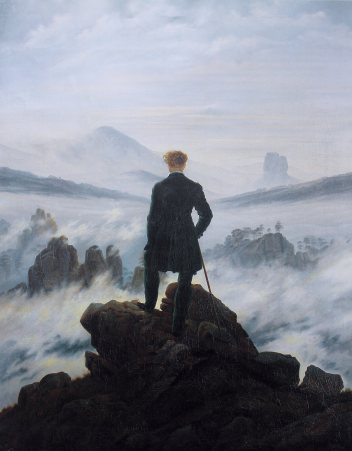
The writer about whom I write says that the painting entitled Wanderer above the Sea of Fog by Caspar David Friedrich is his favorite painting. I share it with you here:

Wanderer above the sea of fog Caspar David Friedrich

The blogger who declares his favor for this painting says he’s not sure why he likes it so much. In sharing his thoughts and feelings about this painting, this writer drew me into a conversation with the painter and the blogger who appreciates the painter’s work. This diablog is my participation in that conversation. I believe that the conversation is among all of us who sense within us the imagination of an artist and the heart of a lover awakening. I invite all with whom this diablog resonates to feel this awakening presence and savor it as our renewed awareness of the interconnecting synergy of wholeness that is within each of us. It is not necessary that we all feel the same emotions on account of viewing and interacting with this painting. That it invokes emotions is what we have in common. The heart that feels! That is the holy ground to which Browning referred as the place where taking off our shoes seems an apt response, just as it did to Moses in the presence of his burning bush. Our hearts leap up aflame with emotions at the presence of fresh, creative possibilities radiating from the Mystery when life calls us to turn aside to see what’s going on that is out of the ordinary and unconventional – above and beyond the sea of fog.

Our minds are curious to see and learn more when the Mystery draws us in by our hearts’ desires and passions. Our hearts require us to turn aside. We may have been wandering a long time or a short time, but as wanderers we are seeking, consciously or unconsciously for answers to Life’s Mysteries. When the Creator speaks, our hearts respond. For any of us, another artist may be the Creator’s voice in whatever medium the artist works. Wanderer above the Sea of Fog may serve as one of our burning bushes if it speaks to us. We may turn aside to contemplate it, seeking to comprehend why it speaks to us and what it is saying that so intrigues us. In that moment, we may identify with being the wanderer who sees a vista within our imagination populated with pinnacles of clarity above and beyond the more common fogginess among which we spend most of our days. We stand transfixed by the vision we have stumbled upon. We have been climbing uphill in our wanderings, aware that we were struggling upward and yet not knowing what we might expect to find. Suddenly we are no longer a mere wanderer. We have become a wonderer in the Presence of the Divine Mystery that awaits all who seek to see above the sea of fog that otherwise hampers our vision.

Suddenly we see both the fog that had hampered our vision and the vision we’d not known to expect but which drew us relentlessly onward and upward nevertheless. Blind wandering in response to our heart’s desires becomes an amazing sight before which we stand in awe, transfixed as we take it all in as best we can. We recall dimly the way we came to reach this pinnacle experience and are uncertain how we’ll descend again. We cannot go back the way we came. We must somehow move forward, most likely back down the other side once more into the sea of fog – for leaping from pinnacle of clarity to pinnacle of clarity seems impossible. Yet, we cannot forget the vista we’ve encountered or dismiss the power of our imagination to capture and be captured by it. We are one with the vista and its novel clarity. It is ours, we are its. We are the vista and it is us. We’ll never be the same again. Having awakened we must remain awakened no matter how the sea of fog once again surrounds us and clouds our vision. We remember clarity of sight. We now know that it is possible. We stumble onward hoping that future opportunities to climb will present themselves that we may again see with clarity, the clarity that only heights confer.

Can we be sure of achieving a height again? Do we want to achieve it the same way twice or is there a natural high we seek beyond the ones we may have stumbled upon before? What enhances clarity and what does not? We are learning as we wander. We are becoming the Eternal Wonderer. In time and space we wander while in Eternity we wonder. Having once connected with the Master Artist whose Master Artwork we each are and remembered, we cannot forget again. We carry the memories of past encounters with the Divine as it has spoken to us and feel the power of its inspiration ever drawing us forward as we wander along life’s convoluted pathways in search of the being who we are and the Being from whence we came and to which we return. We seek to return to oneness with ourselves and all Creation and with the Creator of all that is alive and well. We are Love’s emerging Presence in an unfolding realm of Love that has no beginning and no end. No sea of fog can obscure that Truth forever.

© Art Nicol 2015


Wholeness as the Pivot Point of Change

Let me keep this simple. Unless a person who seeks to be the change in the world he or she wants to see (pursuant to Gandhi’s admonition) slips out of and beyond his or her ego, he or she will fail to participate in a true change. The ego is a master of disguises. To change from one ego-disguise to another is no change. For the world to outgrow violence as a norm and instead enter into a phase devoted to healing the wounds of past violence as a new norm, individually and collectively we all must become humble, ego-free healers.

Beyond the phase of healing awaits the phase in which no harm is ever done that requires healing. To reach that harmless phase, we must undo the harm that our harming stage has done.  To pivot away from ego requires what we pivot out of the ego’s closed system of thinking to enter into the only true alternative — open-mindedness to all creative possibilities.  Wholeness offers us the pivot point around which to turn all of the ego’s ways of thinking on their heads and emerge beyond ego as if we’ve entered into and passed beyond the worm hole into a whole new universe of grand options that set us free to be more than ego wants or believes we can be.  Freedom frightens the ego.  Freedom wisely lived requires no ego and thus no longer lets fear of change hold us back. Only then can we become the change in the world our hearts desire but our egos fear.

Phase 2 is upon us. We either elect to participate in Phase 2 as one of the healers of the harm done in Phase 1 or we remain a participant in Phase 1. Any attempt to remain loyal to the ego while claiming to do no harm is the cover-up of codependency and enabling that the ego employs to perpetuate its reign of terror. “Oh,” you may say, “but I’m a helpful person who never harms anyone.” Perhaps you truly are. Perhaps you truly intend to be but do not yet realize how your best intentions remain unfulfilled.  It is more likely than not that you are allowing your ego to fool yourself into believing you are doing no harm while it’s not true. Do I sound too harsh and unkind to you? Please forgive me if I seem that way.  In actuality, all I’m inviting you to do is move beyond the mistakes I made as a co-dependent enabler who failed to realize that my ego was still in charge of my heart and mind and running me in circles like a fool.

Despite the fact that I once desperately wanted to never be a fool, I was one. It was much more obvious to others than it was to myself, but that’s how the ego operates. It makes you look like a fool to others so that they in their own ego-oriented foolishness can comment upon, judge and find fault with your foolishness rather than see and address their own. It serves the ego’s purpose to make each of us look like a fool to others of us.  It serve the ego’s goal of perpetuating itself to generate controversy among us and set us to judging one another instead of seeing the ego at work behind the scenes. The ego achieves this ego-perpetuating status quo by convincing each of us to adopt one of its contrasting sets of values as “ours” and set ourselves apart from “others” by virtue of our chosen set of values. Sets of values that contrast with one another establish the basis for on-going, continuous conflicts, discussions to resolve conflicts and all out battles when discussions fail to resolve them. The ego does not want our conflicts resolved. So, my ego will do everything it can to justify my claiming the superiority of my set of values over contrasting sets of value and my unwillingness to see things through the eyes of others whose sets of values differ from mine.

Sets of values may in fact differ for a variety of reasons. But if the reason is not focused with clarity upon the role of ego in perpetuating conflicts and correspondingly upon the means by which we may rise beyond ego, then the sets of values conflict only in relatively superficial ways. Superficial differences among sets of values have historically been sufficient to justify all levels of conflict, including wars. That one group may raise three fingers while pronouncing a blessing while another group raises two fingers is nonsensically superficial. Other superficial differences that have seemingly justified violence by one group upon another may not be as obviously superficial and foolish, but they are. People who allow their egos to be in charge of their decisions resort to a wide variety of excuses for identifying other people as enemies upon whom the infliction of violence is seen as fully justified, even reasonable.

Wholeness is the alternative to the ego. That is why wholeness is the necessary, pivotal component of any path by which a person who seeks to be the change in the world he or she wants to see achieves that goal rather than remains trapped within the ego’s conflict-perpetuating worldwide status quo. A person must be willing to become aware of his or her wholeness and devoted to its nurture and perpetuation in order to stop participating in the perpetuation of ego-generated harm. Wholeness is health. Devotion to the nurture and perpetuation of wholeness in ourselves and others is healing. Without wholeness neither health (Phase 3) as a goal nor healing (Phase 2) as an interim path to that goal is possible. Why? Because the ego will successfully resist healing and health and preserve the status quo of ill-health and harmfulness in order to preserve itself as essential to the person’s sense of personal safety and personal identity.

We who have been raised in an ego-oriented society to believe ego to be our identity are like fish who have been swimming in water without being aware of the water. The only reason I become aware of the water is there came to be a time in my life when I felt like a fish out of water. Amid the discomfort of flopping around and suffocating on the shore, I awoke to the realization that my ego was not my true identity. On that shore, my ego died and yet I, the true me, was still alive. In that phase of my life, I suffered an acute identity crisis. If my ego is not I, then who am I? I spent several years on a quest for the answer to this amazing question I’d previously failed to ask. Who am I?

Early in my quest for answers to this pressing question, I was introduced to a work called A Course In Miracles. I devoted myself to studying this course with more diligence than I’d ever studied before. I had been a fairly good student of other areas of study in my past. This area of study motivated me like none had previously motivated me. In the past I studied other subjects to please others, not expose myself to the shame of public failure and achieve academic expectations and benchmarks set by others. In studying A Course In Miracles, I studied and applied what I learned for reasons far more personal to me, from motivations that arose from within me, as if Life itself called me to succeed. Through this process I awakened to and gradually accepted my true identity and discovered many answers as well as many continuingly unanswered questions. I learned to live by faith in the presence of the Mystery of the Divine, including of my own identity within the Divine.

Above and beyond all else that has motivated me have been the experiences of peace, hope, joy and love that my ego never allowed me to encounter and enjoy. On account of those experiences alone, and not for any argumentative reasons, do I now encourage you to enter upon your own quest for your identity beyond the ego and the path that will take you through Phase 2 into Phase 3 as you emerge to yourself and others as a whole person rather than remain disguised behind the masks and entrapped behind the walls of your false identity of ego. If you feel so called, come forth to join me and others in the realm beyond ego of which Rumi wrote when he penned,

“Out beyond ideas of wrongdoing and rightdoing there is a field. I’ll meet you there. When the soul lies down in that grass, the world is too full to talk about.”

Let me here share a snapshot of my own version of that truth in the form of an illustration I invite you to contemplate for its value to you as your inner voice of Spirit counsels you to do.  More about this topic is available by clicking on the Heartbook tab on the menu.

Wholeness Archtype with text 2015

For more encouragement from Rumi as a source of inspiration and wisdom, visit http://launchyourgenius.com/2014/08/04/rumi/.

For more encouragement to understand how to use your own path of faith to grow beyond the ego’s confining definition of your past, present and future, make it a point to enter into your own personal quest for answers to the pressing question “Who am I?”  Our human race will not develop beyond its current adolescent stage until each of us asks this riddle of the Universe and learns to listen to the answer we receive within our hearts and minds.  I would be honored to encourage you to find deepest satisfaction in your quest.

© Art Nicol 2015


Free Will – What Is It, How Does It Work?

Free will has challenged human beings since the beginning of time. In fact, mystics say that we used free will to create the illusion of time in the first place. What is free will? How does it work? These are two questions vital to the welfare of humankind in an age when power expressed as force is running amok around the globe destroying much of life. Is such violent disregard for life an exercise of our individual and collective free will?

To keep it simple, let’s consider “free will” to be one of the features of humans that distinguishes us from other life forms. A sign of this distinction is that we function with a consciousness of time. No other life form has perfected the art of “telling time” as we have. Agates, asteroids, asters, apples, anthrax, amoebas, anemones, anacondas, aardvarks, antelopes and apes do not schedule their lives by the clock even though some do order their activities based on the effect of the sun as the earth rotates. They live in relationship to such conditions naturally without concern for predicting them or controlling them. They’ve found no need or ability to invent sun dials and other handier timepieces until they arrive at a precision pegged on the periodic motion of atoms. We have chosen to do so as no mineral, plant or animal has. Our power to make such choices and carry them out can be called “free will.”

Free will is a power. We sometimes call it “willpower.” We can choose intentionally to fix our wills upon a goal with such determination and discipline that it appears we’ve lost our freedom to choose otherwise. Yet, the truth is that we remain free to choose to focus our determination and capacity for discipline differently if we conclude that the first exercise of our focus and capacity is not achieving the goal we seek and decide to take another approach. “Deciding” is an aspect of our free will. All we need to do to “free” it again is to realize what we’ve focused it on one goal and can nevertheless, despite every argument to the contrary, change our focus if we want to.

Yes, if we “want” to. The exercise of our free will is heavily influenced if not totally dictated by what we “want” to happen or “want” to be true. That’s why it’s important to be aware of what we truly are “wanting” in order to be truly free to exercise our will. Most of us do not remain fully or even partially aware of what we “want” and allow our buried desires to take control of our wills and establish our life’s direction and destiny – even our demise. Beneath the destructive forces now at work around the globe is a desire to do or die. We are choosing death over life, more freely than we realize. We may have become unaware of the origin of our choice to “do or die” but we’ve made it. It remains there for us to choose differently if we want to choose differently. Do you “want” to choose to violate the norms of our violence-prone society and create for yourself and others who choose with you a society based on peace and love instead? You can if you truly want to.

Our “wanting” is the same as our “heart’s desires.” What are your heart’s desires? If what’s happening in your life is not in line with your deepest heart’s desires, why not? What other desires or “wants” have taken over your will to make it seem less than free? Why might you have unwittingly joined in the collective decision to “do or die” instead of to “do and live?” Why might you be willing to throw out the baby of life with the bathwater in order to achieve a death that vindicates your belief, opinion or perspective about anything? About what topic would you prefer to die instead of admit you might be mistaken and could, if you wanted to, change your mind?

I’ve asked key questions. Now, I want (yes, want and as an exercise of my free will) to share with you a perspective that has helped me decide to participate in the peace-and-love-prone alternative to a violence-and-hate-prone society. What I learned that helped me to change my mind arises from our understanding of the process of grieving. I learned that many of our decisions are influenced by our emotions and that we think we “want” what we’re in the mood for. I learned by experience that it’s not always wise and healthy to opt for what I’m in the mood for. Moods offer poor guidance for free will.

Grief is a process. The process of grief takes us stage by stage from the pain of being hurt in some manner to the release of that pain and a life beyond that pain. How these stages may progress in your life may differ from the pattern in my life. But, let’s consider how universal it is that grief begins with anger and resolves itself in peace if we allow all of our stages of grieving to function fully. The grieving process starts with the emotion of anger and winds up at the emotion of peace if we let it arrive there and don’t insist on remaining angry or sad (depressed) along the way. Our heart’s desires are influenced by the emotional state we are in. I suggest that being in an early stage of grief allows anger to dominate our “wants” and our wills and sets the stage for revenge-stoked violence to be our choice. That’s why I have learned the wisdom of not making important choices when I am in a HALT mode: Hungry, Angry, Lonely or Tired. When in these mood-modes, it’s wise to wait and allow the mood to pass before exercising my will. Otherwise my will is not as “free” as I would want it to be. (Yes, I do “want” to learn to exercise “free” will, not some form of imprisoned or compromised will.)

I invite you to observe reports of violence for a while and to notice how many acts of violence occur under the influence of anger and/or fear. How many occur while the person who acts violently is still heavily influenced by the motive of revenge? Anger is an emotion that barely hints at the level of pain that a person is carrying around inside from encounters with pain from the past. Unhealed emotional pain is the same as unresolved grief. The “desire” to have revenge or “settle the score” is a symptom of unhealed, internalized pain, even when it may be called “justice.” As the saying goes, “an eye for an eye makes us all blind.” We are in grave danger of being blinded by the violence awash in the world and unable to see our way clear of it. But there is an alternative to blind rage and anger-clouded vision. We can see our way clear if we’ll take the time to grieve, resolve the painful issues of our past and present lives and then move forward together in peace. We can build lasting peace, not merely intermittent truces, through such patient processing of our collective and individual griefs.

Are you willing to step back from the frenetic pace of your life and grieve sufficiently so that your heart’s burdens of pain are resolved and you rise up with fresh energy to help build peace on earth among all peoples of good will? Good will is free will. All human beings are good people at heart. In the depth of our hearts we can find the common ground upon which to build lasting peace. We can find by faith that this common ground is there because the Creator of us all put it there. But to see and stand together upon such holy common ground we must be willing to be determined to acquire, honor and relentlessly use the habits of grieving needed to keep our visions clear and our minds focused on peace instead of focused on justifying anger.

We can “do” peace and live together in it. We need not allow hidden griefs and motives of revenge to dominate and imprison our hearts and minds – or our wills – as if we have no other choice. We do have another choice, a healthier and more promising one. I hope what I’ve written here helps us to see it and to make it. We can choose unifying humility in preference to divisive pride and shame. We need not proudly fight to our deaths over things that matter little in comparison to love’s simpler, more highly valued features and benefits over which no one needs to fight because they are universally available for free. We need not shame, blame or guilt-trip ourselves or others for our decisions or theirs. We can seek to understand by compassion’s perspective “There but by the grace of God go I.”

Many people who advocate on behalf of violence as a solution to human conflicts and confrontations (including to protect innocent defenseless people or in self-defense) have endured trauma in their past, sometimes trauma too severe to imagine if one has not been exposed to it personally. What I write here in no way denies or minimizes the pain that traumatized people have endured or continue to carry as ongoing suffering. I know that I’ve been fortunate to experience only moderate levels of emotional pain. I do not know by personal experience the fuller intensity of pain and suffering. Yet, I continue to advocate on behalf of grieving as the way to heal even the most severe pain and to relieve suffering that otherwise occurs when ungrieved emotional pain is allowed to take root unaddressed, often unnoticed as an underlying theme so prevalent as to be taken for granted as one of life’s unavoidable and permanent conditions.

Ungrieved pain is generating havoc around the world, nearby in our own homes and neighborhoods and far away in the homes and neighborhoods of other members of the human race. My heart’s desire is to help stop this havoc and chaotic, misplaced reliance on inflicting more pain as a response to pain. It’s time to see through the clouds of pain and dust storms of suffering that anyone who acts out violently, even with the full sanction of his or her social institutions, is acting out of unresolved pain. Our social institutions that rely upon punishment to control other people’s actions or impose guilt and shame as a “consequence” of violating those institutions’ rules, roles and rituals are contributing to the overarching pattern of violence that threatens to end the human race. While it is true that we must not deny or minimize pain, we must also not justify inflicting it is as if it is an essential part of the solution. It is a symptom of the problem of emotional unhealthiness we must all address more effectively together. Inflicting more pain and suffering in response to existing pain and suffering is totally counterproductive.

It is my intention to encourage us all to address this unhealthy condition in societies around the world by promoting the mastery of the grief-relief process in place of the grief-infliction process. Too many of our rules, roles and rituals perpetuate grief and pass it along generation to generation, person to person, group to group and humanity to our ecosystem (animals, plants and minerals). Let’s us experiment together instead with the process of relief and see the miracles that peace beyond anger and depression will bring.

Longer explanations of free will have been written by many superb thinkers. If you want to read examples of such works, check out Rollo May’s books entitled Love and Will and Freedom and Destiny. You’ll find great value in focusing your mind on these books and others like them. To do so would be an exercise of your own free will in a nonviolent way. My shorter discussion of free will is not alone sufficient to bring it all home to your heart. If it gets the ball rolling, please keep this ball of healing energy flowing freely within your life as you cultivate your own motivation for learning more about the process of relief called “grieving.” There is no more promising way to exercise your free will than to learn that it’s simply not true that “Big boys don’t cry” or that tears are a sign of weakness. Emotionally unhealthy boys, girls, men and women don’t cry. Ones with tender hearts, reasoning minds and good wills do. Please don’t be ashamed to be one of us.

© Art Nicol 2015


Which Arms Race Do You Choose to Enter?

Once again it is evident that those who profit from manufacturing and marketing military weapons continue to engage in propaganda urging US taxpayers to foot the bill for their luxury lifestyles. (Those who pay directly or indirectly for governments around the world are also roped in by this global propaganda machine underwritten by multinational corporations who are more loyal to fattening their own bank accounts and indulging in conspicuous consumption as global playboys and playgirls than they are to any nation or peoples beyond their immediate families.) The main theme of such propaganda is the “arms race.” According this propaganda, we are always at the mercy of hostile nations and unruly hostile non-nations acting on their own. Threats from all sides seem to justify arming ourselves to the teeth. Add to that the seeming threats from within our own borders attributed to criminals, terrorists and general crazies and we have the makings an endless arms race from which no one escapes but a few definitely profit. It’s a bonus to the profit-makers that many US citizens have decided that the only adequate response to this growing perception of apparent hostility from others outside and inside our borders is to arm themselves with weapons supplied by the same arms industry. Ah, the profitability of fear!

Are you and I powerless in the face of this arms race that sucks resources from our pockets as relentlessly as lampreys suck life from lake trout and leeches suck blood from any animal to which they can attach themselves? Are we at the mercy of these profit-making vampires who own and operate major media sources so as to keep their propaganda ever before us? Do we have no choice but to be taken in by the propaganda and participate as unsuspecting or suspicious but compliant dupes and funders of the excesses of those who profit from this arms race?

Not necessarily. First we can decide to disregard the propaganda that tells us that the world is entirely hostile towards the US and that we have no choice but to arm ourselves with a succession of soon-to-be-obsolete weapons in an endless race towards the wars we cannot avoid. The inevitability of war is assumed by the propaganda and the only issue presented is how well prepared will we be to win that war. Few of us want to go down in defeat. So, if one assumes that war is inevitable, most of us will join the cry for increased preparedness at any cost. Yet, we don’t have to believe that assumption or buy into the propaganda. We can choose to participate in an alternative arms race instead.

What might that alternative arms race look like? It would look like neighbors opening their arms to each other and reaching around the globe to welcome strangers as neighbors in our global village. We can ignore the doomsayers and act as if we have a better future based on peace and good will shared by good-natured, reasoning people who populate the globe with values and priorities akin to our own. We can assume not hostility but instead common ground in our shared hearts’ desires to raise children in healthy conditions and share life with loved ones in stability and harmony without fear of losses inflicted by hostile forces prepared only to spread violence like an epidemic throughout the human race.

We could engage in a race into each other’s arms if only we trusted each other more than feared each other. Are we willing to take that risk? Might we set aside our xenophobia and reach out to each other as if we might find friends instead of enemies? What do we have to lose? The military version of the arms race dooms all of us. All we have to lose by taking the risk of embracing each other as neighbors instead of as hostile strangers is doom. Might it make sense to you and I to forsake doom in exchange for embracing peace and the freedom to share the globe with good will?

How will we ever find the courage to take such a risk in the face of pressures to believe the propaganda and stand apart in fear? I suggest our courage will come from our faith that there’s a power greater than the arms merchants and their minions, a Power that will aid our alternative arms race. If we race into the arms of the Creator who loves us, we will discover divinely inspired courage within our hearts and God’s corresponding wisdom to make our dreams of peace on earth among people of good will a reality even in the face of contrary arguments proposed by distributors of death. All we need to do is to decide to be customers of the Distributor of Life who charges us nothing for receiving all we can open ourselves to receive of life. It costs us nothing but our egos to open our hearts and minds to the Source of Life and receive in abundance all that the Source generously offers to share with us. Is humility too great a price for peace on earth?

I hope that anyone who prefers life over death and love over fear will consider joining me in the alternative arms race into the loving arms of God and the people who say “Amen” to God in whatever language they choose to say it. God is great in any language spoken around the world by people of all faiths in a God who wills that the human race enjoy being surrounded and filled with love and allowed to live into the fullness of time as Eternity’s children.

© Art Nicol 2015


Open Letter to Those Reaching Out to Outcast LGBTQ Youth and Young Adults

If you are reaching out to LGBTQ youth and young adults who feel unwelcome in their families, communities of faith, schools and other traditional social institutions, first let me say “Thank you” for your earnest effort to awaken dignity and self-respect in those harmed by the lies by which mainstream society surrounds them and inevitably fills them as these lies seep in to poison their hearts and minds. The harm is oftentimes mental and emotional before its toxicity builds up to the point of causing physical harm.   Self-destructive actions come along after self-destructive ideas about how life works take root and toxic emotions that naturally result from believing lies about being unworthy of dignity, respect and love color self-perceptions. Since self-rejection, self-hatred and self-punishment follows on the heels of social rejection, it is helpful to have society cease to reject and begin instead to wholeheartedly accept LGBTQ youth and young adults as welcome members of society. If given enough opportunity, self-acceptance, self-love and self-actualization will also follow from the healing power of social acceptance. But it is not enough to convert the shame of social rejection into the pride of social acceptance. Why? Because shame and pride are flipsides of the same coin by which an ego-based society enslaves us all. We need to do more than help LGBTQ youth and young adults to adopt the ego’s ways of being enslaved to social approval by pride and taken for the ego’s ride to a destiny unworthy of all human beings.  The ego’s way is not the solution. There is another resolution to the dilemma of being nonconforming or “different.”

Because a spiritually rooted and enriched life is the only true alternative to the ego’s seductive illusions, I especially want to thank those who are doing all they can to alert men and women who claim to speak for God to the harm caused by religious teachings that utterly denigrate the personhood and dignity of people with nonmainstream sexual and gender orientations.  As a follower of Jesus, I encourage you to challenge those who claim to honor Jesus to do much, much more than to stop spreading the lies that purport to condemn people of all ages who live with nonmainstream sexual and gender orientations to lives of guilt and shame and doom them forever to hell as unqualified to ever enter heaven.  To end systemic and individual bigotry is a worthy goal because once it’s achieved, we’ll stop harming our youth and young adults who dare to feel “different” and as part of their feeling different struggle secretly or openly with “different” sexual and gender orientations than the mainstream may admit to sharing.  But ceasing to do harm is not enough.  We must invest ourselves without reservation in undoing harm already done and in healing broken hearts much in the need of mending.  Only then will we face within ourselves the adverse effects of ego on and within all of us and evolve beyond ego’s limitations to embrace lives flowing freely with love’s most desired and treasured experiences.

Until their hearts are healed, those who have been wounded by lies and social rejection carry emotional pain and will continue to act out their pain in ways that socially conformist folks will condemn as “proof” of the wounded’s inherent unholiness.  Inner pain is often acted out in socially nonconformist (even rebellious) ways in the face of the conformity that has caused the pain.  (Such acting out is a way of saying, “No, you cannot do that to me anymore.”)  We must educate conformists (adherents to traditions) to be aware of how their unreasonable, fear-based demands for conformity are themselves a root cause of psychic pain and of the resulting harm that flows from believing oneself to be utterly unworthy of and unavailable to God’s love.  Lies confuse our minds.  Confusion = a form of psychic pain that couples with feelings of guilt, shame, inadequacy, powerlessness and resentment to imprison a person’s mind in a dilemma from which there appears to be no escape but death.  Death looks like the only relief after forms of temporary relief like drugs, alcohol, sex and other thrills and pleasure-triggering pursuits prove futile.

We must learn to say to inflexible traditionalists “If, in order to please God and experience Divine Love in abundance, I have to be 100% like you and not deviate in any way from the model of human life that you have adopted, then you are saying that God did not create diversity within the human race even though God created diversity among all other realms of Nature.”  Minerals, animals and vegetables embrace diversity without judging any aspect of diversity unworthy of belonging.  We must be willing to ask “What other expression of Nature polices its members to demand conformity and penalizes by rejection the minority who may not conform? Are not other species wise enough to accept nonconformity as a source of new-and-improved versions of the species that may prove to be more adaptive to changing conditions and capable of causing the species to survive those changes? Might demanding conformity and rejecting nonconformity doom the human race to extinction? Might a holy race include nonconformist expressions of holiness in all innocence as a way of ensuring that the race thrives beyond its currently limited vision for itself? Might God’s vision for the future of the human race encompass more than past traditions have embraced? Might future traditions embrace more of life, love, liberty and laughter because ancestral traditions learned to be more open to God’s creativity as a (re)new(ed) tradition?”

I’m not qualified to address how people of other religious flavors may view the socially marginalized (social “outcasts” or “rejects”), but I am qualified to speak to my brothers and sisters who claim Jesus as their Lord and Savior, as their primary Teacher and Friend.  We who follow Jesus are called to go far beyond stopping the transmission of harmful lies.  Yes, we do need to stop spreading messages of condemnation in the name of the one who said to the adulteress “And neither do I condemn you.”  Her sanctimonious, self-righteous neighbors accused her of “sin” and then dropped their stones when Jesus reminded them to look into their own hearts at their hidden, unconfessed and unrepented shortcomings.  All “sin” means at its origin is “separation.”  Jesus came not to separate from but to reconcile us to the Creator of Us All who loves and favors each of us as the individual and collective apple of His/Her eye.

The shortcomings of followers of Jesus include not only 1) accusing others of different sexual and gender orientations of being lifelong, irredeemable sinners (forever “separatists” from God doomed to suffer throughout all Eternity) but also 2) failing to heal and comfort those who are condemned.  It is not enough to stop condemning.  Jesus is a healer.  His followers must take up healing as their primary avocation until the harm done by the Church (and others) is undone.  We must heed the call to be allied not against but alongside those whom less understanding members of society have rejected as unacceptable family members, friends, classmates, fellow worshippers , co-workers, etc.

As an example of the misguided conclusions researchers are coming to about how to respond to the harm such condemnation causes, I cite this article: http://www.huffingtonpost.com/2015/02/26/lgbt-homeless-youth-survival-sex_n_6754248.html?utm_hp_ref=gay-voices.

As this article evidences, researchers tend to intellectualize their way through data to spot the harm (as if it needs to be proven, which it does only to those who otherwise restrict their lives to associating with other members of the privileged class and remain blind to the plight of the less privileged). But they know nothing of the response followers of Jesus are called to provide in response to such harm.  We are not called to study “the problem” in order to gain “insight into a little-understood world and demonstrate the need for more government-funded shelter beds and other resources focused on LGBTQ youth.”  Government is not the answer here anymore than government-run orphanages and foster care meet the needs of unwanted children and youth to be welcomed in homes where they are wanted.  Plenty of followers of Jesus have homes that have room to welcome unwanted youth to be included there as members of the family, as spiritually adopted children and siblings simply because they are already divine children of the Divinely Loving God Jesus called Abba.  We need not out-source the care of the unwanted youth and young adults to governments or any other resource beyond the Christian community itself.  We who claim to occupy the privileged status of having Jesus’ care and guidance must take into our hearts and homes those Jesus says he identifies with, whom the Bible says he called “the least of these.”

I urge you who advocate on behalf of LGBTQ youth and young adults not to settle for speaking to believers in Jesus as if the government is the resource Jesus calls upon to serve God in his name and nature.  Jesus calls upon his followers to serve according to his way, truth and life.  He says we will do what he did and greater things will we do.  He does not teach that his followers should badger politicians into spending taxpayers’ money to provide for the socially marginalized.  He calls for his followers to serve directly in accordance with the blessings that they have received, to dig into their own pockets as the Good Samaritan did to provide for the stranger found beaten and abandoned along the road.  Emotionally beaten and abandoned LGBTQ street kids (as well as LGBTQ youth elsewhere in society) need more followers of Jesus to heed their Lord’s commandment to love God and one another and to leave no one out of their circle of love.

Others may be free to insulate themselves from direct involvement in the lives of those whom the distorters of Jesus’ teachings have harmed.  We who live by the truth of Jesus’ teachings must step forward to demonstrate by the congruency of our words and deeds that the age of  hypocrisy is over and a new age of integrity has begun.

To those who advocate on behalf of LGBTQ youth and young adults and seek to serve their best interests, I say, “What you are doing is a much needed beginning to the age of integrity.  I encourage you to take it all the way and call upon followers of Jesus to confess their own shortcomings as followers, turn from their adherence to habits of falling short, take up their responsibilities and follow the One who sends the Holy Spirit to leads us into all truth.” And I repeat, the gratitude of all whom you serve and of the God of Love who watches over them goes with you always. May you be open to reaping as you sow from the One who sows generously within the hearts and lives of all who serve in the nature of truth and love!

© Art Nicol 2015

A Topic of Interest to Men: When Will God Man-infest?

The possibilities of how God will resolve the tendency of male human beings to resist surrendering to Divine Authority while preferring to assert their own ego’s impotent but prideful authority are numerous, perhaps infinite.  So, if you don’t like the ideas I offer here, please don’t fret.  Make up your own alternative solution.  If you use your imagination to listen intently to the Spirit that is always sharing wisdom and truth about love within your heart, you’ll find your own story to tell of how God will with men indwell.

My idea is based on looking at things oddly.  For example, most people have interpreted the fact that Jesus came into the world as a male as indicating that God favors men over women. Many interpretations of sacred teachings from many paths of faith have indulged in this same kind of error to justify male dominance of human societies (and, not surprisingly, to justify reserving to men the role of interpreting sacred scriptures as extra protection against loss of male privileges). I interpret the fact of Jesus’ human maleness differently.  I see in that fact a God who tackles the most challenging, stubborn problems head on and does not avoid them.  I see a God who seeks to lift the whole of the human race out of our attachment not to sin but to suffering by converting traditionally aggressive members of the race into superlative healers of all forms of harm.  We’ve been suffering escalating pain for so many millennia that we are psychologically bonded to suffering as if it is part of our identity.  Unless we’re presented with a clear alternative we cannot even imagine living without suffering. The best we can imagine is avoiding as much suffering personally as we can avoid while shifting suffering onto other people’s plates and off of ours.  We cannot imagine an end to suffering for everyone.

Yet, God can imagine it.  In fact, God wills an end to suffering for everyone and has set a plan in motion to bring that end into reality here on Earth.  We might call it God’s totally (that is, free) Affordable Care Act or Universal Healthcare policy.  God’s plan involves sharing God’s immunity to harm and suffering with us, all of us.  To set the Divine Plan in motion, he introduced an example of a starkly clarifying alternative into the human experience that stands in complete contrast to the human race’s normal experience.  That contrast is Jesus, not a contrast because he’s God while we are not but a contrast because he’s totally one with the human race while refusing to be a clone or copy of stereotypical maleness as defined by any human culture.  Witness, for example, that unlike men in most cultures, Jesus did not try to prove his masculinity by fathering children or prove his superiority by running roughshod over others.  Instead he showed that we are all God’s children and demonstrated what that looks like.  He exercised his power not to show himself off as superior but to show us all upward to God as our unconditionally loving Superior Parent.

Normally, male humans are more likely to inflict physical pain and suffering on others than women are. Because men are, on average, larger bodied than women, they tend to cause more pain, sometimes out of awkwardness towards smaller bodied humans such as women, children and smaller bodied men and sometimes quite intentionally to try to demonstrate external superiority while internally (in their secret heart of hearts) feeling quite the opposite in their undisclosed feelings of inferiority. Jesus confronted male stereotypes of social superiority by showing what true superiority on divine terms looks and acts like and teaching that all men as well as women and children have equal opportunity to access the same Diving Power.  God is an equal opportunity deployer of Divine Power, so Jesus says.

In human cultures, women are more likely to be involved in comforting the “little ones” and those who suffer and trying to relieve pain and suffering if they can.  Most human cultures distinguish masculinity and femininity based on factors like softness, gentleness, compassion and cooperation.  In most cultures women are permitted to be softer, gentler and more compassionate and cooperative than men.  Social training reinforced by rewards of social approval for successfully conforming to stereotypes shapes men into inflictors of pain because socially aggressive males are rated as more manly than less socially aggressive ones.  Most societies reserve derogatory names like “wimp,” “sissy” and “coward” for those boys and men who are reluctant to engage in aggressive behaviors and shy away from inflicting or experiencing pain.  To be a “real man” means to inflict and endure pain without flinching – and without crying.

To counteract this social prejudice in favor of casting men as sources of pain and suffering, God decided that the expression God would use to exemplify Divine Love and Grace in human form had to be a male.  God chose the least likely candidate through whom to express Divine Grace and Mercy – a man.  Had God chosen a woman to reveal Divine Qualities and Power, the human race would not have been so shocked.  It had to be a man through whom God manifested the Divine as a Supremely Gentle Nurturer and Healer.  So, in the man Jesus, God man-infected the human body to start the ball rolling. God infected Jesus with the power to not only “do no harm” but also to heal all harm that had already occurred.  In doing so, God challenged the human race to think differently at the core of our assumptions and social constructs about issues like gender identity and stereotypes of masculinity and femininity.  He emphasized the absurdity of casting God as a stereotypical male figure as if God has a human body.  (Given God’s lack of a body with sexual traits, God’s qualities are more likely to be associated with androgyny than with either extreme of masculinity or femininity.)

Since being confronted by the Jesus model of manhood, men have variously faced and/or avoided the challenge of being like Jesus in all of his qualities and letting go of all socially reinforced but nevertheless incompatible ideas about what it means to be a man.  That challenge goes right to the heart of social assumptions that are rooted in the greater size and physical strength of the average man’s body in comparison to women’s bodies and in the fact of penetration by men to accomplish the act of sexual reproduction.  Women by physical nature and reproductive function are defined by their bodies as softer, smaller and more receptive of penetration than a source of penetration. When men identify with their bodies’ traits and functions, they are led away from identifying with the process of submitting or surrendering their lives to God in service according to God’s will.  Yet, the opportunity of men to serve God awaits in our allowing God to be in charge and allowing God to plant seeds of inspiration to gestate and come into fullness of time through male lives.  Images like being the Bride of Christ simply offend the socially reinforced standards for being a “real man.”

The ego, not exclusively a male tradition but prevalent throughout the human race, can be seen as a set of defenses against the truth of God’s plan to call us back home as Divine Children.  In 12-step programs, it is said that EGO stands for “edging God out.”  Jesus demonstrated how to allow God to edge back into our lives by opening our hearts and minds to the transforming power of the Spirit of Truth and Love that Jesus promised would be ever present with us to guide and comfort us.  Often this Spirit is cast as feminine in nature.  Imagine how contrary to a male’s upbringing it may be to allow a feminine power to be in charge and to enter into the depth of his being to create new life!  I believe that such a total reversal of male functions is a major obstacle for men in our quest for experiences of God.  We simply desire to be in charge and have a hard time admitting that God already is in charge.  Let us ponder in our hearts the reality of the Spirit’s abiding presence there and keep things simple by accepting as truth what is already true.

As I said at the beginning, if you don’t like my ideas, please feel free to contemplate at length to come up with ones of your own.  It’s worth our weight in gold to come forth as gold after suffering as Job suffered.

© Art Nicol 2015


Going Beyond Out of Our Way

“Only those who will risk going too far can possibly find out how far one can go.”  T. S. Eliot

When you go out of your way to care for another person, is it possible to go too far?  How might you know that “too far” is?  If it’s inconvenient to go out of your way for another person, is convenience the limit and inconvenience where you draw the line?  What is it OK to risk when you go out of your way for another person and what is too much to risk?  Let’s agree that love calls us to take risks in caring for others. Let’s agree that it’s not always convenient to care for another person as love calls us to care and that there will be times when it’s right in love’s eyes to go beyond convenience and extend ourselves into come degree of inconvenience.

Let’s examine the limit to which love calls us to go and acknowledge love’s power to call us to go farther than we might at first imagine.  I suggest that Eliot was correct to note that taking the “risk of going too far” is the only way you or I will discover how far love goes and is ready, willing and able to take us along with it.  In my investigation of love’s limitless nature, I’ve become a radical explorer of the nature of love.  I confess it.  Don’t expect me to argue in favor of setting limits on love’s expression in your life or mine.  I genuinely believe that our tendency to set such limits is precisely why the modern world has become as bogged down in fear, violence and suffering as we have.  Think about it.  If it’s true, as John wrote, that God is love (God = Love, for math fans), then any practice of setting limits on love is the same as setting limits on God.  How is that possible?

How could you or I set a limit on God?  It’s actually quite simple.  We can set a limit on God because God gave us the power to do so.  God gave us free will.  Free will gives us the power to choose between setting God (love) free to be fully expressed in our lives and in the lives of others or setting limits on that expression.  God has already chosen to express the Divine Power of Life and Love in and through your life and mine as fully as we’ll allow.  His/Her choice is made in Eternity and stands forever.  Our choices are made in the realm of Time and Space and can be made, changed and changed again until we discover a choice we never want to change.  The tendency in the modern world, where material values are given greater influence than spiritual ones, is to allow our fears to set limits on the influx and outpouring of love throughout our life experiences.  Our fears set very restricted limits to keep us feeling “safe” within our familiar territories.  In fact, to make sure we’re feeling safe, our fears tend to gradually shrink the territories within which we are willing to take risks and prevent us from even thinking about “going too far.” Thus it is by fear’s logic we never come close to discovering how far we can go if we were to exercise more courage.

In our ego-trained, fear-based orientation to the modern world, we’ve been taught to take a risk that I believe is now haunting us.  We’ve been taught to take the risk of setting severe limits on God and the expression of Divine Love.  We’ve been taking that risk for so many generations that it is now the social norm and heavily reinforced by social approval.  It’s unlikely that anyone told you or me that we were being taught to place limits on God (Love). The ego is not that honest in its dealings with us.  It’s actually quite deceptive and likely to claim that we are being as loving as we need to be or even can be when we do only what is socially approved of.  It’s likely to teach us to believe that social approval sets the proper limit on love that keeps us safe from going too far.  Too far where?  In the ego’s frame of reference, too far out of bounds to risk being thought of as foolish and naïve and subjected to ridicule.  Too far out of bounds that we risk losing the approval of those whose opinions of us we value most.  Too far out of bounds that we risk being hurt and feeling deeply in our hearts in ways we’ve been taught to avoid.  Yet, suppose you or I were to reverse the risk ratio and take the risk of defying social approval and exploring beyond conventional definitions and expressions of love.  Might we encounter more of God and Love “out beyond social norms?”  Might we enter into the realm of mystic experiences to which Rumi referred when he said:

“Out beyond ideas of wrongdoing and rightdoing there is a field.  I will meet you there. When the soul lies down in that grass, the world is too full to talk about. Ideas, language, even the phrase ‘each other’ doesn’t make any sense.”

Damn these unconventional poets!  Why don’t just they leave us alone?  I suggest that they are heaven sent. I suggest that they don’t leave us alone precisely because God knows that “It is not good for man to be alone.” (Genesis 2:18 NIV)  Poets, lyricists, writers of fiction, composers, dancers, choreographers, painters, sculptors and other artists stir our hearts to take second looks at what the ego has taught us and encourage us to consider changing decisions we might have thought were unchangeable.  Artists express the divine grace that may soften our hearts and allow us to rethink a “conclusion I concluded long ago.” (A Puzzlement from The King and I)

As a believer in Jesus, I tend to take a look at what his teachings by word, deed and lifestyle say about issues that haunt me.  As I realized that decisions I had made under the influence of ego-based teachings were haunting me, I gradually awoke to the reality that Jesus did not usually agree with the ego’s teachings – if ever he did!  He was definitely an unconventional person.  He did not seem to worry much about social approval, winning popularity contests or catering to the social elites of his day.  He was not running for office or trying to win a job or a life-partner’s attention and affections.  He was focused on identifying God’s will in all things and then taking the risk of going too far – at least in the eyes of others.  Gradually Jesus’ ideas, actions and model of lifestyle came to influence me more and more.  To emulate him I began to shed the common excuses given for not going too far.  Some said he was God and, since the rest of us are not God, then of course we cannot go as far as Jesus went in caring about others.  He intentionally hung out with folks others did not approve of and avoided at all costs. He seemed to not realize that they were of a different class and (supposedly) looked down upon by God. Jesus went so far as to wind up hanging on a cross as a vilified criminal and endured shame, pain and other unsavory features of human life on his way to death.  He could have avoided all that.  But would he have honored God and Divine Love if he had?  How could he demonstrate how far we can go if he had not gone beyond death to return as an expression of the Eternal?

Is it true that Jesus was so different from you or me that we can excuse ourselves from taking the risk of going too far in following in his footsteps?  What if he were actually the same as you and I? Suppose whatever identity with God Jesus had and has we have too? Suppose the fact that we’ve avoided going too far is actually the only reason we don’t know how identified with God we are!  Suppose that when Jesus prayed that his followers would know oneness with God as he knew oneness (John 17: 20-23) that he meant precisely that and that his prayers are answered once we quit setting limits on God (Love). Might God be ready, willing and able to show us our oneness with the Divine once we say “Yes, here I am, send me?”  Are we afraid to be sent “too far” and never come back to where we’ve been?  Are we afraid that an encounter with God will change our outlook on life and our choices forever?  The ego is afraid of that outcome.  We need not be.  In our heart of hearts we are hungering for such an outcome.

Radical nonconformity to the ways of the world includes taking the risk of going too far in the ego’s eyes.  Yet it also opens the door to risking that Love will flood in and never stop sweeping us away into greater and greater adventures as well as ever increasing capacity to share Divine Love with others.  Might our hunger for adventure and love never be truly satisfied until we take this risk?

How radical is love as Jesus’ followers believe it to be?  Let’s check out the oft-quoted follower whose writings appear in the Bible as letters written by Paul.  Let’s quote him not for ideas he clung to about how to set limits on God’s Divine will but for ideas about “going too far” in embracing God’s will.

Here is how this eloquent writer spoke about love:

“If I speak in the tongues of men or of angels, but do not have love, I am only a resounding gong or a clanging cymbal. If I have the gift of prophecy and can fathom all mysteries and all knowledge, and if I have a faith that can move mountains, but do not have love, I am nothing. I f I give all I possess to the poor and give over my body to hardship that I may boast, but do not have love, I gain nothing. Love is patient, love is kind. It does not envy, it does not boast, it is not proud. It does not dishonor others, it is not self-seeking, it is not easily angered, it keeps no record of wrongs. Love does not delight in evil but rejoices with the truth. Love never fails. But where there are prophecies, they will cease; where there are tongues, they will be stilled; where there is knowledge, it will pass away. For we know in part and we prophesy in part, but when completeness comes, what is in part disappears.” (1 Corinthians 13:1-10 NIV)

Regardless of how eloquently Paul spoke or wrote, he admitted that words lacking in love’s true essence were hollow, pointless and powerless.  He acknowledged that all of the partial understandings he might gain about the truth about love would dissolve in the presence of “completeness” or wholeness perfected by God.  Paul took the risk of going too far in following Jesus beyond Paul’s (Saul’s) previous life of social conformity and of meeting the expectations of those higher up the ladder in his religious institution.  His daring risk-taking brought him into conflict with the very authority figures he’d once tried so hard to please.  He became an outsider to the social club within which, earlier in his adult career life, he’d worked so hard to qualify for membership.  Traditionalists scorned him as a maverick who’d lost his way instead of honoring him as a master student of their long-awaited Messiah’s Most Excellent Way.

Today many traditionalists selectively quote Paul’s writings when he espoused the preservation of beliefs and practices prevalent in his day, beliefs and practices he’d not yet realized were interfering with the evolution-revolution Jesus had set in motion.  Yet, it remains worthwhile to glean wisdom and guidance from Paul’s experiences in his transformation from Saul who had once persecuted followers of Jesus into Paul who himself followed Jesus.  The man who had persecuted became one of those he’d previously persecuted.  Pretty radical change of heart and mind!

How did Paul address this issue of radical nonconformity in going too far?  He addressed it directly by writing:  “Do not conform any longer to the pattern of this world, but be transformed by the renewing of your mind. Then you will be able to test and approve what God’s will is—his good, pleasing and perfect will.” (Romans 12:2 NIV)  It’s instructive that Paul tied “going too far” with demonstrating God’s will.  Might that be the point of your life as well as mine?  Each of us in our own way may have the divine opportunity to prove that God’s “good, pleasing and perfect will” is to share Divine Love for all of us with all of us, without exception or exclusion no matter how much pressure socially conformist thinkers place upon the question of the limits of God’s love.  If God loves the previously-hidden but now more-boldly-emerging nonconformist maverick in each of us, then going too far to be true to ourselves as children of God is not possible.  Even the sky sets no limit on how far we can discover we can go – if only we let go and let God be God as we let ourselves go far afield beyond the limits of social approval to belong exclusively to God.

The sky does not set limits.  It invites eagles to soar and not have to seek safety near the ground.  Love likewise invites us to soar to the heights above life’s storm clouds and risk having gone too far.  Our wings will not melt off, for they are not attached with wax.  They sprout from within the energy field of the divine love that radiates through us as it lifts us ever nearer to the heights of heaven.  Some call this falling upward.

© Art Nicol 2015

Cancer in the Body of Believers in Jesus

Cancer begins as a few cells rapidly multiply without the purpose-driven orderly structure that controls the growth of healthy cells elsewhere in the body.  These rapidly multiplying, disorderly cancer cells form masses of tissue we call “tumors” and may eventually spread throughout the body to generate out-of-control cell-production that proves contrary to the purpose of the host organism.  Once the cancerous cells populate too much of the host organism, death looms as the original life-purpose of the organism is lost amid the disorderly purposelessness of the cancer cells.   Cancer is characterized by a disconnect between the main organism’s life-oriented purpose and the process of cell production and tissue regeneration.  Some people say that cancerous tumors “grow.”  But if the term “growth” applies only to orderly cell production that aligns with the life-orientation and purpose of the main, overarching organism then cancerous tissues do not grow.  They merely expand in a disorderly fashion that mimics growth but does not contribute to life.  Once the main organism’s health declines enough to bring about death, even the cancer cells die. They have sabotaged their host to their own detriment.

If Jesus’ institutionalized Church is Christ’s body of believers on Earth then what might be the cancer that is causing the Church’s decline and bringing the body of believers nearer and nearer to disintegration and ultimately death?  I suggest that the cancer can be spotted in every idea and resulting practice that disconnects the Church from the life-oriented purpose God gave it through Jesus.  Ideas and practices not in alignment with the God-given purpose of the Church are generating cancerous cell-production throughout the Church that mimics growth but does not contribute to the life of the Church as God defines that life.  These forms of illusory “growth” are sabotaging the Church and contributing not to its life but rather to its decline.

I believe that God is working through paths of faith other than the one associated with Jesus. Be that as it may, I’m devoted to the path of faith along which Jesus has sent the Holy Spirit to lead all who believe in him.  As a believer in Jesus, I seek to hear the leading of the Spirit within my heart and to heed its guidance and honor the wisdom it transmits to faith-oriented believers in Jesus.  I accept without qualification Jesus’ promise to send the Holy Spirit to lead us into all truth.  John 16:13.  That is why this article is devoted to spotting the cancerous ideas and practices at work within Christ’s Church rather than focused upon the possible shortcomings of other paths of faith.  Until the Church of Jesus Christ has submitted itself to healing of all cancerous ideas and practices at work within it, it is in no position to point out the possible ills of other paths of faith. The Church must allow the Holy Spirit to point out and remove logs from its own eyes before it tries to point out splinters in the vision of other paths of faith.

To whatever extent any other path of faith may be failing to adhere to God’s purpose and plan for that path of faith, it is the responsibility of faithful adherents to that path to assess those shortcomings and take steps to rectify them from within the borders of that faith as a follower of that faith. Within the body of believers in Jesus we have our hands full addressing the ills of Christ’s institutionalized Church and cannot afford to cast our eyes upon other religions or paths of faith until we’ve resolved all of our own issues between us and God.  That is to say that the fact that I take up the task of identifying some of the Church’s blind spots does not imply that there are none present in other paths of faith.  It means only that I adhere to the principle of the Fourth Step of the 12-steps and suggest that believers in Jesus must focus on taking our own inventories and repent of our own ill-conceived ideas and sabotaging practices that have led to the decline of the Church at large. Once we’ve humbly submitted to the Holy Spirit’s removal of the logs from our own eyes, we can seek God’s guidance about what to do next with our clarified vision.  In the meantime, to honor Jesus as the head of our body of believers, we need to refrain from violating his principle of not judging others.

In this article I do not pretend to present an exhaustive list of the ideas and practices rampant within Christ’s Church that are proving to be cancerous.  I intend here only to highlight a few so as to contribute to a dialogue within the Church that may lead the Church, its leaders and its members of all stripes and flavors to humility, repentance and healing.  I believe that the process God calls us to engage in is akin to the repentance that Jonah’s message to Nineveh invoked.  Ideas and practices not aligned with God’s holy purpose for the body of believers in Jesus are “wickedness” (failure to adhere to holiness) in the eyes of God whether or not they qualify as “wicked” under popular definitions of the populace at large. If God’s people who are called by His name desire with all their hearts to see the world healed of all forms of violence and oppression and the resulting harm, we must heed God’s definition of “wickedness” in order to humble ourselves before God and participate fully in the conditions that permit healing to flow from God unlimitedly.

In saying that I have identified a few of the Church’s misalignments with Jesus’ directions to his followers is not to say that I mention them in order of significance or priority or have cited the most important ones.  To contribute to the dialogue about Church-wide humility, repentance and healing, I cite only these for now:

  1. The error of judging people of other faiths, as mentioned above. We are not qualified to assess from beyond the borders of any other path of faith how that path of faith is best lived. That is an internal affair as to which responsibility rests with those who claim that path of faith
  2.  The error of citing quantifiable statistics as signs of growth while measures of quality are neglected. When quantity is valued over quality, the Church has dropped the ball that Jesus handed off to the Church. Throughout the Scriptures referenced by Jesus and the Church are many passages indicating that God is more concerned about the quality of life people are experiencing than about the quantity of people who are claiming to believe in Him. God has often preferred to rely upon a few people to accomplish His goals than to rely upon great numbers to prove His significance. In short, God is not concerned with social approval ratings as if God is a politician or Earthly monarch. God does not put His mind upon the things of man. God puts His mind upon the things of God whether or not humankind approves of God’s values, ideas or priorities. For the Church to express God’s orientation, the Church will have to stop catering to social approval, no longer seek to amass quantities of members or money and focus on God’s values, ideas and priorities. To measure the success of the Church by numbers is to measure by the same measurements attributed to newly released movies or TV shows. Audience ratings are not symptoms of the health of the Church except to the extent that high popularity may be a symptom of poor health. Ratings measure the cancerous illusory “growth” and call it admirable. Not so in God’s eyes.
  3. The error of measuring the quality of a believer’s faithfulness to Jesus by the financial prosperity or social popularity of his or her lifestyle. By his example, Jesus revealed the true measures of a believer’s life while he was on Earth. He was neither financially prosperous nor popular. In fact, he allowed himself to walk through life with few possessions and admonished his followers to do likewise. He traveled light but he did not travel far. He remained focused on a relatively small territory of personal concern rather than roam throughout the wider territory using means of transportation then available to him. Today the industrial/technological world has developed means of transportation that enable humans to travel the globe. The Internet empowers our minds to travel everywhere at any time. The practice of traveling widely is promoted by commercialism and mass media as “good.” Good for what? Good for profit-making by purveyors of travel-related services, including the marketing industry. Good for allowing those with wealth to congregate as mutual admirers around the globe and fancy themselves to be participants in a diversely multicultural world when in fact all they are doing is sharing their escapist activities and self-indulgences with other members of their economic class while remaining indifferent to the plight of other classes. I suggest that God disagrees with the standards of the world on this point and prefers that believers focus on local concerns in-depth, moving among all economic classes and other indices of human diversity as Jesus did, rather than spread themselves so thin as to have little significant, long-term impact on anything anywhere. Jesus impacted the lives he touched in significant, life-transforming ways (called “miracles”) and predicted that those who were his true disciples would do likewise, even having greater significance and impact than he had. Jesus was able to perform miracles because he developed relationships locally and allowed the least of these in his locality to have access to him personally. Although he participated in discussions with elites and allowed himself to be interviewed from time to time by representatives of the media of his day, he did not make a priority of doing so. Instead he remained directly accessible to the masses and most importantly to individuals who separated themselves from the masses to approach him one on one. In interacting with Jesus’ energy personally people were brought to faith and offered opportunities to act upon their faith to receive miracles of healing. The Church’s mass-media-influenced values and priorities today turn Jesus’ values and priorities upside down.
  4. The error of catering to worldly powers rather than serving those that worldly powers look down upon, exploit and oppress. The Church has become an apologist for those who wield social power instead of being an advocate for those the powerful disdain. Nowhere in Jesus’ model of life to which he called his disciples did he serve in the role of sycophant to the elites or aristocrats of his time. Moses set captives free. Jesus set captives free. For the Church now to cater to those who hold powerless people in captivity is an anathema to the Father who loves all of us. The modern world is awash with captives of all kinds. Many workers around the world are held captive in one way or another by their employment’s meager returns and harsh conditions. The worldwide trade in sex-for-money in all its forms imprisons participants on all sides of these transactions within walls of secrecy and shame. To help build prisons and justify their existence rather than to visit prisoners and help them never to return to prison ignores one of Jesus’ most strident quality control standards for his followers. To fail to invest its all in helping the least of these to take up lifestyles of freedom and no longer risk going to prison, being homeless or exploited or going without the necessities of life, including personal dignity and the capacity to provide for one’s children, indicts the modern Church.

Christians believe that God’s nature and priorities were expressed in a physical body through Jesus and that Jesus intends the Church as an institution to continue to express God’s nature and priorities.  After starting out so well in Jesus’ life, it may be hard to understand how Christianity drifted so far afield from the truth he promised would set us free.  But it’s vital that we admit the drift and correct the errors if ever we want to allow the truth to set us free from mistakes humans made in the past.  Self-examination, repentance, correction of errors and granting and receiving of forgiveness are not the ego’s talents because these disciplines to which Jesus calls us are expedited by humility and resisted by pride.  So long as spokespersons for Jesus filter their information through the ego and water down their ideas and their experiences – their principles and their practices – to suit their egos no significant correction will occur and the power of forgiveness, once so radically illustrated by Jesus, will remain stillborn.

It is essential to rise free of and beyond the ego to correct the errors that the ego has so diligently preserved.  Overcoming the ego is what the passages in Chapter 3 of Revelations beginning with “He who overcomes shall” refer to.  By the power of diligent self-examination, change of mind and forgiveness of errors, we can join together to resurrect the Church from the tomb into which popular opinion has shoved it by crying out for the crucifixion, censorship and silence of minority members of the Church who have called the Church to account for its harm.  It is a mistake to focus on errors as guilt-and-shame-ladened “sins.”  To encrust our errors with barnacles of guilt and shame only makes them all the more difficult to acknowledge and shed.  Let’s stop adding to the difficulties of the task of resurrecting the Church and simply let Jesus call us forth from the grave as he once summonsed Lazarus, as a friend he missed and wanted to see alive again.  We are each Jesus’ friend, no matter how far we may have gone astray.  He has not forsaken us.  We need no longer forsake him.  By God’s grace, we have the power to redeem our error-prone lives and live lives renewed by forgiveness and mercy and overflowing with liberty and justice for all.

The Church’s healing from spiritual cancer awaits us as individuals who accept healing on behalf of the whole.  The healing begins one by one and gains momentum as the healed ones gather as a healed body of believers.  Healed twos become healed threes, fours and so forth until the heart-count becomes too numerous to quantify.  There is no need to count because once we are healed we are all one.  When Jesus calls you to join the healing movement by submitting yourself to its heart-cleansing flow, remember that you as an individual do not need the permission of anyone else to participate in the healing. All you need to do to respond to Jesus’ call to be healed is to declare with all your heart, mind, body and soul, “I can, sir,” in the face of the Church’s cancer.  As we each do our part as Jesus did, God will do the rest.

© Art Nicol 2015


Intellectualism: Its Harmful Nature and Its Cure

During one of her talks, Esther Hicks presented her Inner Voice as saying, “Your Inner Being likes to skip and laugh and think about things; your Inner Being likes to offer compliments and feel appreciation and contemplate something that is not fully understood and then feel the understanding come forth.  Your Inner Being is just like your frisky two-year old who is eager for life experience.  To meet up with your Inner Being just be more like that now.”  That quote shares one angle on how to avoid the pitfalls of intellectualism.  For a corresponding observation we need only turn to Aldous Huxley who said, “The secret of genius is to carry the spirit of the child into old age, which means never losing your enthusiasm.”

Intellectualism is the practice or habit of using the mind to conceive of ideas that are heartless and cruel in their impact on others, consider them viable options and logically explain why they are most effective.  It’s the byproduct of a mind trapped in ego.  The ego requires that we deny our emotions and become progressively insensitive to own heartfelt emotions and the hearts and emotions of others.  When we cultivate our egos as our false identities, we must tune out our natural capacity for empathy to avoid being overwhelmed by the obvious messages of pain that ego causes us and others to endure as if suffering is inevitable.  Intellectualism assumes that suffering is inevitable and that the primary purpose of human life is to decrease the pain and suffering we encounter no matter what the cost of our decisions may be in pain and suffering that others endure.  To avoid pain and suffering, a person guided by ego can decide to climb over others on the way to the top because the top looks freer of pain or insulate oneself from others because separating from others looks like a way to protect from pain or at least from awareness of other people’s suffering.  Ironically, the ego’s tactics end up isolating us from one another, increasing our agonizing loneliness and leaving us feeling confused, betrayed and powerless.  In teaching us to be emotionally uninvolved with ourselves and others, the ego teaches us to avoid forming bonds of love, be alone and accept loneliness as our inevitable lot in life. It’s not our only option.  We can choose to reverse the ego’s trapping logic and let the truth in our hearts set us free.

The quotes by Hicks and Huxley emphasize the value of retaining our wholeheartedly childlike (but not childish) nature as we develop into maturity.  They underscore the truth that healthy maturity is not discovered in denying our childlike qualities but in extending ourselves beyond childhood into adulthood while retaining the best qualities of childhood.  Children are naturally curious, playful, care-free, sensitive, compassionate, innocently trusting and open to love’s natural flow.  Adults who abandon those traits in order to survive in the adult world impoverish themselves and help to fabricate an artificial adult world that inflicts pain and suffering on children and others as if to punish them for being childlike.  Such emotionally impoverished adults adopt intellectualism’s emotionless logic in some form to “explain” or “justify” their repeated decisions to abandon their own “inner child” in favor of neglecting and abusing it as they neglect and abuse themselves and others in order to prevail as an adult in competition for ego-valued rewards.   What’s really being “explained” and “justified” is the ego’s preservation of itself.  When one mistakes one’s identity for being an ego, one can only logically fight to preserve that false identity, remain trapped within its blindly clawing attempts to survive and intellectually excuse and rationalize its fight for survival as “survival of the fittest.”  In truth, no ego is fit because no ego can experience and share love.  Ego is the antithesis of our capacity to experience and share love.

Moralists try to counteract the “evils” of ego’s intellectualism by arguing for ethics and laws that control everyone’s actions by confining our permissible actions within limits that supposedly minimize the harm of pursuing ego-valued rewards.  Moralists argue in favor of drawing lines and enforcing them through systems of reward and punishment primarily because moralists are themselves limited by their cognitive development to thinking in terms of reward and punishment as the top level of adult maturity.  They conceive of “adults” as those qualified by age, longevity of service or elegantly and subtly manipulative (or mere brute) force to administer the systems of reward and punishment.  It’s understandable that those whose thinking is not yet developed beyond the reward-punishment duality will think in those terms and not realize that there is a more highly evolved alternative.  But it is not necessary that a whole society be run into the ground by the limited capacity of moralists to think simply because, in their fear of the unknown and uncontrolled aspects of society’s emerging diversity, they demand conformity, are persuasive and present their arguments forcefully by invoking religious texts to back them up.

Since moralists wrote most of the religious texts, of course these texts back them up.  Their argument that God totally agrees with them amounts to their citing dead authors’ claims to speak for a living God.  A living God does not need dead or living authors to speak for the Divine Truth that God shares with every one of us within our hearts.  If only we would learn to listen and receive what God shares in our hearts we’d know.  Hick’s quote makes that point by noting how our understanding will grow into increasing clarity through our life experiences not through memorizing or quoting dead or living authors.  As a living author, I encourage you to be frisky, take risks and encounter God and Divine love within your experiences, even those experiences that others may counsel you not to have.  Surely wisdom does seek to guide you but the fears of others are not necessarily the Voice of Wisdom.  It’s your responsibility to listen and decide for yourself what Wisdom is saying to you. Don’t take my word for it.  If you prefer to jump through other people’s hoops and submit yourself to their authority, by all means do so.  Perhaps in this stage of your life that’s what’s best for you.  I did that for many years in my life.  Fortunately, I was blessed to have teachers, mentors and other authority figures worthy of my attention and cooperation until I ran out of them and had to learn to listen to God as my eternal and internal Authority Figure.  God, as it turns out, is the only infallible source of Wisdom and Guidance.   Stop, look within and listen.  God is speaking to you in your heart even now, as you read this sentence . . .

It is one of the natural results of moralism for moralists to gain control of social institutions and use traditions to climb higher within those institutions so as to gain the power to write and enforce the rules as if they should apply to everyone.  Moralists are accomplished social climbers – and conformist and apologists for rigorously enforced conformity.  By imposing external rules on us all, they would make clones of us as if manufacturing Model-T Fords to roll off a single, rigidly controlled factory line.  (Witness the super-conformist Common Core Curriculum generated by intellectualism in service to a conformist society’s demands for more clones to fit into predetermined slots in a modern mechanistic economy – whether capitalistic, socialistic, communistic or otherwise defined by values that are materialistic.)  In fact, metaphors idealizing the mechanistic, replicative processes of the industrial age have heavily influenced the power of conformists to insist that theirs is the only way that works.  They can mask all of their inner conflicts and struggles behind their egos’ facades and pretend to qualify to be in charge of our materialistic, factory-like consumerist society.  When one of their club members reveals a moral lapse, the moralists gasp in surprise and oust the offender as their way of purifying their club and retaining claim to power over others.  Few among the intimidated masses notice or dare to point out that the emperor has no clothes on – in fact, that none of the emperor’s counselors and hangers-on are clothed with true authority to govern.

As the tale of The Emperor’s New Clothes reveals, it takes a child to notice and speak the truth about the nakedness of those whose actions are motivated by their desire to have power over others that they acquire through competition.  The capacity to see with one’s heart and have the courage to speak up is a childlike trait that conflicts with survival in the adult world as a seeker of ego-valued rewards of competition.  The truth offends the ego and those who subscribe to the ego’s way of adulthood.  Most children learn to keep their thoughts to themselves for fear of losing rewards and reaping punishment.  Fear censors and silences the truth that we’d otherwise naturally observe and talk about if we were feeling safe to risk sharing what’s on our hearts and minds.  Intellectuals masquerading as moralists want us to feel unsafe so that we rely upon them to protect us from making mistakes and taking risks that might result in adverse consequences imposed by them.  Their logic is circular but fear often keeps us from noticing.  Bullies cow the rest of us into submission unless we simply don’t value what the herd heard and instead listen inwardly to our own Inner Voice.  The Inner Voice of our Inner Being or Inner Child conveys the wisdom of the ages to each of us but most of us have tuned it out.  No one warns us that tuning out our hearts and learning to be progressively less sensitive, less empathetic, less compassionate and less altruistic carries a price – a high price.  That price is the loss of the most rewarding qualities of life that wisdom would preserve, uppermost of which is Divine Love.

If you want to investigate the possibility of regaining your capacity to see life through the heart and eyes of a child and experience and share divine love, I highly recommend reading It Will Never Happen to Me by Claudia Black.  Read the second edition.  She applies her principles to all of us in that edition after describing them as applicable to survivors of alcoholic families in her first edition.  She espouses a simple solution to the dilemma imposed upon our minds by ego’s roles, rules and rituals.  She encourages us to risk violating the ego’s rules and learn again to trust, feel and talk about things that matter.  If you’ve appreciated reading this article you’ll likely find great value in reading Ms. Black’s book, not because she necessarily has all the answers but because she knows the truth about how each of us can regain our natural access to answers supplied to us in our hearts by the unconditionally loving Divine Being who leaves no one out of His/Her family.  We are all – every single one of us – a child of God favored by God, unforgotten and unforsaken by God.  Whether you prefer to refer to the Divine Being by God, Goddess or any other term, Divine Love awaits you as an experience as you turn inward to allow your heart to awaken and blossom under the influence of the energy of the Lovelight within you.  Perhaps it’s time for you to be under its influence instead of under the influence of any alternative mood-altering substance, experience or intoxication.   Try being high on Love.  You’ll enjoy discovering and returning to that high as the healthy alternative to all others.  It’s the only true cure for intellectualism.

As innocent children know it so can you.  Learn to let go of ego’s teachings about guilt and shame as if those painful features of your experiences are permanent.  They need not be permanent.  Suffering is perpetuated by the belief that pride is the antidote and cure for shame and blame directed at another is the antidote and cure for guilt.  Such nonsense only perpetuates suffering by recycling it.  Forgiveness lets it go and releases you from the cycle of suffering.  Only you can choose to forgive.  And no one else can prevent you from forgiving if you desire to follow your heart and be free of all the past that the ego says you’ll never be free of.  You may feel afraid of stepping beyond your ego. That’s understandable and only need be shared to be overcome.  By sharing your fears you’ll find within you the courage to overcome them.  By sharing your heart with others you can trust and talking about all that matters most to you, the True You will come forth from behind the ego’s shadow and discover that like the moon’s shadow the ego’s shadow only temporarily blocked the Lovelight of the Divine Son or Daughter you are.  Once you’ve tasted the Lovelight you’ll never really want to retreat into your ego for long again.

To quote another source of wise spiritual guidance on this topic, let me set out the text of Matthew 18:1-4: “At that time the disciples came to Jesus, saying, ‘Who is the greatest in the kingdom of heaven?’ And calling to him a child, he put him in the midst of them and said, ‘Truly, I say to you, unless you turn and become like children, you will never enter the kingdom of heaven. Whoever humbles himself like this child is the greatest in the kingdom of heaven.'” (English Standard Version.)  To turn from the heartlessness of being an intellectualizing adult and once again embrace the endearing qualities of childhood allows us to resume our natural relationship with the Creator of Heaven, who is our Father.  As beloved dear ones of the Creator we know the qualities of heavenly love are ours to cherish and honor within our hearts and share with one another as sisters and brothers in One United Divine Family.  Intellectualism is one path by which we forget who we are and blindly stumble into treating each other as if we do not all belong within our Father’s family household.  By the power of paradox that defies our human capacity for reasoning, every one of us is greatest in the greatest kingdom.  No superlative outshines our Father’s love for each of us who stops thinking of himself or herself as an ego and instead humbly accepts his or her nature as a Divine Child. Within God’s family of sibling rivalry there is no need or cause because each is greatest.

© Art Nicol 2015